
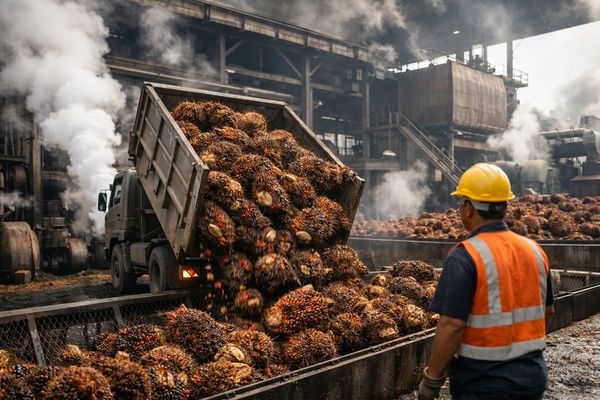
Palm oil futures on the Malaysian derivatives market are consolidating after recent strength, with the current curve edging lower but remaining historically elevated. Spillover support from strong soybean processing and firm vegetable oil demand is offset by profit-taking, ample regional stocks and softer energy prices.
The nearby months on the Malaysian exchange show a mild downward correction across the forward curve, suggesting a transition from a weather- and geopolitically driven rally into a phase of cautious consolidation. At the same time, record US soybean crush and declining soy oil stocks are underpinning the broader oilseed complex, limiting the downside for palm oil. Weather risks tied to a shift from La Niña towards El Niño later in 2026, and ongoing geopolitical uncertainty in the Middle East, keep volatility risks elevated even as prices momentarily cool.
📈 Prices & Term Structure
Crude palm oil (CPO) futures on the Malaysian derivatives exchange softened on April 16, 2026, with most actively traded contracts posting modest day-on-day losses.
- Front-month May 2026 settled at around MYR 4,400/t, down 26 points (-0.6%) on the day.
- June and July 2026 closed at roughly MYR 4,444/t and MYR 4,466/t, both about 0.6–0.7% lower.
- The curve gently declines into 2027–2028, with far-dated contracts near MYR 4,285–4,345/t, indicating moderate backwardation but no sharp premium for nearby supply.
Recent exchange data indicate that, despite this pullback, open interest in benchmark CPO futures remains high, signalling sustained speculative and hedging activity around current price levels. Overall, the structure points to a market that is no longer in acute shortage but still pricing in non-trivial supply and weather risk.
| Contract | Settlement (MYR/t) | Approx. EUR/t* | Daily change |
|---|---|---|---|
| May 2026 | 4,400 | ~880 | -0.6% |
| Jun 2026 | 4,444 | ~889 | -0.6% |
| Jul 2026 | 4,466 | ~893 | -0.7% |
| Jan 2027 | 4,391 | ~878 | -0.5% |
| May 2028 | 4,285 | ~857 | -0.1% |
*Approximate conversion at 1 EUR ≈ 5.0 MYR, for orientation only.
🌍 Supply, Demand & Cross-Market Drivers
The broader oilseed complex currently provides important context for palm oil. Rapeseed futures in Europe and canola in Winnipeg have recently benefited from rising US soybean prices, while Malaysian palm oil also posted earlier gains before the latest consolidation.
In the US, monthly NOPA data for March showed member soybean crush at 226.16 million bushels – a record for the month and up 8.3% versus February and 16.2% year-on-year. Soybean oil stocks declined 2% versus end-February to 2.04 billion pounds, though they remain 36% above last year and above trader expectations. Strong crush and robust soymeal and soy oil demand support vegetable oil prices, indirectly underpinning palm oil despite today’s modest futures losses.
Market participants are also watching US soybean planting progress, where localized rainfall could delay fieldwork. Any notable planting delays in North America would tend to be supportive for the global oilseed/oil balance and thus for palm oil, although this influence is still prospective rather than immediate.
☀️ Weather & Fundamental Outlook
Regional climate outlooks for Southeast Asia point to a transition from the recent weak La Niña phase towards ENSO-neutral conditions in March–April 2026. Several forecasting centres and regional experts then anticipate a significant probability of El Niño emerging later in 2026, implying a tilt towards hotter and drier conditions across parts of Malaysia and Indonesia.
For palm oil, such a pattern would typically raise medium-term yield and output risks, although current production is still primarily influenced by the previous weather cycle and localised flooding seen earlier in the year. In the very short term (next 1–2 months), rainfall in key producing belts is expected to be near to slightly below normal, suggesting no immediate, broad-based stress but heightened vulnerability if El Niño strengthens into the second half of 2026.
📊 Market Sentiment & Macro Links
Futures market commentary in early March already pointed to a cautious consolidation phase for CPO, after a strong run-up partly fuelled by higher energy prices and geopolitical tensions in the Middle East. Since then, crude oil prices have eased on expectations of an extended ceasefire in the US–Iran confrontation around the Persian Gulf, reducing one pillar of support for biofuel-linked vegetable oils.
Nevertheless, open interest in benchmark palm oil futures recently hit record levels on Bursa Malaysia, underscoring strong investor interest and the potential for sharp short-term price moves around weather or policy headlines. In the US and Europe, end-user demand for vegetable oils remains steady, while regulatory changes such as the upcoming EU deforestation-free product rules from mid-2026 are beginning to shape longer-term trade flows and sustainability premia in palm oil supply chains.
📆 Short-Term Price & Trading Outlook
Given the modest backwardation and the small daily declines across nearby contracts, the palm oil market appears to be entering a range-trading phase around current levels rather than signalling a sharp reversal. Strong soybean processing, resilient demand for vegetable oils and emerging weather risks argue against a deep correction, while high palm oil stocks in the region and softer crude oil constrain further upside.
- Producers: Consider layering in additional hedges on nearby months (May–Sep 2026) on rallies, using the current MYR 4,350–4,500/t (~EUR 870–900/t) band as an attractive coverage zone, given the risk of policy or demand shocks.
- Refiners & consumers: Use the present dip to secure part of Q3–Q4 2026 needs, but keep some optionality for a further pullback if stocks remain heavy and crude oil stays soft.
- Speculators: Bias towards short-term range strategies (e.g. selling volatility or trading the 4,250–4,550 MYR/t range) while closely monitoring El Niño updates and any escalation in Middle East tensions.
📍 3-Day Directional Outlook (EUR-based)
- MDEX CPO (nearby): Slightly negative to sideways. Expect trading roughly in a band equivalent to EUR 860–900/t, with intraday volatility tied to crude oil and US soy complex moves.
- European palm oil imports (CIF NWE, implied): Stable with a mild softer bias in EUR terms, following MDEX but cushioned by FX and freight.
- Competing oils (soy, rapeseed): Firm relative to palm, suggesting limited scope for a major palm discount widening in the very near term.
Related posts:
 Rapeseed Market Pauses as MATIF Flat, Oilseed Complex Softens
 Sunflower Market: Stable Black Sea Seeds, Softer SAFEX Futures Amid Firmer Oil Complex
 Rapeseed Market Steady as Oilseed Complex Turns More Volatile
 China Pumpkin Seed Kernels: FOB Prices Ease While Freight Stays Elevated
 Palm Oil Futures Hold Firm as Vegoil Complex and Biodiesel Demand Support Prices
 Palm Oil Edges Higher Above Key Resistance as Crude Oil Rebounds
 Palm Oil Market Firms on Futures Strength and Tightening Asian Supply Controls
 Palm Oil Futures Edge Higher on Supply Concerns and Geopolitical Risk