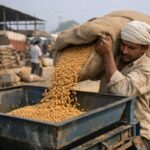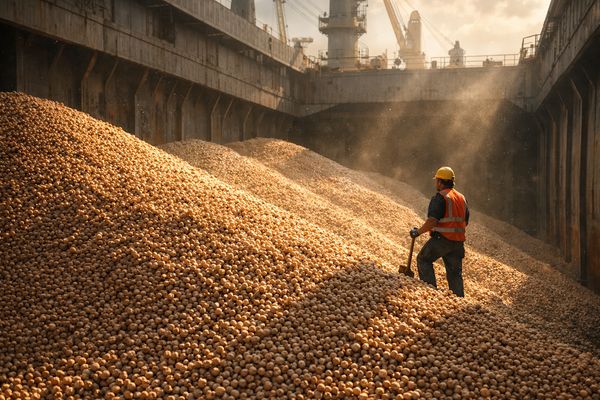
Indian chickpea prices in New Delhi are trading in a narrow range with only minor grade-wise moves, as fresh rabi arrivals meet firm but price-sensitive domestic and export demand. With early summer heatwaves intensifying across central and north India, the short-term balance looks comfortable, keeping upside in check and pointing to a broadly steady to mildly softer bias in the coming days.
The spot market is being driven mainly by new-crop supply, with arrivals in central India and Delhi mandis sufficient to cap any sharp price spikes despite improved buying interest from exporters and dal mills. Field conditions remain mostly stable: high temperatures are now a concern for human comfort and logistics rather than for the freshly harvested crop. In this environment, buyers retain the upper hand in negotiation, while sellers focus on moving stocks ahead of deeper summer heat.
[cmb_offer ids=1179,1180,1181]
📈 Prices
All prices converted approximately to EUR/kg (INR reference values from recent mandi indications where applicable). New Delhi FCA levels on 17 April 2026 translate to:
| Origin | Location / Term | Specification | Latest price (EUR/kg) | 1-week change (EUR/kg) |
|---|---|---|---|---|
| India | New Delhi, FCA | Chickpeas, 42–44 count (12 mm) | ≈ 0.92 | +0.02 |
| India | New Delhi, FCA | Chickpeas, 44–46 count (11 mm) | ≈ 0.90 | -0.01 |
| India | New Delhi, FCA | Chickpeas, 46–48 count (10 mm) | ≈ 0.87 | -0.03 |
| India | New Delhi, FCA | Chickpeas, 58–60 count (9 mm) | ≈ 0.80 | -0.03 |
| India | New Delhi, FCA | Chickpeas, 60–62 count (8 mm) | ≈ 0.71 | +0.01 |
Recent mandi data for Kabuli chickpea in central India show modal prices around INR 6,600–6,800 per quintal, broadly equivalent to roughly EUR 0.78–0.80/kg, reinforcing the view that wholesale and export values are aligned within a tight band. 📈
🌍 Supply & Demand
India remains comfortably supplied after a large rabi chickpea harvest, with ample arrivals in major producing states such as Madhya Pradesh, Rajasthan and Maharashtra feeding into Delhi and central India mandis. Recent trade analysis highlights that India continues to dominate global chickpea production and exports, with the 2026 crop adding to already solid availability.
On the demand side, domestic consumption is seasonally steady, while export interest is described as price-sensitive rather than aggressively bullish. Competing origins such as Mexico, Turkey and Australia remain active, which caps India’s ability to push offers substantially higher without losing share.
📊 Fundamentals & Weather
The key near-term fundamental driver is the interaction between strong arrivals and only moderately improving demand. New Delhi prices show modest week-on-week adjustments by grade rather than any broad directional breakout, consistent with a market digesting new crop under comfortable supply conditions.
Weather is shifting quickly into full summer mode. The India Meteorological Department (IMD) has issued heatwave alerts for large parts of central and northwest India, including segments of Madhya Pradesh, Maharashtra and western Rajasthan, with Delhi-NCR expected to reach or exceed 40°C around mid-April.
For chickpeas, this heatwave comes largely after the rabi crop has been harvested, so direct yield risk is limited at this stage. Instead, the impact is more logistical: higher daytime temperatures may slow labour-intensive operations and increase storage and transport costs, but these effects are not yet strong enough to outweigh the underlying heavy supply scenario.
📅 Short-Term Outlook (3 Days)
IMD forecasts sustained heatwave conditions in central and parts of north India through at least 20 April, with very high daytime temperatures and only limited thunderstorm relief in northern plains. This pattern supports continued active arrivals and steady movement but does not provide a clear trigger for sharp price gains.
- New Delhi FCA Kabuli (10–12 mm): Expected to trade broadly sideways around current levels, with a bias for minor intra-day softness if arrivals stay heavy.
- Smaller sizes (9–8 mm): Likely to remain in a tight range, with slight support from value buying as relative discounts versus larger calibres have widened.
- Export FOB indications: Should track FCA trends closely; strong competition from alternative origins and steady but cautious overseas demand limit near-term upside.
💡 Trading Outlook
- Domestic buyers (dal mills, wholesalers): Maintain a hand-to-mouth strategy over the next few days; use any minor dips caused by heavy arrivals or heat-related logistics constraints to top up nearby coverage.
- Exporters: Focus on prompt shipments where India retains a freight or quality edge; avoid overcommitting at higher offers until there is evidence of tightening arrivals or stronger overseas demand.
- Producers and stockists: Consider phased selling into current stability rather than holding large volumes through peak summer, unless clear signs emerge of aggressive government procurement or weather-related supply disruption.
Overall, the 3-day price outlook for New Delhi chickpeas is steady to slightly softer in EUR terms, with grade spreads likely to remain the main source of movement rather than a broad directional trend.
[cmb_chart ids=1179,1180,1181]