
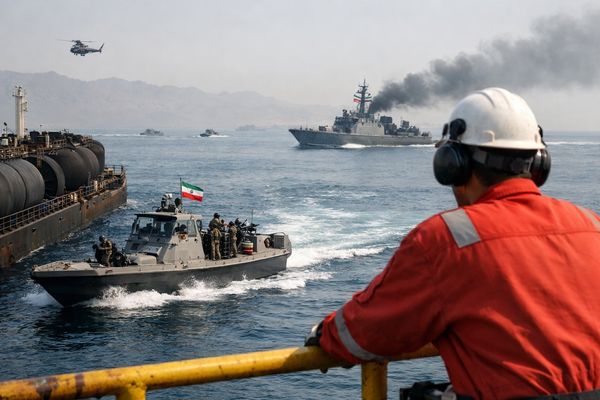
Crude oil is trading with an elevated geopolitical risk premium as U.S. interception of Iranian tankers and a de facto blockade in and around the Strait of Hormuz tighten physical supplies and inflate freight and insurance costs.
The seizure and redirection of multiple Iranian-flagged tankers, including very large crude carriers, have pushed traffic in one of the world’s key energy corridors close to a standstill. With nearly a fifth of global oil and gas supply typically flowing through Hormuz, traders are rapidly repricing regional grades and rerouting cargoes. Higher freight, insurance, and financing costs are spilling over into refined products and non-energy supply chains, especially for agriculture and fertilizers. Market focus is now on how long the blockade and counter‑seizures persist and whether alternative routes and spare capacity can prevent deeper inventory draws and price spikes.
📈 Prices & Market Mood
Front-month crude benchmarks are holding a pronounced risk premium, supported by curtailed Persian Gulf flows and heightened tanker risk. Recent analyses of the tanker market suggest traders expect crude to hover around the equivalent of roughly €90–€95 per barrel over the coming months, with options pricing skewed to the upside on escalation risk.
Physical differentials for Middle Eastern grades exposed to Hormuz are widening against alternative Atlantic Basin and U.S. grades as buyers compete for more secure barrels. Volatility remains elevated, with intraday swings increasingly driven by headlines on tanker interceptions, military incidents, and shifting blockade rules rather than pure fundamentals.
🌍 Supply & Demand Disruptions
The interception of at least three Iranian crude tankers near India, Malaysia, and Sri Lanka — including a supertanker carrying close to 2 million barrels and another vessel with around 1 million barrels capacity on partial load — points to meaningful short‑term supply losses into Asia. Additional U.S. orders forcing up to 29 ships to turn back or return to port further underscore the scale of disruption to Iranian-linked flows.
At the chokepoint itself, shipping activity through the Strait of Hormuz has slowed dramatically, approaching a standstill in recent days. Independent vessel tracking confirms that overall tanker traffic is sharply lower, with only sporadic crossings as shipowners weigh the risk of interception, higher insurance, and potential Iranian retaliation.
Iran’s reported seizure of cargo vessels attempting to transit the region compounds these risks, effectively turning Hormuz into a contested zone where both U.S. enforcement and Iranian counter‑measures threaten continuity of flows. While some crude is being rerouted via alternative load ports and ship‑to‑ship transfers, logistical friction and longer voyage times are reducing prompt availability and tightening nearby spreads.
📊 Fundamentals & Cross‑Commodity Impact
The physical disruptions are occurring against a backdrop of already‑reduced commercial crude inventories, particularly in OECD hubs, after months of constrained exports from the Gulf. Recent tanker and inventory analysis indicates that if current Hormuz restrictions persist, global stocks could draw down to critical levels over the summer, supporting a structural premium near €90+ per barrel despite any demand headwinds.
Beyond energy, higher bunker fuel prices and elevated war‑risk premia are lifting freight rates on key container, dry bulk, and product tanker routes that intersect with the Middle East. This is feeding through to landed costs for agricultural commodities, fertilizers, and food exports that rely on these corridors, raising input prices for importing regions and complicating procurement strategies. Shippers are increasingly diverting vessels or delaying loadings, which could translate into localized shortages or price spikes in downstream markets even where commodity balances appear adequate on paper.
🌦️ Regional & Logistical Outlook
Near term, the primary driver for crude is not weather but navigational risk and rules of engagement around Hormuz. Naval deployments and changing inspection patterns are creating day‑to‑day uncertainty over which tankers can pass and on what terms. Maritime security advisories continue to flag the region as high risk, with some owners and insurers effectively pricing in intermittent closures or forced diversions.
As long as both U.S. enforcement actions and Iranian vessel seizures continue, market participants should assume ongoing delays, elevated demurrage, and sporadic cargo losses. Any credible diplomatic progress or verified easing of interdictions would likely prompt a rapid, but possibly temporary, compression of the risk premium in both crude and freight.
📆 Trading Outlook & Strategy
- Producers & Exporters: Consider layering in incremental hedges at current elevated EUR price levels to lock in margins, while retaining some upside exposure via options in case of further disruption‑driven spikes.
- Refiners: Diversify crude slates toward less Hormuz‑exposed grades (Atlantic Basin, U.S., West Africa) and pre‑book freight to mitigate further increases in tanker and insurance costs.
- Importing Countries & Large End‑Users: Build precautionary inventories where storage allows and review alternative sourcing routes and suppliers, especially for fuel, fertilizers, and key food commodities that depend on Middle Eastern logistics.
- Financial Traders: Expect headline‑driven volatility; strategies that exploit widened time‑spreads and inter‑grade differentials may remain attractive, but position sizing should account for potential sudden de‑escalation risks.
📉 Short‑Term Price Direction (3‑Day View, in EUR)
With Hormuz tanker traffic still heavily constrained and additional seizures possible, crude is likely to remain bid on dips over the next three sessions. Unless there is a clear, verifiable easing of the blockade or a credible diplomatic breakthrough, the market bias points to sideways‑to‑higher prices in EUR terms, with volatility concentrated around geopolitical headlines and any fresh reports of tanker interceptions or reroutes.
Related posts:
 Iran War and Hormuz Blockade Trigger Historic Realignment in Global Crude Flows
 Strait of Hormuz Blockade Triggers Fuel Shock and Global Freight Rate Surge
 Hormuz Blockade Threat Lifts Fertiliser Prices and Risk Premiums Worldwide
 Strait of Hormuz Naval Blockade Deepens Energy and Commodity Trade Risks
 U.S. Maritime Blockade of Iran Raises New Risks for Global Commodity Flows
 Strait of Hormuz War Escalation and US Blockade Threat Jolt Global Oil and Product Markets
 Strait of Hormuz Crisis and US Naval Blockade Deepen Global Energy Market Turmoil