
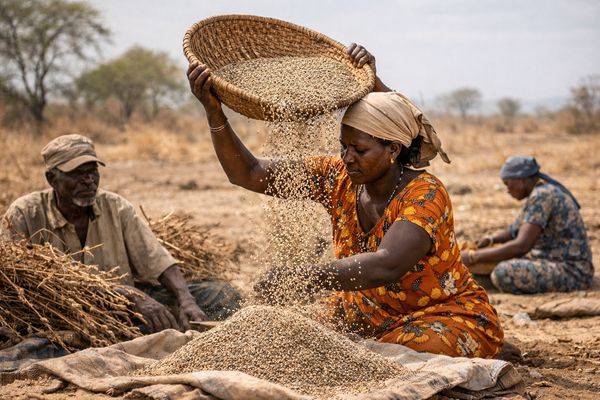
Sesame seed prices are currently soft to sideways, but rising weather and input-cost risks in key origins suggest downside is increasingly limited for the coming weeks.
Global sesame is trading in a narrow band, with Indian and African origins competing for European and Asian demand and buyers still focused on nearby cover rather than long forward positions. Indian sesame sits in a broader oilseed complex where other crops face heat and weather risk, echoing the stress seen in India’s peppermint belt, and this is beginning to cap sellers’ willingness to discount further. Weather signals for Indian sesame regions have recently turned more negative, while Chadian offers into Europe show a mild upward bias, hinting that today’s low prices may not be sustainable into late Q2 2026.
Exclusive Offers on CMBroker

Sesame seeds
hulled, EU-Grade
99.98%
FOB 1.49 €/kg
(from IN)

Sesame seeds
hulled, EU-Grade
99.97%
FOB 1.47 €/kg
(from IN)

Sesame seeds
hulled, EU-Grade
99.95%
FOB 1.45 €/kg
(from IN)
📈 Prices & Inter-Origin Spreads
Recent offer data in EUR for Indian sesame (New Delhi, mid‑April, FOB/FCA) points to a modest softening from early April but no collapse. Standard non‑organic hulled EU‑grade lots with 99.95–99.98% purity are indicated around EUR 1.45–1.49/kg FOB, while natural white and regular natural grades trade near EUR 1.11–1.25/kg FCA/FOB. Premium black sesame remains significantly higher, typically EUR 2.08–2.38/kg FOB depending on grade and purity.
African competition remains important. Chadian hulled sesame into Europe on an FCA basis has shown a mild upward price bias in early April as nearby availability tightened, preventing a deeper correction in CIF Europe values even as Indian offers edged lower. With logistics and freight still volatile due to broader geopolitical tensions, the landed cost gap between Indian and African origins remains fluid, but Indian quotations now sit close enough to African levels that aggressive further discounting looks unlikely unless demand weakens sharply.
| Origin / Type | Grade & Terms | Latest price (EUR/kg) | 1–2 week change (approx.) |
|---|---|---|---|
| India hulled white | 99.95–99.98% EU‑grade, FOB | 1.45–1.49 | −0.02 to −0.04 |
| India natural white | White Natural 99/1/1, FCA | ≈1.11 | Flat to slightly softer |
| India black sesame | Regular to Super Z, FOB | 2.08–2.38 | −0.10 to −0.20 on some lots |
| Chad hulled | FCA Europe | Low‑mid 1.60s | Mild upward bias |
🌍 Supply, Weather & Cost Drivers
India remains a core origin for sesame, and its oilseed sector is currently navigating mixed weather and cost signals. In related crops such as peppermint, heat stress, negligible carry‑over stocks and sharply diverging price expectations between cautious traders and bullish producers are already visible in Uttar Pradesh. This illustrates a broader pattern: acreage shifts into higher‑value crops and mounting heat stress risk can quickly tighten effective oilseed availability if yields underperform, even when nominal planted area is increased.
For sesame specifically, recent Indian weather updates point to a more challenging pattern. Key sesame‑growing areas have seen episodes of unseasonal rainfall and cooler‑than‑average conditions during flowering and pod development earlier in April, followed by a deterioration in sentiment around 20 April as excess moisture and disease pressure risks built up. While the final yield impact is still uncertain, this kind of weather noise tends to limit farmers’ appetite to forward‑sell at current weak price levels, especially where alternative cash crops like peppermint are expected to command higher returns if heat damage remains manageable.
On the demand side, the global sesame oil industry continues to grow steadily, though processors are highly sensitive to raw‑material price swings driven by weather and geopolitics. A recent sesame oil market overview notes that supply chain disruptions and seed price volatility, particularly in Asia and the Middle East, remain a structural risk for crushers and food manufacturers, even though 2025 volumes and average prices were healthy. With energy and fertiliser costs elevated amid ongoing geopolitical tensions, input‑cost pressure is another factor that can cap downside in seed prices once current inventories are absorbed.
📊 Fundamentals & Demand Outlook
Short‑term fundamentals for sesame are balanced to slightly soft. Indian price benchmarks compiled for 2024–2026 show a downward drift in average wholesale sesame prices, with 2026 levels running below 2024 as larger crops and cautious global buying reduced the need for aggressive spot coverage. This aligns with today’s EUR‑denominated export offers from India, which remain historically competitive in nominal terms.
However, the same dataset highlights that India’s sesame sector is heavily exposed to export‑market scrutiny around pesticide residues and post‑harvest treatments, which can suddenly concentrate demand on compliant origins and grades. In such episodes, high‑purity EU‑grade hulled seeds and organic sortex lots tend to tighten first, often leading price moves. Against the current backdrop of soft but not collapsing prices, any weather‑related downgrade in Indian or African crops into late Q2 could flip the market from slight oversupply to near‑balance, particularly for premium qualities.
📆 Short-Term Forecast (3–4 Weeks)
Given the recent easing in Indian export prices, mild firmness in some African offers and emerging weather concerns, the base‑case scenario for late April to mid‑May is a sideways to mildly firmer sesame market in EUR terms. Nearby physical demand from Europe and East Asia is likely to stay hand‑to‑mouth, but any negative headlines on India’s monsoon outlook or African crop progress could trigger quick, sentiment‑driven rallies focused on premium grades and nearby positions.
Conversely, a sharp downside break appears unlikely unless macroeconomic sentiment deteriorates significantly and oilseed complex prices correct across the board. Even then, elevated input costs (diesel, fertiliser and labour) and tightening credit conditions in some origins should provide a floor, as farmers resist selling below full cost of production. In this environment, the risk‑reward skew for late‑Q2 2026 seems to be shifting gradually from downside price protection towards securing supply at today’s relatively attractive levels.
📌 Trading Outlook & Strategy
- European and US buyers: Use current weakness in white hulled EU‑grade sesame (around EUR 1.45–1.49/kg FOB India) to extend coverage into Q3 2026 on a staggered basis rather than chasing the absolute bottom.
- Focus on quality: Prioritise high‑purity, residue‑compliant lots and secure accreditation paperwork early, as any tightening will likely start with these segments.
- Origin diversification: Maintain a balanced book between Indian and African origins; treat recent firmness in Chadian FCA offers as a signal that African supply is not unlimited at current levels.
- Producers and exporters: Avoid deep discounts on premium black and organic grades; instead, consider incremental forward sales on any weather‑driven rallies, keeping some unpriced volume in case of further weather or logistics shocks.
📍 3-Day Directional Price View (in EUR)
- India – New Delhi FOB white hulled EU‑grade: Stable to slightly firm; expected range EUR 1.45–1.50/kg as buyers test the downside but weather concerns limit fresh discounts.
- India – New Delhi FOB/FCA natural white: Mostly steady around EUR 1.10–1.20/kg, with limited liquidity and a modest upward bias if negative weather headlines persist.
- Africa – FCA Europe hulled (e.g. Chad): Mildly firm, with buyers likely to pay small premiums for prompt nearby positions and freight‑secure parcels.
Related posts:
 Strait of Hormuz Conflict Triggers Fertilizer Supply Shock and Raises Global Crop Cost Risks
 Sesame seeds: Indian prices correct, Egypt stable as logistics and weather risks loom
 Soybeans Edge Lower on Ample Supply, Weather Risks Build in India and Black Sea
 Indian Sesame FOB New Delhi: Firm Prices as Heat Builds and Demand Stays Cautious
 Indian Sesame FOB Prices Hold Firm as Global Demand Stays Soft
 Sesame Prices Edge Softer in Egypt While Hulled Markets Stay Firm
 Ukrainian rapeseed prices hold firm as EU demand and weather risks support market