
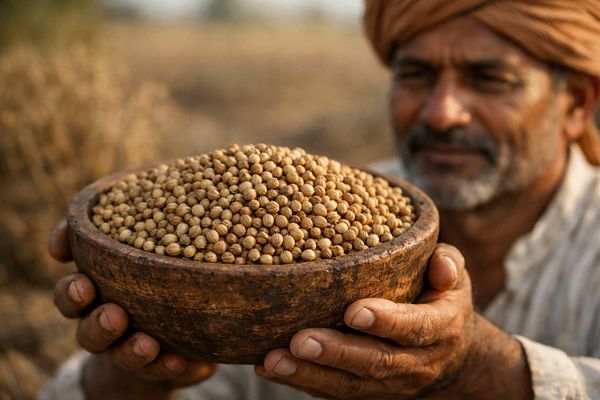
Indian coriander is bucking the generally softer tone in the wider spice complex, with prices in key Indian mandis firming on stronger-than-expected demand. The near-term balance appears moderately tight, supporting a cautiously bullish outlook for the next 2–4 weeks, especially for higher grades and export-focused buyers.
Coriander gained meaningfully in Wednesday’s session even as large cardamom, cumin and turmeric weakened, signalling a genuine, coriander-specific demand impulse rather than broad-based spice buying. Stronger offtake in Delhi and at Rajasthan’s Kota hub, combined with the market’s transition into the post-harvest inventory phase, is underpinning prices at a point in the season when they would normally ease. Export demand from India’s regular buyers and recent indications of tighter global supply add an additional layer of support, particularly for European food manufacturers and spice blenders.
Exclusive Offers on CMBroker

Coriander seeds
whole
FOB 2.05 €/kg
(from IN)

Coriander seeds
single parrot
FOB 1.15 €/kg
(from IN)

Coriander seeds
99,9%
FOB 0.94 €/kg
(from IN)
📈 Prices & Market Mood
In Delhi, coriander firmed by about EUR 1.95 per quintal, with badami (natural) grade now around EUR 140–142 per quintal and higher-quality green mala quoted in a wider band of roughly EUR 150–168 per quintal, reflecting clear quality-based differentiation. In Kota, Rajasthan, prices rose more sharply, by roughly EUR 4.90 per quintal, to about EUR 101–107 per quintal as processors and traders stepped up restocking at origin.
This firmness aligns with a broader rally in Indian coriander highlighted by recent trade reports, which describe constrained arrivals and robust export demand tightening effective supply. While spot retail prices earlier in April were already elevated year-on-year, the latest mandi strength suggests that the wholesale segment is now catching up, enhancing the upside risk for export values over Q2 2026.
📊 Indicative FOB Levels (New Delhi, latest updates, converted to EUR)
| Product | Origin | Spec / Type | Delivery | Price (EUR/kg) | Trend vs mid‑March |
|---|---|---|---|---|---|
| Coriander seeds whole, organic | India | Whole | FOB New Delhi | ≈ 1.92 | Slightly softer, but firm vs 2025 |
| Coriander seeds, 99.9% purity | India | Machine cleaned | FOB New Delhi | ≈ 0.88 | Stable to marginally lower |
| Coriander seeds, single parrot | India | Export grade | FOB New Delhi | ≈ 1.04 | Sideways |
| Coriander seeds, double parrot | India | Premium whole | FOB New Delhi | ≈ 1.18 | Sideways |
(USD mandis converted to EUR at ≈1.09 USD/EUR; FOB offers converted from USD to EUR at same rate.)
🌍 Supply & Demand Drivers
Coriander (dhania) is now fully into its post-harvest phase in Rajasthan, Madhya Pradesh and Gujarat. With the rabi crop largely off the fields, the market is working through stored inventory rather than fresh arrivals. Under normal seasonal patterns, this would introduce some price softness; instead, the current firmness indicates that consumption and processing demand are outpacing the flow of stock to market.
Demand in Delhi is supported by both retail and wholesale channels, while fresh buying in Kota and other Rajasthan hubs reflects processors and traders rebuilding working stocks. This is occurring against a backdrop of robust export interest: India remains the leading global coriander exporter, and any tightening in domestic availability at this stage typically transmits quickly into FOB and CIF values for key destinations such as Bangladesh, Malaysia, the UAE and Europe. Recent commentary from international trade sources also underlines that constrained global coriander supply is helping keep floors elevated for EU procurement.
On the import side, Russia has expanded coriander seed shipments to India, increasing volumes by roughly one-third and value almost by half over the latest reported 8‑month period. While this offers some medium-term diversification for Indian users, it is unlikely to materially loosen the near-term balance dominated by domestic rabi supplies and export commitments.
🌦 Weather & Logistics Context
Weather is seasonally hot across key coriander districts in Rajasthan, including Kota and Baran. Earlier forecasts pointed to heatwave conditions into late April, discouraging daytime movement of goods and labour and thereby marginally tightening effective supply at mandis despite adequate physical stocks.
Looking ahead over the next few days, no major rainfall or extreme weather disruptions are currently flagged for eastern Rajasthan beyond localized heat and typical pre-monsoon instability. Logistics constraints therefore stem more from heat-related reductions in trade activity than from structural transport blockages, meaning that any demand surge can quickly translate into higher spot prices.
📉 Relation to Other Spices
The same session that saw coriander strengthen also recorded weakness in large cardamom, cumin and turmeric. This divergence indicates that buyers are making selective category decisions rather than executing broad pepper-and-spice basket purchases, which adds credibility to the coriander move as a genuine fundamental signal.
With cumin and some other seed spices showing comparatively softer trends earlier this month, coriander’s relative outperformance is drawing attention from both domestic blenders and overseas buyers who must manage category-specific price risk rather than relying on a generalized “spice complex” view.
📆 Short-Term Outlook (2–4 Weeks)
The near-term outlook is cautiously positive. Post-harvest arrivals are expected to taper further over the next month, while domestic consumer and processing demand remains firm. In this environment, coriander is likely to continue trading at a premium to where many buyers had initially expected post-harvest values to settle.
For European and other international importers, the current price trajectory is running counter to the softer tone in several other spices. If demand continues to outpace the flow of stocks from producing regions, current levels could solidify into a higher price floor for Q2 2026, particularly for premium grades and organic product aimed at value-added food manufacturing.
🧭 Trading & Procurement Recommendations
- Importers in Europe & MENA: Consider advancing a portion of Q2–Q3 coverage for higher-grade and organic coriander, as current firmness during a normally weak seasonal window raises the risk of further upside.
- Indian processors & blenders: Maintain at least normal working stocks; selective restocking in Kota and Delhi still appears justified while arrivals are present but easing.
- Buyers with flexible origins: Explore supplementary cover from alternative origins such as Egypt or Russia where quality fits requirements, while recognizing that Indian origin will likely continue to set the reference price for many markets.
- Risk management: Where available, use coriander-linked futures or structured contracts to lock in prices for a share of forecast demand, given the market’s constructive tone versus other spices.
📍 3‑Day Indicative Directional Outlook
- Delhi mandis (India): Bias mildly upward as firm retail/wholesale demand meets gradually thinning post-harvest arrivals.
- Kota / Baran, Rajasthan (India): Upward to steady‑firm; processor restocking and heat-related logistical frictions keep sellers reluctant to discount.
- FOB India for export (EUR-based): Steady to slightly firmer, especially for higher purity and organic coriander, with modest upside risk if fresh export tenders emerge.
Related posts:
 Indian Mustard Seed Prices Firm as Arrivals Tighten and Oil Complex Stays Mixed
 Indian Coriander Rally Tightens Global Supply and Lifts EU Procurement Risk
 Coriander Market Tightens as Indian Stocks Thinning Support Firm Prices
 Indian Pepper Under Pressure as US Spice Demand Stalls
 Nigella Seeds Rebound: Demand-Led Recovery and FOB Soft Patch
 Indian mustard seed under pressure as edible oil complex softens
 Indian Turmeric Prices Ease as Post‑Harvest Lull Caps Upside