
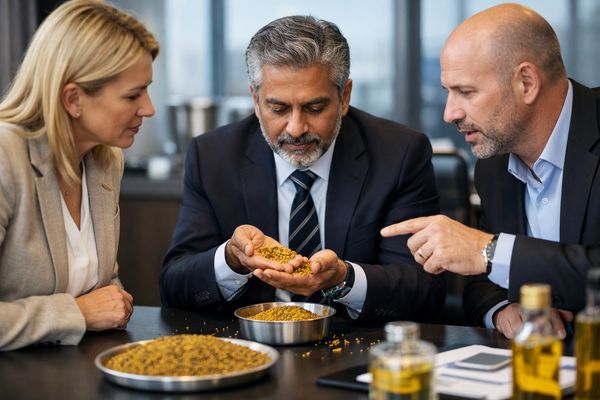
Mustard seed prices in India are firming as declining daily arrivals meet solid oil mill demand, with upside capped unless inflows fall further or imported edible oil prices spike.
India’s benchmark mustard market in Jaipur closed Monday on a stronger note, extending firmness across seed, oil and refined products while mustard cake softened slightly. Tighter daily arrivals for a fourth straight session are the main driver, even as global edible oil markets send mixed price signals and geopolitical tensions in the Middle East keep a risk premium in supply chains. European buyers still find Indian mustard oil broadly competitive versus canola-based alternatives from Canada.
[cmb_offer ids=255,254,252]
📈 Prices & Spreads
In Jaipur, conditioned mustard seed rose by $0.59 per quintal to $84.51 per quintal, confirming a modest but broad-based firming in the spot market. Crude mustard oil in Jaipur climbed by $1.30 per 10 kg to $170.47 per quintal, while Bharatpur crude ghani oil added $1.18 per 10 kg to $169.30 per quintal. Kolkata crude mustard oil held steady at $186.68 per quintal, indicating some regional differentiation on the oil side.
Mustard cake prices eased despite stronger seed and oil, slipping by $0.24 per quintal in Jaipur and Bharatpur to $32.45 and $32.92 per quintal respectively, while staying flat at $31.62 per quintal in Charkhi Dadri. This divergence suggests that current firmness is driven primarily by the crush margin on oil rather than byfeed demand. Export-oriented, sortex-quality mustard seed offers from New Delhi for Indian origin remain broadly stable around EUR 0.68–0.98/kg FCA/FOB, with yellow bold types near the upper end of this range and brown bold near the lower end.
| Product (India, New Delhi) | Spec | Delivery | Latest Price (EUR/kg) | 1-week Change (approx.) |
|---|---|---|---|---|
| Mustard seeds yellow, bold, sortex | 99.95% non-organic | FOB | 0.98 | ≈ flat |
| Mustard seeds yellow, micro, sortex | 99.95% non-organic | FOB | 0.88 | slightly softer vs early April |
| Mustard seeds brown, bold, sortex | 99.95% non-organic | FOB | 0.69 | slightly softer vs early April |
🌍 Supply & Demand
Daily arrivals at producing wholesale markets have fallen for the fourth consecutive working day to about 8 lakh bags, from 9 lakh bags in the previous session. This tightening of physical inflows is the key near‑term support for prices, particularly in Rajasthan and Haryana, which dominate India’s rabi mustard belt. Several branded oil mills held seed purchase prices steady in the evening session, signalling some caution amid the rally, while others increased bids to secure volume.
On the demand side, oil mill buying remains steady, supported by competitive crush economics versus imported oils and ongoing domestic consumption of mustard oil in northern India. Mustard cake’s mild weakness indicates that feed and livestock demand is not yet a constraint but also not strong enough to pull cake higher alongside seed, which could limit upside if oil values soften. European buyers continue to see Indian mustard oil and derivatives as price‑competitive relative to Canadian canola oil, underpinning export interest even as freight markets remain sensitive to geopolitical risks in Middle Eastern shipping lanes.
📊 External Drivers & Weather
Global edible oil benchmarks provide a mixed backdrop. Malaysian palm oil futures have recently been supported by an upward revision to 2024 crude palm oil price forecasts and expectations of firmer prices into 2026, but day‑to‑day market moves remain volatile and sensitive to changes in stocks and energy markets. In contrast, Chicago soybean oil has shown periods of softness, highlighting cross‑commodity complexity for Indian processors when choosing between domestic mustard oil and imported soft oils.
Weather in Rajasthan and Haryana has transitioned into a hotter, drier pattern typical for late April, with recent heat alerts indicating maximum temperatures above 40°C in parts of Rajasthan and continued dry conditions in the immediate outlook. For mustard, which is mostly harvested from late March to mid‑April, this pattern is broadly neutral to slightly supportive for market tightness: limited rainfall reduces post‑harvest quality risks but also discourages prolonged on‑farm holding if heat intensifies. If temperatures remain high and farmers accelerate selling, arrivals could recover toward 9–10 lakh bags, easing present tightness.
📆 Short-Term Outlook (2–4 Weeks)
Over the next two to four weeks, mustard seed prices in India are expected to remain firm to modestly higher, anchored by lower arrivals and steady crush demand. A sustained rally above the recent benchmark level around $85 per quintal in Jaipur would likely require either a continued decline in arrivals below roughly 8 lakh bags per day or a sharp and broad-based rise in imported edible oil prices that improves relative value for mustard oil.
If arrivals rebound toward 9–10 lakh bags as weather-stressed stocks move to market, the current rally could lose momentum and shift into a sideways pattern. Much will depend on how palm and soybean oil trade in coming weeks; a stronger palm oil complex, especially if supported by tighter stocks or policy changes in Southeast Asia, would lend additional support to Indian mustard crush margins, while any sharp correction in global oils could cap further upside for mustard seed.
📌 Trading & Procurement Outlook
- Oil mills in India: Consider staggered procurement at current levels while closely tracking daily arrivals; maintain coverage for at least 2–3 weeks given the risk that flows stay near or below 8 lakh bags.
- Feed and livestock buyers: Use current softness in mustard cake as an opportunity to secure near‑term requirements, as any renewed strength in seed and oil could eventually tighten cake supplies.
- European importers: Indian-origin mustard oil remains competitive versus canola alternatives; securing forward volumes now could hedge against potential escalation of Middle Eastern shipping disruptions and any renewed upswing in the global oil complex.
- Producers and traders: Monitor geopolitics and palm/soybean spreads closely; a synchronized rally in global edible oils would justify holding a slightly longer bullish bias on mustard seed prices.
📉 3-Day Directional View (Indicative)
- Jaipur physical mustard seed: Slightly firm bias in EUR terms, with limited upside as mills test resistance near the equivalent of $85 per quintal.
- New Delhi export-grade mustard seed (FOB/FCA): Largely stable in the EUR 0.70–0.98/kg range, with narrow, arrival-driven fluctuations rather than a decisive trend change.
- Mustard oil (north India): Mildly supportive tone following recent gains; any further strength will depend on direction of palm and soybean oil futures.
[cmb_chart ids=255,254,252]
Related posts:
 Indian Mustard Seed Prices Edge Higher as Arrivals Slow and Weather Stays Supportive
 Indian Mustard Seed Prices Under Pressure Despite Lower Arrivals
 Indian Mustard Seed FOB Prices Edge Lower as New Crop Arrivals Build
 Indian mustard seed prices edge higher as mills absorb steady arrivals
 Indian mustard seed under pressure as edible oil complex softens
 Fenugreek Prices Hold Steady as Indian Arrivals Tighten and Weather Shifts
 Indian Mustard Seed Prices Steady as Weather Disrupts Arrivals but Record Crop Caps Upside