
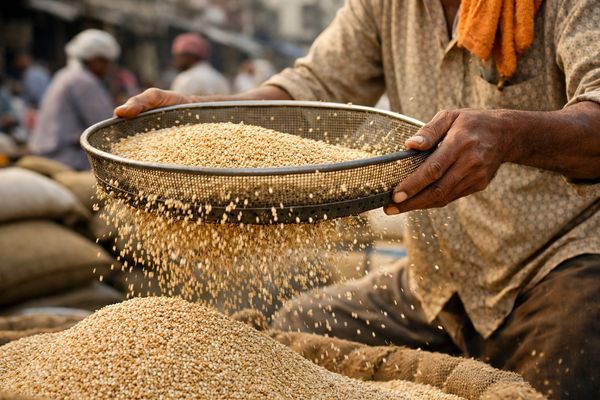
India’s sesame market is pivoting from tightness to a future of potential oversupply as Gujarat’s 2026 sowings surge by 14.55% and export-grade prices in New Delhi begin to edge lower in EUR terms. Unless China, Japan, South Korea and Middle Eastern buyers lift demand, a heavier crop from September onward is likely to cap or pressure prices.
Gujarat’s sesame belt is entering the 2026 season with exceptional momentum. Sown area has already reached 140,300 ha, 116% of the three‑year average and well above last year, driven mainly by the Saurashtra region and sustained by attractive sesame oil returns. Current spot prices still reflect a relatively firm nearby balance, but forward fundamentals have turned clearly more bearish for Q4, especially for White and hulled EU‑grade material. European buyers should prepare for better availability and more competitive Indian offers in the second half of 2026 if weather remains cooperative and export demand does not spike unexpectedly.
Exclusive Offers on CMBroker

Sesame seeds
hulled, EU-Grade
99.98%
FOB 1.49 €/kg
(from IN)

Sesame seeds
hulled, EU-Grade
99.97%
FOB 1.47 €/kg
(from IN)

Sesame seeds
hulled, EU-Grade
99.95%
FOB 1.45 €/kg
(from IN)
📈 Prices & Nearby Market Tone
Sesame oil prices in Delhi are reported steady around the equivalent of EUR 1.55–1.60 per kg (approximate conversion of USD 166.38 per quintal), indicating that current physical supply is firm but not excessively tight. At the same time, Indian FOB and FCA offers for sesame seeds in New Delhi show a mild softening trend in mid‑April, particularly for standard hulled, EU‑grade qualities.
Indicative current levels (converted to EUR) for New Delhi around 17–18 April point to:
| Product | Origin | Location/Terms | Price (EUR/kg) | 1w Trend |
|---|---|---|---|---|
| Sesame seeds, hulled, EU‑Grade 99.98% | IN | New Delhi, FOB | ≈ 1.49 | ⬇ from ≈ 1.51 |
| Sesame seeds, hulled, EU‑Grade 99.95–99.97% | IN | New Delhi, FOB | ≈ 1.45–1.47 | ⬇ about 0.02 |
| Natural sesame 99%+ | IN | New Delhi, FOB | ≈ 1.15–1.25 | mixed |
| Black sesame (regular to Super Z) | IN | New Delhi, FOB/FCA | ≈ 1.40–2.35 | volatile, slightly softer |
The combination of stable oil prices and gently easing seed offers suggests the market is transitioning from a seller’s to a more balanced, possibly buyer‑friendly, environment as the enlarged 2026 crop comes into view.
🌍 Supply & Demand: Gujarat Drives a Looming Shift
Gujarat is the decisive swing factor for India’s 2026 sesame balance. As of 20 April, the state has 140,300 ha under sesame versus 122,469 ha a year earlier, an increase of 17,831 ha or 14.55%. This already stands at 116.47% of the three‑year average area (120,439 ha), pointing to a structurally larger pipeline of supply into the next marketing year.
The Saurashtra region dominates this expansion with 126,600 ha, led by Junagadh (25,600 ha), Morbi (21,700 ha), and Surendranagar (20,000 ha), while Amreli, Bhavnagar and Gir Somnath also contribute sizable areas. Smaller but meaningful gains in South, Central, North Gujarat and Kutch confirm that the upswing is broad‑based rather than confined to a single cluster.
On the demand side, the expansion is a direct response to strong economics: farmers have been incentivised by attractive sesame oil prices over recent seasons. However, the global demand outlook is more nuanced. China and other key Asian buyers remain structurally important, but there is limited evidence of a concurrent surge in forward import demand that would fully absorb a significantly larger Indian crop. This asymmetry between expanding Indian supply and only moderately growing external demand is the core bearish driver for late‑2026.
📊 Fundamentals & Weather Outlook
Fundamentally, the sesame balance sheet for 2026 is pivoting on three pillars: higher Indian acreage, weather risk through the monsoon, and the timing/strength of export demand. With sowings already well ahead of average, yield outcomes will depend heavily on monsoon performance in Gujarat and Saurashtra between June and September.
Recent regional weather updates for Gujarat indicate episodes of pre‑monsoon rainfall and some localised thunderstorms, but no major adverse event specific to sesame has been reported so far. Seasonal outlooks hint at pockets of below‑normal monsoon rainfall in parts of India, but such guidance is still early and highly uncertain. For now, the base case remains for a normal to slightly above‑average crop in Gujarat, given the enlarged area.
On the demand side, China, Japan, South Korea and Middle Eastern buyers are expected to continue underpinning trade flows, while European importers should see improved availability of EU‑grade hulled material from India in Q4. Unless these markets accelerate purchases markedly ahead of harvest, the enlarged Gujarat crop is likely to tilt fundamentals towards looser balances and more competitive pricing into late 2026.
📆 Market & Trading Outlook
From September onwards, the market faces a high‑probability scenario of increased Indian export availability as the Gujarat crop moves into harvest. If export demand does not expand proportionally, this should cap rallies and could push prices moderately lower in EUR terms, especially for standard white and hulled grades aimed at Europe and East Asia.
- Importers in Europe & MENA: Avoid over‑covering long‑dated needs at current levels; consider staggering purchases into Q4 2026 when larger Indian availability is expected to soften offers.
- Asian buyers (China, Japan, South Korea): Use any short‑term dips before harvest to secure core volumes, but retain flexibility to add coverage later if the Indian crop comes in as large as current sowing suggests.
- Indian exporters: Monitor forward selling carefully; consider locking in margins on current oilseed and sesame prices before the new crop weighs on market sentiment, particularly for EU‑grade hulled material.
- Farmers in Gujarat: The acreage expansion already prices in favourable economics; further expansion next season should be cautious, as a large 2026 crop without matching demand could pressure farm‑gate prices.
📍 3‑Day Directional Price Indication (EUR)
For the coming three days, absent major weather or policy shocks, sesame seed prices are expected to be broadly stable to slightly softer in EUR terms:
- New Delhi FOB white hulled 99.95–99.98%: Sideways to mildly lower around EUR 1.45–1.50/kg as sellers remain active and buyers cautious.
- New Delhi FOB natural white: Mostly steady near EUR 1.15–1.25/kg, with limited immediate downside before clearer signals on monsoon progress.
- Premium black grades (India, FCA/FOB): Slightly volatile but biased lower, reflecting improved forward supply expectations and selective demand.
Overall, the sesame complex is transitioning into a more comfortable supply phase, setting up a buyer‑friendly window in the second half of 2026, particularly for importers with flexible timing.
Related posts:
 Sunflower Oil Market 2025/26: Firm Prices Despite Softer Volumes
 Palm Oil Pressured by Weak Crude, Softer Vegoils and Disappointing Biodiesel Support
 Sunflower Market: Stable Black Sea Seeds, Softer SAFEX Futures Amid Firmer Oil Complex
 Soybeans Price Check: India Steady, Ukraine Softer as CBOT Firms
 Sesame Prices Edge Softer in Egypt While Hulled Markets Stay Firm
 EU Rapeseed Rebound Sets Stage for Softer Prices and Stronger Crushing Margins
 Soybeans: Strong Start in 2026, But Supply Wave Signals Softer Second Half