
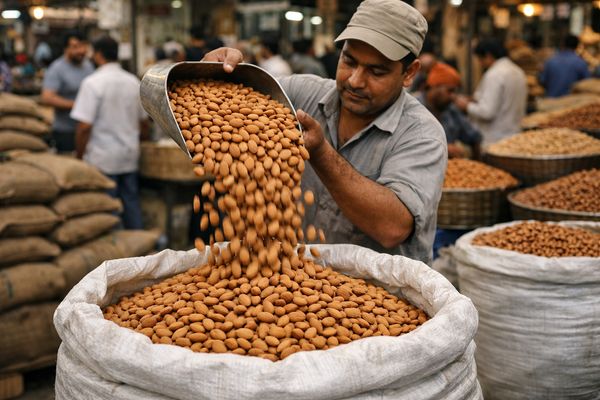
Almond prices are holding at recent levels in Delhi and on key export offers, with thin importer selling offsetting soft consumer demand. The market is trading a narrow, well-supported range while participants wait for clearer signals on the next California crop.
India’s almond segment currently reflects equilibrium rather than stress: wholesale prices are steady, supply from California is comfortable, and domestic demand is structurally rising even if day-to-day kiryana buying is subdued. International offers from the US and Spain also show flat quotes over recent weeks, supporting the view of a broadly balanced global market. With the 2025 California crop still supplying trade and early indications for the 2026 harvest only just emerging, most players are managing inventory cautiously rather than taking directional bets.
Exclusive Offers on CMBroker

Almonds kernels
carmel, ssr, 18/20
FAS 6.70 €/kg
(from US)

Almonds kernels
carmel, ssr 20/22
FAS 6.65 €/kg
(from US)

Almonds kernels
natural, 27/30, nonpareil ssr
FOB 9.32 €/kg
(from US)
📈 Prices & Spreads
In Delhi’s wholesale dry fruit market, almond kernels (badam giri) are quoted around EUR 8.10–8.15/kg (≈ USD 8.64–8.69/kg), unchanged from the previous session. California-origin whole shelled almonds land around EUR 5.80–5.85/kg (≈ USD 6.20–6.22/kg) on a 40-kg basis, also steady day-on-day. Price resilience is notable given broader softness across the grocery commodity complex, including other dry fruits and spices.
Recent export offer indications broadly align with these levels. US-origin Carmel kernels (SSR 18/20 and 20/22) are currently offered out of Washington, D.C. at roughly EUR 6.15–6.20/kg FAS, while US organic Nonpareil 27/30 is near EUR 8.55–8.60/kg FOB, all unchanged across the last several weekly updates. Spanish Marcona and Valencia kernels are similarly flat, with mainstream conventional grades mostly in a EUR 5.20–6.10/kg range and premium Marcona and organic lines higher. This confirms a stable international price structure.
| Product | Origin | Location / Terms | Latest Price (EUR/kg) | 1-Month Trend |
|---|---|---|---|---|
| Almond kernels, ex-wholesale | Imported (mainly US) | Delhi, India | ≈ 8.10–8.15 | Sideways |
| Carmel kernels, SSR 18/20 | US | Washington D.C., FAS | ≈ 6.20–6.25 | Flat |
| Nonpareil kernels, organic 27/30 | US | Washington D.C., FOB | ≈ 8.55–8.60 | Flat |
| Marcona kernels 12/14 | Spain | Madrid, FOB | ≈ 6.10–6.15 | Flat |
| Valencia kernels 12/14 | Spain | Madrid, FOB | ≈ 5.15–5.20 | Flat |
🌍 Supply & Demand Balance
India remains the world’s largest almond importer and draws the bulk of its needs from California, which accounts for roughly 65% of global production. The current trading period is being supplied largely from carry-over inventory of the 2025 California crop. Recent industry position data point to adequate overall availability and only a modest year-on-year reduction in total supply and shipments, reinforcing the perception of comfort rather than tightness in raw material.
On the demand side, Indian end-consumption continues its structural upward trend, driven by health-conscious households, rising use in food processing and bakery, and a resilient premium gifting segment. However, daily consumer buying in Delhi and other hubs has recently been described as generally weak across the dry fruit and spice complex, tempering spot offtake. In this environment, limited importer selling is balancing soft demand and helping to anchor prices at current levels.
📊 Fundamentals & External Signals
Importer sentiment is presently neutral to slightly cautious. With no acute shortage signals from California and international prices broadly stable, most Indian importers are focused on inventory management rather than aggressive forward coverage. Reported sales are thin, and traders appear reluctant to chase volume at current price points while retail and kiryana demand remains subdued.
Looking ahead, attention is turning to early indicators for the 2026 California almond harvest. Flowering and bloom conditions, together with spring weather and disease pressure, will shape yield expectations. Recent technical forecasts for California’s key growing valleys indicate a mix of showers, moderate temperatures, and some wind episodes in the near term, conditions that warrant monitoring but do not yet point to significant production risk. Market participants will be watching forthcoming bloom and crop development updates closely for any shift in supply expectations.
☁️ Weather & Crop Outlook
California’s Sacramento and San Joaquin valleys are currently experiencing a pattern of passing low-pressure systems bringing scattered showers and moderate temperatures. Forecasts over the coming days call for light to moderate rainfall, daytime highs mostly between the mid- to upper-60s and mid-70s °F, and some gusty winds. These conditions are typical for the season and more important for managing disease risk and orchard access than for determining final yield at this stage.
With the 2025 crop already harvested and in the supply chain, the critical focus now is on how flowering, nut set, and early nut development in 2026 evolve under this weather regime. So far, there are no strong indications of either severe stress or exceptional upside. As a result, Indian and European buyers of California-origin almonds remain attentive but are not yet adjusting procurement strategies on weather alone.
📆 Short-Term Market Outlook
In the next two to four weeks, almond prices in India and on key export routes are expected to remain broadly stable. The current equilibrium—comfortable California carry-over, structurally firm Indian demand, but soft day-to-day buying and cautious importer selling—argues for shallow price moves in either direction. Absent a notable weather shock in California or a sudden shift in Indian retail demand, the market is likely to trade sideways through May.
For European traders and confectionery buyers sourcing California almonds either directly or via Indian channels, this implies a relatively predictable pricing environment in the near term. Basis differentials between Delhi wholesale, US FAS/FOB offers, and Spanish alternatives are narrow and mostly steady, encouraging routine procurement rather than speculative positioning.
🧭 Trading Recommendations
- Indian importers: Prioritise inventory rotation over volume expansion. Maintain hand-to-mouth to moderate coverage at current levels while monitoring California crop and Indian retail demand for clearer directional cues.
- Indian wholesalers/retailers: Use the current price stability to fine-tune margins but avoid aggressive discounting; underlying structural demand remains supportive even if near-term footfall is soft.
- European buyers: Lock in short-term needs (through May) on dips or at current levels, using the stable Delhi and US offer structure as a hedge against potential later-season weather or policy surprises.
- Growers and handlers: Monitor California spring weather and disease updates closely and communicate early crop signals to key buyers, as even modest revisions to 2026 yield expectations could quickly shift sentiment from neutral to bullish or bearish.
📍 3-Day Directional Price Indication (EUR)
- Delhi wholesale kernels (badam giri): ≈ EUR 8.10–8.15/kg, expected steady over the next three sessions.
- US Carmel kernels, SSR 18/20, FAS: ≈ EUR 6.20–6.25/kg, bias sideways with very limited downside without a demand shock.
- Spanish kernels (Valencia/Marcona, FOB Madrid): ≈ EUR 5.15–6.15/kg, seen stable, tracking California parity and European confectionery demand.
Related posts:
 India anchors global almond trade as shipments surge but buyers stay cautious
 Almond Markets Hold Firm as Exports Lead and Weather Stays Supportive
 Almond Market 2026: Pollination Tech, Regenerative Orchards and Stable EU Prices
 Cashew kernels steady as India’s harvest caps prices, Vietnam holds firm
 Almond Kernels Hold Firm as Weather Risks Loom in Spain and California