
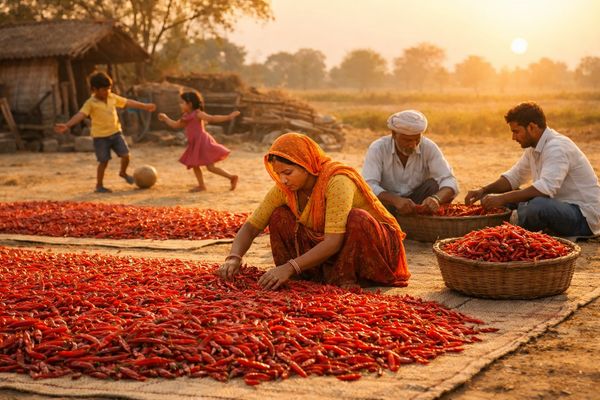
Indian chilli prices have turned lower after a sharp rally as export demand softens and arrivals at Guntur drop, but a steep production shortfall limits downside and keeps the medium‑term trend mildly firm.
India’s chilli market has shifted from a bullish sprint to a consolidation phase. After successive sessions of gains, prices at key wholesale hubs are now correcting as exporters retreat and crop quality deteriorates. Arrivals at Guntur have more than halved, signalling tightening physical availability even as lighter quality weighs on premiums. Domestic demand from the current wedding season and structurally reduced production provide an underlying floor, while export momentum year-to-date remains strong. Overall, short-term sentiment is cautious but not bearish, with buyers advised to secure forward cover rather than wait for a deep correction that is unlikely under current fundamentals.
Exclusive Offers on CMBroker

Chilli dried whole
bird eye, grade a
FOB 4.65 €/kg
(from IN)

Chilli dried
powder, grade a
FOB 4.40 €/kg
(from IN)

Chilli dried
flakes, grade a
FOB 4.35 €/kg
(from IN)
📈 Prices & Short-Term Trend
Benchmark Teja chilli at Guntur has fallen by about USD 11.83 per quintal from its recent peak, now trading around USD 224.85–236.69 per quintal. The popular 334-number variety at Guntur has eased to roughly USD 236.69–266.27 per quintal, while 341-number is steady near USD 212.95–254.44 per quintal. Fatki (broken chilli) is unchanged at USD 142.01–177.51 per quintal, showing that the correction is concentrated in higher grades rather than in off-spec material.
In Delhi’s wholesale grocery market, 334-number chilli remains stable around USD 272.19–295.86 per quintal and 341-number at USD 290.24–307.99 per quintal, both unchanged from the prior session. Warangal’s Teja variety mirrors Guntur’s softer tone, slipping by roughly USD 11.83 per quintal to USD 224.85–248.52 per quintal. Recent export-oriented offers from India also point to a firm but consolidating market, with high-quality dried chilli products typically around EUR 4.35–4.65/kg FOB and conventional whole stemless grades near EUR 2.15–2.16/kg FOB.
🌍 Supply, Quality & Demand Balance
The most significant shift is on the supply side: daily arrivals at Guntur have dropped to about 70,000 bags, down from 100,000–125,000 bags just weeks ago, a decline of more than 40%. This reduced flow is happening against the backdrop of an estimated 30% drop in total production versus last season, leaving the overall balance sheet structurally tight even as nearby prices soften. However, the quality of incoming chilli has become lighter due to adverse weather during the crop development phase in Andhra Pradesh and Telangana, undermining export-grade availability.
Exporters, who had been aggressive buyers during the rally, are now stepping back because current lots do not meet their specification requirements. This loss of high-grade demand is the main reason why prices have pulled back from recent highs. On the domestic side, the ongoing wedding season is providing an element of support as caterers and food processors increase purchases, particularly in key consumption centres. As a result, domestic demand is helping to offset weaker export spot buying, keeping the market from turning decisively bearish.
📊 Fundamentals & Export Performance
Structurally, fundamentals remain constructive. Seasonal production is estimated to be down by roughly 30% compared with last year, which places a clear floor under prices. At the same time, export performance has been robust: in the first ten months of the 2025–26 financial year, chilli exports reached about 572,757 tonnes valued at USD 964.96 million, up from 484,219 tonnes and USD 934.28 million a year earlier. That equates to an 18% increase in export volume and a 3% rise in export earnings, confirming strong global demand for Indian chilli despite recent quality issues.
This combination—tight production, solid export growth on a year-to-date basis, and still-firm domestic consumption—suggests that the current correction is more a technical and quality-driven pullback than the start of a prolonged downtrend. Unless quality improves enough to bring exporters back, upside in spot prices will be capped, but any attempt at aggressive selling is likely to meet strong underlying demand from both domestic and overseas buyers once suitable lots appear.
🌦️ Weather & Quality Outlook
The lighter quality currently arriving at Guntur and other markets is directly linked to earlier adverse weather during the crop development phase in Andhra Pradesh and Telangana, such as unseasonal rains and humidity affecting colour and pungency. While the main damage to the current crop is already done, near-term weather remains relevant for post-harvest handling and storage. Warm, relatively dry conditions in coming days would help stabilise quality in stocks, while any further spells of humidity or scattered showers would risk additional deterioration, especially in on-farm and open-yard storage.
Given that this season’s quality issues are rooted in past weather events, a rapid improvement in the overall grade mix is unlikely. The market should therefore prepare for a persistently limited share of top-spec material, which will continue to support premiums for well-coloured, high-pungency lots even if average grades remain under pressure. Buyers with stringent quality requirements may find it challenging to cover large volumes at short notice and should plan procurement windows carefully.
📆 2–4 Week Market Outlook
The short-term outlook for the next two to four weeks is broadly neutral to mildly firm. On the downside, the combination of exporters on the sidelines and lighter quality caps any sharp rebound and keeps prices below their recent peak levels in the immediate term. On the upside, the 30% production shortfall, reduced arrivals, and seasonal domestic demand all work against a deep or sustained correction. Market participants should therefore expect range-bound trading with a slight upward bias as the supply squeeze gradually reasserts itself.
For high-quality export-grade chilli, FOB India prices in EUR terms are likely to hold near current levels, with only modest fluctuations in the 2–5% band unless there is a step-change in quality or a fresh external demand shock. Domestic wholesale prices in Guntur, Delhi and Warangal are expected to track within recent corridors, with selective firmness in better grades and relative stability in lower grades such as Fatki.
💡 Trading Recommendations
- Importers & Industrial Buyers: Cover a significant share of your requirements for the next 2–3 months at current levels rather than waiting for a deeper correction that is unlikely given the 30% production shortfall.
- Exporters: Focus on securing and segregating top-quality lots that meet international specifications, as persistent quality constraints will support premiums for such material.
- Domestic Traders: Use any short-lived dips, driven by exporter absence, to build inventory in benchmark varieties (Teja, 334, 341) with acceptable quality, targeting moderate price appreciation as arrivals continue to thin.
- Processors: For powder, flakes and crushed products, consider forward contracts at current EUR-based FOB prices to lock in margins before any renewed firmness in raw material values.
📉 3-Day Directional Price Indication (EUR)
| Market / Product | Direction (3 days) | Indicative Level* |
|---|---|---|
| FOB India – Dried whole, stemless (grade A) | Sideways to slightly firm | ≈ EUR 2.15–2.20/kg |
| FOB India – Organic powder / flakes (grade A) | Sideways | ≈ EUR 4.35–4.65/kg |
| Guntur physical – Teja benchmark (converted) | Slightly soft to stable | Broadly in current USD range, mild EUR firmness if INR strengthens |
*Indicative, based on recent offers and wholesale levels converted to EUR; actual traded prices depend on quality, lot size and terms.
Related posts:
 Mustard Seeds Hold Firm as Palm Oil Rally Supports Indian Market
 Indian Chilli FOB Prices Edge Higher on Tight Crop and Firm Export Demand
 Large Cardamom Pauses After Rally While Green Grades Stay Firm
 Indian Chilli Prices Hit Records as Tight Supply Meets Firm Export Demand
 Chilli Market Steady as Peru Strengthens Regional Spice Role
 Large Cardamom Softens as Retail Demand Pauses and Iran Trade Stalls
 Indian Chilli Prices Hold Firm on Tight Supply and Strong Export Pull