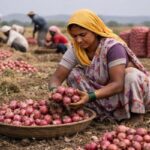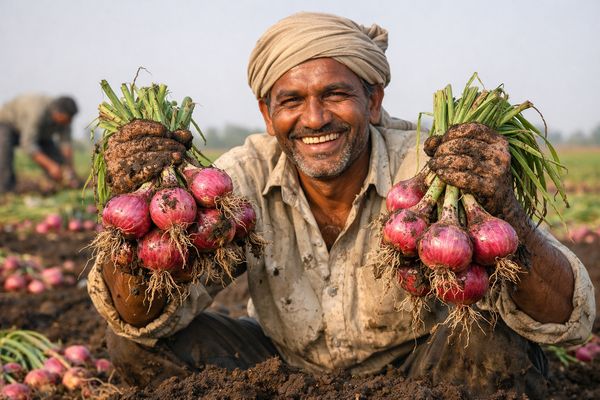
Production losses in India’s 2026 pink Garwa onion season are substantial, yet global onion prices remain broadly subdued as alternative origins and weak demand absorb much of the shock.
India’s key Garwa onion belt around Nashik is facing one of its most challenging seasons in recent years, with heavy weather-related losses, quality downgrades and sharply reduced exports. Nevertheless, comfortable availability from other Indian states and strong competition from Egypt and European supply are preventing a strong price rally. Instead, traders face squeezed margins, elevated freight costs and very selective export buying.
Exclusive Offers on CMBroker

Onions fried
crispy freid onions
FCA 2.39 €/kg
(from PL)

Onion powder
white
FOB 1.54 €/kg
(from IN)

Onion powder
grade - B
FOB 1.27 €/kg
(from IN)
📈 Prices & Current Levels
Processed and fresh onion benchmarks indicate a generally stable to slightly firm price environment in Europe and the export market.
- Poland, crispy fried onions (Łódź, FCA): about €2.39/kg, modestly higher after earlier April softening, but trading largely sideways.
- India, onion powder (white, FOB New Delhi): about €1.54/kg, flat for the past 2–3 weeks with no significant export-driven spikes.
- India, onion powder grade B: about €1.27/kg, also steady, reflecting good raw material availability despite Garwa crop stress.
- India, organic onion flakes and powder: around €5.05/kg and €2.62/kg respectively, stable on muted buying interest.
- Egypt, fresh bulk onions (FOB Cairo): roughly €0.82/kg, with shipments progressing smoothly amid strong overall vegetable export flows.
| Product | Origin | Term | Latest Price (EUR/kg) | Short-term Trend |
|---|---|---|---|---|
| Crispy fried onions | Poland | FCA Łódź | 2.39 | Slightly firm / sideways |
| Onion powder, white | India | FOB New Delhi | 1.54 | Flat |
| Onion powder, grade B | India | FOB New Delhi | 1.27 | Flat |
| Onion flakes, organic | India | FOB New Delhi | 5.05 | Flat |
| Onion powder, organic | India | FOB New Delhi | 2.62 | Flat |
| Fresh onion, bulk | Egypt | FOB Cairo | 0.82 | Stable |
🌍 Supply & Demand: India at the Center
India’s pink Garwa onion crop is under heavy pressure in 2026, with production estimated about 25% below last year due to cyclones, unseasonal rain and extreme heat in core regions such as Nashik. Market arrivals there are reportedly 30–40% lower year-on-year and include a much larger share of second-grade bulbs, as moisture damage, bacterial infections and poor storability cut into top-quality volumes.
Domestic supply gaps from Maharashtra are being partially filled by arrivals from Madhya Pradesh and Karnataka, softening the impact on Indian wholesale prices. At the same time, export flows out of Nashik have slumped, with container loadings said to be 70–80% below last season as both availability and quality fall short of importer requirements.
Compounding the problem, logistics costs have risen sharply. Moving a container from Nashik to Dubai is reported around $10,200 per box (about €9,500), versus export prices of only about $0.30/kg (≈€0.28/kg) and some domestic trades clearing as low as $0.10/kg (≈€0.09/kg). This leaves exporters with severely eroded or negative margins and has turned export activity highly opportunistic rather than continuous.
Meanwhile, Egypt is steadily building its role as a competitive exporter. Recent data highlight robust Egyptian vegetable shipments and solid onion volumes, with diversified destinations across the Middle East and Europe. In Europe, especially Poland, wholesale onion prices remain relatively low by historical standards, underlining that global buyers still have options despite India’s Garwa shortfall.
📊 Fundamentals & Weather Outlook
The fundamental picture for onions in spring 2026 is mixed: India’s Garwa segment is tight and quality-challenged, while the broader global balance looks more comfortable. Removal of India’s earlier export duty and minimum export price regime continues to support the structural competitiveness of Indian onions and dehydrated products, but this year’s weather damage means the country cannot fully capitalise on that policy space.
In Nashik and the wider Maharashtra belt, the current short-term weather outlook is mostly hot and dry with maximums in the mid-30s °C. While this reduces further immediate rainfall damage, it also stresses already weakened crops and complicates post-harvest handling when ventilation and cold storage are limited. Going forward, concerns about soil health, recurring moisture shocks and heatwaves raise questions about yield resilience in coming seasons.
On the demand side, buyers in key import markets such as the UAE, Sri Lanka, Malaysia and Singapore have become cautious toward Indian pink onions after recent quality and transit issues, leading to shipment delays and sporadic acceptance. This, in turn, encourages greater diversification toward Egyptian and other origins, reducing India’s pricing power in the near term.
📆 Market & Trading Outlook
Near term, the onion market is likely to stay broadly balanced at a global level, with India’s Garwa losses offset by alternative Indian regions, Egypt’s strong export programme and solid European supply. Price risk is skewed slightly to the upside in India for better-quality pink onions, but international benchmarks for fresh and processed products are expected to trade in a neutral to mildly firm band rather than break sharply higher.
Export margins from India will remain under pressure as long as container rates stay elevated and FOB price realisations for damaged or mixed-quality lots are close to break-even. Only carefully selected, high-grade consignments to trusted buyers are likely to move profitably. If logistics or policy conditions improve later in 2026, some recovery in export flows is possible, but the sector’s exposure to climate volatility is now clearly on display.
🎯 Trading Recommendations
- Importers in Europe & MENA: Continue to diversify between India and Egypt; secure forward volumes of high-grade Indian pink onions only at modest premiums, using Egypt as a price anchor for standard quality.
- Indian exporters & processors: Prioritise quality segregation and contract shipments where freight is partially shared or hedged; avoid locking in long-distance low-price deals that do not fully cover logistics and potential rejection risk.
- Food manufacturers (dehydrated/onion-based ingredients): Use the current stability in onion powder and flakes prices to extend coverage for the next 2–3 months, but keep some flexibility in case adverse weather or logistics shocks tighten supply later in the year.
📍 3-Day Directional Outlook (EUR-based)
- Europe (processed onions, Poland FCA): Sideways to slightly firm; crispy fried onions expected to hover around €2.35–2.45/kg.
- India (FOB dehydrated products): Largely flat; onion powder and flakes likely to remain within ±2% of current levels as buyers watch export logistics and quality.
- Egypt (fresh onions FOB Cairo): Stable; prices seen around €0.80–0.85/kg with steady export demand and no major short-term weather threats.