
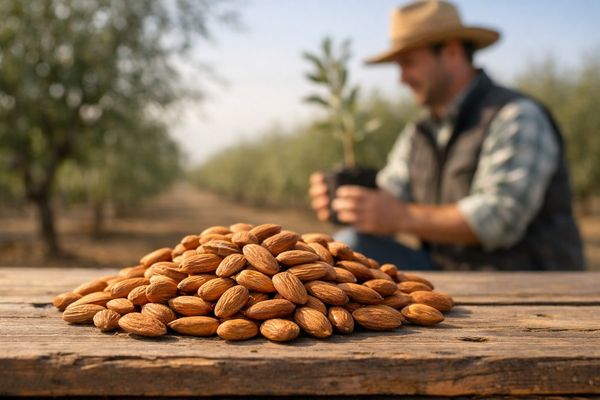
U.S. almond planting for 2024/25 is holding steady, but a gradual shift away from the dominant Nonpareil variety signals a more cautious and diversified production strategy. With kernel prices slightly softer in both U.S. and Spanish origins, the market currently leans mildly bearish, yet structural demand and ongoing orchard renewal support a balanced medium-term outlook.
Planting decisions in California, the world’s key almond origin, are in a consolidation phase. Total new and replacement plantings are unchanged year-on-year, but growers are clearly adjusting the varietal mix, reducing exposure to Nonpareil in favor of alternative varieties. On the price side, recent quotes in EUR for U.S. and Spanish kernels show a modest week-on-week easing, suggesting buyers retain some negotiating power in the near term.
Exclusive Offers on CMBroker

Almonds kernels
carmel, ssr, 18/20
FAS 6.65 €/kg
(from US)

Almonds kernels
carmel, ssr 20/22
FAS 6.60 €/kg
(from US)

Almonds kernels
natural, 27/30, nonpareil ssr
FOB 9.27 €/kg
(from US)
📈 Prices
Recent almond kernel offers (converted and shown in EUR) indicate a slight softening across main origins between 17 April and 24 April 2026. The weakness is broad-based but not dramatic, consistent with a market digesting stable supply expectations rather than a sharp surplus shock.
| Origin / Type | Delivery | Latest Price (EUR/kg) | Prev. Price (EUR/kg) | Trend (1 week) |
|---|---|---|---|---|
| US Carmel, SSR 18/20 | FAS Washington D.C. | 6.65 | 6.70 | ⬇︎ marginal |
| US Carmel, SSR 20/22 | FAS Washington D.C. | 6.60 | 6.65 | ⬇︎ marginal |
| US Nonpareil, natural 27/30, organic | FOB Washington D.C. | 9.27 | 9.32 | ⬇︎ marginal |
| ES Marcona 12/14 | FOB Madrid | 6.55 | 6.60 | ⬇︎ marginal |
| ES Valencia 10/12 | FOB Madrid | 5.55 | 5.60 | ⬇︎ marginal |
The modest downward adjustment across both premium (Nonpareil, Marcona) and standard (Carmel, Valencia, Guara) lines suggests buyers remain disciplined, with no immediate supply scare to force aggressive forward coverage.
🌍 Supply & Demand
New data for the June 2024–May 2025 period show around 9,300 hectares of total U.S. almond plantings, based on an estimated 2.93 million nursery trees sold and an average density of 131 trees per acre. Roughly 52% of this area is dedicated to new orchards (about 4,900 hectares), while 39% (around 3,600 hectares) replaces older orchards, and the remainder targets tree-by-tree infill.
This structure underscores a sector more focused on sustaining productivity and renewing aging orchards than on aggressive acreage expansion. With the U.S.—and especially California—still the key global supplier, this stabilisation in plantings points to a more measured growth path in future production rather than the rapid expansion seen in previous cycles.
📊 Fundamentals & Varietal Trends
A notable feature of the 2024/25 data is the gradual decline in Nonpareil plantings. Total Nonpareil area planted has decreased from about 3,600 hectares in 2023/24 to roughly 3,200 hectares in 2024/25, despite stable overall planting activity. New orchard plantings of Nonpareil have also slipped from 2,400 to 2,000 hectares.
This shift implies a deliberate diversification by growers into alternative varieties, potentially driven by changing demand patterns, risk management considerations, and evolving climatic conditions. Over time, a lower share of Nonpareil could tighten availability of this flagship variety relative to more versatile types like Carmel and Spanish alternatives, with implications for quality spreads and price differentials within the almond complex.
🌦 Weather & Short-Term Outlook
With stable U.S. plantings and a high share of replacement orchards, near-term supply risk hinges more on in-season weather and yield outcomes than on acreage swings. At present, the balance of information supports a view of steady to slightly growing medium-term supply, assuming normal weather and no major pollination or water shocks.
Given the recent mild price easing and the absence of a clear bullish supply catalyst, the market tone over the coming weeks is likely to remain cautious, with buyers taking advantage of dips but avoiding large speculative coverage until clearer indications emerge from flowering and early crop development reports.
📆 Trading Outlook
- Buyers (roasters, confectionery, retailers): Use the current marginally softer prices in the EUR 6.5–6.7/kg range for standard U.S. kernels and around EUR 5.5–6.6/kg for Spanish types to secure short- to medium-term coverage, but avoid over-committing far forward until yield prospects are clearer.
- Producers and cooperatives: With plantings stable and replacement-focused, resist selling too aggressively at current levels, especially for premium varieties, as gradual tightening in Nonpareil availability could support relative premiums later.
- Traders: Expect a mostly sideways market in the very short term, with limited downside as replacement-driven plantings curb long-run surplus risk, but also constrained upside until weather or demand surprises emerge.
📉 3‑Day Price Indication (Directional)
- US kernels, standard grades (Carmel SSR, FAS Washington D.C.): Bias: stable to slightly softer around EUR 6.6–6.7/kg.
- US Nonpareil organic (FOB Washington D.C.): Bias: broadly stable near EUR 9.2–9.3/kg, with limited liquidity.
- Spanish kernels (Valencia, Marcona, Guara, FOB Madrid): Bias: stable with a mild downward tone, roughly EUR 5.5–8.8/kg depending on variety and size.
Related posts:
 Indian Almond Market Softens as Importer Selling Outpaces Demand
 Almond Market Softens as Australian Harvest Pressures Indian Prices
 Storm Damage, Fungicide Costs and Stable Prices Shape Almond Market
 Almond Market Holds Steady as Delhi Trade Marks Quiet but Balanced Tone
 Almond Markets Hold Firm as Exports Lead and Weather Stays Supportive
 Almond Market 2026: Pollination Tech, Regenerative Orchards and Stable EU Prices