
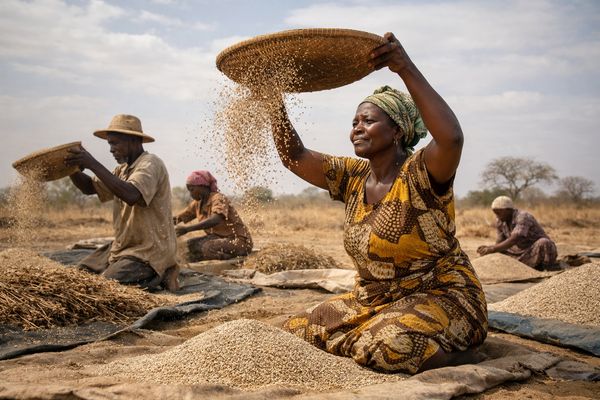
Global sesame prices are under mild downward pressure, driven mainly by improved Indian and Brazilian supply prospects, while weather risks in Mozambique and steady Asian demand limit the downside. The market remains broadly balanced, but regional divergence in crop conditions and currency moves is creating selective opportunities.
Strong sowing in Brazil, a solid summer crop in India and stable output in much of Africa are easing near‑term supply fears. At the same time, cyclones in central Mozambique and selective export buying are preventing a deeper price correction. Japan’s higher Q1 imports and expected Korean tenders underpin demand, but traders remain cautious ahead of larger Indian arrivals from May and the actual impact of African weather on export availability.
Exclusive Offers on CMBroker

Sesame seeds
hulled
99,95%
FCA 1.65 €/kg
(from DE)

Sesame seeds
hulled, EU-Grade
99.97%
FOB 1.47 €/kg
(from IN)

Sesame seeds
hulled, EU-Grade
99.98%
FOB 1.49 €/kg
(from IN)
📈 Prices & Spreads
Brazilian export offers to China are quoted around USD 1,100–1,150 per tonne (≈EUR 1,020–1,070/t), roughly EUR 90–95/t cheaper than African origins at USD 1,200–1,250 (≈EUR 1,110–1,160/t). This price gap is steering incremental Chinese demand toward Brazil.
Indicative Indian FOB prices in New Delhi translate to roughly EUR 1.30–1.40/kg for conventional hulled EU‑grade sesame and about EUR 2.00–2.10/kg for regular black seeds, confirming the recent downward correction, especially in black sesame. In Europe, hulled sesame from Chad offered FCA Berlin is around EUR 1.65–1.66/kg, sitting above the most competitive Indian FOB levels but still supported by African supply risk.
| Origin / Product | Term | Indicative Price (EUR/kg) | Trend (w/w) |
|---|---|---|---|
| Brazil, white to China (CIF equiv.) | New crop | 1.02–1.07 | Soft / stable |
| Africa, export grade | New crop | 1.11–1.16 | Firm on weather risk |
| India, hulled EU‑grade (New Delhi) | FOB | 1.30–1.40 | Down / soft |
| India, black sesame (regular) | FOB | ≈2.00–2.10 | Down more sharply |
| Chad → EU, hulled | FCA Berlin | ≈1.65–1.66 | Flat to slightly up |
🌍 Supply & Demand Balance
Brazil and Africa: Competing Signals
Brazil is emerging as one of the most competitive origins, supported by strong sowing activity and firm Chinese demand. Forward export trade is already active ahead of new crop arrivals expected in May, signaling confidence among exporters and buyers in volume availability and quality.
Africa overall maintains broadly stable production, but the picture is uneven. Tanzania is on a growth path, with output rising from 190,000 tonnes in 2024 to 225,000 tonnes in 2025 on the back of increased area and better cultivation practices. In contrast, Mozambique faces serious cyclone‑related disruptions in central belts such as Nampula and Nacala, where output around 100,000 tonnes carries a downside risk of more than 20%, potentially tightening global supply.
India: Improving Supply, Shifting Product Mix
India’s summer sesame crop for 2026 is progressing well, underpinning a more comfortable domestic balance. Sown area near 271,000 hectares is slightly below last year but still sufficient for stable production, especially given favorable agronomic conditions and good yield expectations.
A notable structural shift is the stronger focus on black sesame, particularly in Gujarat, where black production is estimated at 40,000–50,000 tonnes versus 80,000–100,000 tonnes for white. Early arrivals have started in limited volumes and should ramp up through May, increasing raw material availability for exporters just as regional demand (e.g., from South Korea) begins to pick up.
📊 Fundamentals & Trade Flows
Domestic Prices and Currency Effects
Indian domestic sesame prices are correcting lower as the market prices in better supply. In Rajkot, white sesame has fallen by up to 6.4% week‑on‑week, while black sesame has seen deeper declines near 12.5%. This aligns with recent FOB indications, especially for black grades, and is encouraging more aggressive export offers.
Currency moves are amplifying competitiveness. The Indian rupee has weakened by about 1.15% and the Nigerian naira by 1.27% week‑on‑week, allowing exporters some room to reduce dollar prices without sacrificing local margins. Several other producing‑country currencies are following a similar path, which supports the softening trend in international offers despite localized weather risks.
Demand: Japan Steady, Korea Incoming
On the demand side, Japan remains a key stabilizing buyer. Q1 2026 imports reached 46,460 tonnes, up from 41,818 tonnes a year earlier, pointing to steady underlying consumption and potentially some restocking. Tanzania and Nigeria feature prominently among suppliers, with average import prices between USD 1,250 and 1,500 per tonne (≈EUR 1,155–1,385/t) depending on origin and quality.
South Korea is expected to enter the market shortly with a new government tender, which should provide an outlet for India’s improving crop and black sesame focus. However, beyond such tenders, spot export activity remains selective. India currently faces minimal import demand thanks to its new domestic crop, and many exporters are waiting for clearer signals from tenders and the full scale of African weather damage before committing large forward volumes.
🌦 Weather & Regional Risk Outlook
Weather is the key upside risk to prices, concentrated in Mozambique and neighboring central African zones. Recent cyclones and heavy storms have already hit key belts like Nampula and Nacala, and further heavy rainfall or flooding during the late development and harvest window could exacerbate yield losses beyond the currently expected >20% downside risk.
By contrast, Tanzania and much of India are enjoying broadly favorable conditions, supporting yield potential and quality. This regional divergence suggests a two‑tier market could develop, with weather‑exposed African origins holding a premium, while Indian and Brazilian supplies cap overall price gains as long as their crops progress normally.
📆 Trading Outlook & 3‑Day Price Indication
Strategy Pointers
- Importers in Asia & EU: Use current softness in Indian and Brazilian offers to secure partial coverage for Q2–Q3, prioritizing white and black sesame from India for tenders and price‑sensitive channels.
- Buyers exposed to African origins: Maintain some optionality; avoid over‑reliance on Mozambique until cyclone‑related losses and logistics are clearer, but consider Tanzania for more stable volumes.
- Producers & exporters: In India and Brazil, lock in forward sales on price rallies triggered by African weather or Korean tender headlines, while keeping some volume unpriced in case of further currency depreciation.
3‑Day Directional View (EUR Terms)
- India FOB New Delhi (white hulled, EU‑grade): Slightly bearish; modest further easing possible as arrivals increase and tenders are still pending.
- African export grades (East/Southern Africa): Neutral to firm; Mozambique risk supports offers, but Brazilian competition limits upside.
- EU nearby (FCA, e.g., Berlin): Mostly stable; small fluctuations around EUR 1.65–1.70/kg likely, tracking replacement costs from India and Africa.
Related posts:
 Ukrainian Rapeseed Prices Edge Higher as EU Demand Softens
 Soybeans edge higher as oil leads gains while meal softens
 Indian Sesame Softens as Sowing Surges; Egypt FOB Holds Firm
 Indian sesame softens as record sowing meets rising Chinese stocks
 Soybeans Edge Lower on Ample Supply, Weather Risks Build in India and Black Sea