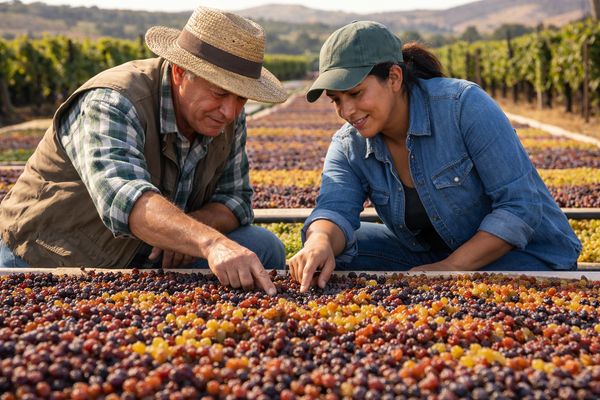
Raisin markets are stable in bulk but gaining a new premium tier as Chilean “Raisins on the Vine” enter U.S. retail, targeting at‑home entertaining and high-margin deli and cheese segments.
The launch of Raisins on the Vine into the U.S. retail channel signals a notable step in the premiumisation of the dried fruit aisle. By offering grapes naturally dried on the vine and sold in intact clusters, the product bridges fresh-fruit aesthetics with the convenience and shelf life of dried fruit. This innovation is aimed squarely at consumers building cheese boards and grazing platters at home, where visual impact and perceived craftsmanship justify higher price points and support retailers’ margin ambitions.
Exclusive Offers on CMBroker

Raisins
sultanas, type 9, grade RTU
CIF 2.13 €/kg
(from TR)

Raisins
sultanas, type 10, grade A
FOB 2.34 €/kg
(from TR)

Raisins
sultanas, type 9, grade A, organic
FOB 3.10 €/kg
(from TR)
📈 Prices & Market Structure
Bulk raisin prices remain broadly steady in late April 2026, providing a predictable cost base beneath the emerging premium layer. Standard sultanas from Turkey trade around EUR 2.10–2.40/kg (FOB/CIF), while organic Turkish sultanas are near EUR 3.10/kg. Indian raisins mostly range between roughly EUR 1.75–2.50/kg depending on colour and grade, indicating continued availability and competitive origins. Against this backdrop, Raisins on the Vine occupy a distinct premium niche where value is driven less by raw material cost and more by presentation, processing method, and retail positioning alongside specialty items.
🌍 Demand Shift: Entertaining & Premiumisation
The dried fruit category remains resilient, with raisins accounting for about one-third of global dried fruit consumption. Within this space, demand is gradually shifting toward value-added, specialty formats that promise both quality and an “experience.” Raisins on the Vine epitomise this shift: consumers increasingly assemble cheese boards and grazing tables at home, looking for products that photograph well, feel artisanal, and are ready to serve with minimal preparation.
This trend is especially visible in U.S. retail, where the new Chilean on-the-vine product is deliberately positioned as a companion to artisanal cheeses, cured meats, and premium accompaniments like honeycomb. Category managers can leverage the unique cluster format to cross‑merchandise in deli and cheese aisles, capturing incremental sales that are less price-sensitive and more driven by occasion-based purchasing.
📊 Supply, Sourcing & Category Fundamentals
Raisins on the Vine were historically produced domestically in the United States only on a limited scale and are no longer commercially cultivated there. The pivot to Chile as a dedicated origin allows more consistent volumes adapted to modern retail programs while preserving the product’s specialty character. Chilean climatic conditions support natural on-the-vine drying, yielding plump texture and concentrated sweetness without losing the cluster structure that differentiates the product.
For the broader raisin market, diversified origins—Turkey, India, China, Chile, and others—continue to underpin stable supply for mainstream formats. As the new Chilean product is clearly positioned as a premium, seasonal offering available through May (subject to conditions), it is unlikely to disrupt core bulk pricing in the near term. Instead, it expands the category’s value ladder, from feed and industrial grades at the low end to visually distinctive, ready‑to‑serve clusters at the top.
🧀 Retail & Foodservice Implications
Retailers are expected to merchandise Raisins on the Vine primarily in high-margin zones, particularly near aged cheeses, charcuterie, and gourmet accompaniments. This placement helps reframe raisins from a commodity baking ingredient into a centrepiece of premium entertaining boards. The product’s strong visual impact on-shelf and on-plate should support higher price points and encourage impulse purchases tied to social occasions.
For foodservice, especially upscale catering and hospitality, the product offers a convenient, ready-to-use garnish that elevates cheese plates and dessert buffets without additional labour. As entertaining-led consumption grows, on-the-vine raisins can help operators differentiate their offerings while riding the broader shift toward experiential, “Instagrammable” presentations.
📆 Short-Term Outlook & Trading Takeaways
Availability of Chilean Raisins on the Vine is expected to run through May, making the next weeks critical for retailers and importers to secure allocations and test consumer response. With the dried fruit category steady and bulk prices relatively calm, the main near-term driver is the strength of at-home entertaining and premium snacking demand rather than raw material shortages.
- Retail buyers: Prioritise cross-merchandising with cheeses and charcuterie; treat on-the-vine raisins as a seasonal spotlight item rather than a bulk substitute.
- Importers/wholesalers: Lock in Chilean specialty volumes early while leveraging stable bulk sultana prices for standard contracts.
- Food manufacturers: Monitor consumer uptake; consider limited-edition SKUs or gift sets featuring on‑the‑vine clusters for Q4 if trials succeed.
📍 3-Day Indicative Outlook (EUR)
| Product | Origin / Term | Current Level (EUR/kg) | 3-Day Bias |
|---|---|---|---|
| Raisins, sultanas type 9 RTU | Turkey, CIF | ≈ 2.13 | Sideways |
| Raisins, sultanas type 10 grade A | Turkey, FOB | ≈ 2.34 | Sideways |
| Raisins, sultanas type 9 organic | Turkey, FOB | ≈ 3.10 | Sideways |