
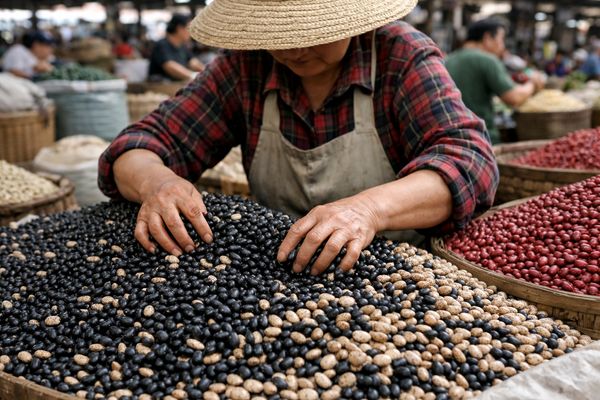
Prices in China’s black bean market are broadly stable, supported by on-farm holding and cautious procurement, while downstream demand remains sluggish and caps any meaningful upside.
The market for Chinese green-kernel black beans (Qingren Wuheidou) is currently characterized by adequate primary supply but restrained selling interest from farmers at prevailing low price levels. Most traders and processors are focused on digesting existing stocks, with some engaging in active selling and small discounts to stimulate flows. On the demand side, distributors in consumption regions buy only as needed and mainly work down inventory, providing little support for a price rebound in the near term.
Exclusive Offers on CMBroker

Mung beans
organic
99.5%
FOB 1.56 €/kg
(from CN)

Mung beans
3.8 mm up
99.5%
FOB 1.47 €/kg
(from CN)

Kidney beans
small, black, organic
99.5%
FOB 1.10 €/kg
(from CN)
📈 Prices & Market Mood
Domestic major production areas report temporarily sufficient availability of raw black beans, but marketable volumes are effectively limited by farmers’ reluctance to sell at low prices. This cost support keeps finished product quotations relatively stable, and recent transactions show only narrow fluctuations where traders offer small concessions to move cargo.
FOB Beijing price levels in other Chinese beans broadly reflect a sideways to slightly softer tone: conventional black kidney beans around EUR 1.03/kg, small organic black kidney beans near EUR 1.10/kg, and organic mung beans around EUR 1.56/kg. The very small week‑on‑week adjustments confirm a calm market with limited directional conviction.
| Product (CN, FOB Beijing) | Latest price (EUR/kg) | WoW change (EUR/kg) |
|---|---|---|
| Kidney beans, black | 1.03 | 0.00 |
| Kidney beans, small black, organic | 1.10 | -0.01 |
| Mung beans, organic | 1.56 | -0.01 |
🌍 Supply & Demand Balance
In producing regions, procurement and sales are described as “normal”: stock holders have beans to offer, but most traders and processors prefer to clear inventories gradually instead of aggressively replenishing. Some participants operate on a buy‑as‑you‑sell basis, minimizing exposure given the lack of strong demand signals.
Farmers’ psychology is a key stabilizing factor. With a clear perception that current levels are low, many producers choose to hold raw beans, accepting slower cash flow rather than conceding further price cuts. This behavior underpins raw material costs and prevents a deeper decline in finished product prices, even as demand stays weak.
Downstream, the pace of offtake for Qingren Wuheidou remains slow. Traders in consuming regions are working through stocks and resort to just‑in‑time purchasing. Purchasing decisions are strongly price‑following rather than anticipatory, and there is no sign yet of restocking waves that could tighten supply or lift prices in the short term.
📊 Fundamentals & Weather Outlook
Fundamental signals from market participants are clearly skewed toward stability: survey feedback indicates roughly 90% of respondents expect a steady market, with only 5% each pointing to potential rises or declines. This matches the observed narrow price range and the predominance of inventory management over speculative positioning.
Weather in key northeastern bean‑growing provinces is seasonally cool to mild, without acute stress. Around Harbin, day‑time highs over the next three days sit mostly in the mid‑teens to around 20°C with cool nights, while the Heihe area shows similar patterns with some cloudiness but no extreme events. Such conditions are broadly neutral for early‑season fieldwork and do not, at this stage, provide a strong bullish or bearish production signal.
📆 Short‑Term Market Outlook
Looking ahead, the black bean market in China is expected to trade in a narrow band. Cost support from on‑farm holdings and the absence of strong new supply shocks make a sharp downside move unlikely in the immediate term. At the same time, persistently sluggish downstream demand and the prevalence of inventory digestion significantly limit upside potential.
Unless there is a sudden shift in demand—for example, from processors or export inquiries—or a notable weather or policy shock, the most probable scenario is continued range‑bound trade with localized discounts where traders are keen to liquidate stocks. Spot activity will likely remain dominated by hand‑to‑mouth buying and opportunistic selling.
💡 Trading Recommendations
- Domestic processors: Maintain low‑to‑moderate inventory coverage, focusing on flexible, small‑lot purchases. Use any localized price concessions to secure nearby needs rather than building large forward positions.
- Traders in producing regions: With farmer resistance providing a floor, consider selective sales on rallies while avoiding aggressive under‑bidding that could struggle to attract volumes.
- Importers/overseas buyers: Current EUR‑denominated levels for Chinese black beans and related pulses are stable; short‑term coverage can be secured, but there is little urgency to chase the market higher.
📉 3‑Day Directional Price Indication (CN)
- Domestic black beans, major producing areas: Stable to marginally softer (local discounts possible where sellers are active).
- FOB North China ports – black beans and black kidney beans: Largely stable in EUR terms; minor intra‑day adjustments tied to negotiation rather than trend.
- Other Chinese pulses (mung, adzuki): Sideways with a slight easing bias, tracking the overall cautious sentiment in the bean complex.
Related posts:
 Lentil market caught between soft demand and limited upside
 Lentils Market Steady to Soft as Indian Green Gram Stocks Cap Upside
 China Mung Bean Market: Tight Domestic Supply Meets Cooling Sprout Demand
 China Bean Market: Black Bean Costs Supportside as Demand Stays Soft
 UK Red Kidney Beans Steady as Raw Bean Costs Support a Sideways Market
 Lentils Market: Indian Moong Overhang Meets Soft but Stable Global Demand
 Lentil Market Steady as Indian Black Gram Stays Soft but Well Supplied