

Import and domestic lentil-equivalent pulse markets are currently rangebound, with weak downstream demand offset by constrained selling interest and only modest support from policy and farmer price expectations. Short-term upside looks limited until fresh Indian summer-crop arrivals become clearer from mid-May, while downside is cushioned by below-support-price levels and importer reluctance to sell at a loss.
The lentil complex is taking its cues from India’s black gram (urad) market, where a stand-off between importers and dal mills signals a broader hesitation along the pulse value chain. Import prices at Chennai for Myanmar-origin urad have firmed, but domestic wholesale quotes across Delhi, Mumbai, Kolkata, Indore and Guntur remain broadly steady, with processors buying hand-to-mouth. At the same time, Canadian and Chinese FOB lentil offers have eased slightly over the past three weeks, reflecting softer international demand and comfortable nearby availability. Overall, the market is searching for direction ahead of India’s mid-May harvest pulse and any surprise in summer crop output.
Exclusive Offers on CMBroker

Lentils dried
Red football
FOB 2.55 €/kg
(from CA)

Lentils dried
Laird, Green
FOB 1.72 €/kg
(from CA)

Lentils dried
Eston Green
FOB 1.62 €/kg
(from CA)
📈 Prices & Spreads
India’s imported urad FAQ for May shipment is indicated around $840/t CNF Chennai, with SQ at $930/t and Brazilian origin near $880/t CNF. Domestic wholesale prices are broadly steady: Delhi FAQ about $87.5/t (per quintal equivalent), Mumbai FAQ near ₹7,975 per quintal, Kolkata ₹8,125–8,150, Indore best bold at ₹8,000–8,500 and Guntur polished at ₹8,100–8,125 per quintal. This stability contrasts with firmer import values, widening the disparity between landed costs and realizable domestic prices.
Global lentil benchmarks show a mild softening. Using an indicative rate of 1 EUR = 1.07 USD, current Canadian FOB offers as of 2 May equate roughly to:
| Product | Origin | Last price (EUR/kg, FOB) | 1 week ago (EUR/kg) | Trend |
|---|---|---|---|---|
| Lentils, red football | Canada (Ottawa) | ≈2.38 | ≈2.40 | ⬇ slight |
| Lentils, green Laird | Canada (Ottawa) | ≈1.60 | ≈1.62 | ⬇ slight |
| Lentils, green Eston | Canada (Ottawa) | ≈1.51 | ≈1.53 | ⬇ slight |
Chinese small green lentils (FOB Beijing) similarly eased by about EUR 0.01/kg over the second half of April. Overall price action across key lentil origins is flat to mildly weaker, in line with the cautious tone seen in India’s urad segment.
🌍 Supply & Demand Balance
On the supply side, India’s rabi urad arrivals from Andhra Pradesh are described as steady, ensuring adequate raw material for mills without creating strong downside pressure. More importantly for the forward balance, summer planting in Madhya Pradesh and Gujarat has picked up versus last year, with harvest expected from mid-May. This prospect of fresh domestic supply is capping any immediate recovery in pulse prices and keeps international lentil and urad exporters on the defensive.
Demand remains the weak leg of the equation. Dal mills are restricting purchases to immediate processing needs and show little appetite to build stocks ahead of summer consumption, despite the theoretical seasonal support. For lentils, this translates into cautious import programs and preference for spot or nearby coverage rather than forward commitments. EU and other European buyers see a market that is fundamentally well-supplied in the short term but sensitive to any weather or yield surprise in India’s summer crop.
📊 Fundamentals & Farmer Economics
A key stabiliser in the Indian pulse complex is the Minimum Support Price (MSP), with urad MSP currently at ₹7,800 per quintal. Spot levels hovering not far above this threshold are limiting farmer selling: growers are reluctant to offload aggressively when prices are only marginally better than state-backed support. This behaviour is effectively creating a soft floor under the market and curbing downside for pulse-linked products, including imported lentils targeting the same demand segments.
At the same time, importers face negative parity. With CNF values into Chennai exceeding realizable domestic prices, traders report a “disparity” that makes fresh selling unprofitable. As a result, import-side pressure on the market has eased, but without a compensating pickup in mill demand. The combination of farmer price resistance, MSP support, and importer reluctance to discount sharply keeps the market locked in a narrow range, with only modest upward bias until new-crop volumes are fully known.
🌦️ Weather & Crop Outlook
Weather risk for the coming weeks focuses on India’s summer pulse belt in Madhya Pradesh and Gujarat. Adequate moisture and the absence of heat stress into mid-May would support the already-improved planting pace and could translate into a larger-than-expected urad and pulse harvest. That scenario would further cap lentil and urad prices into June and could pressure FOB offers from exporters competing for Indian demand.
Conversely, any late heatwave or localised dryness at pod-filling would quickly become price-relevant given the market’s current lack of significant consumer or trade coverage. For European buyers, monitoring short-range Indian weather and early yield reports is crucial, as they will set the tone for pulse and lentil pricing over the early summer period.
📆 Short-Term Outlook & Trading Ideas
- Price direction (2–4 weeks): Rangebound with a mild upward bias, contingent on how Indian summer-crop prospects evolve from mid-May onwards.
- Risk to the downside: A sharper-than-expected increase in Madhya Pradesh summer output could cap or slightly ease prices through June, especially if mills continue buying hand-to-mouth.
- Risk to the upside: Any weather-related hit to Indian yields, or a sudden pickup in dal consumption, could quickly tighten nearby supply and lift both domestic urad and imported lentil values.
🎯 Strategy for Market Participants
- European importers / packers: Consider gradually covering near-term needs while prices remain close to recent lows, but avoid over-committing before clearer information on India’s mid-May harvest; use flexible shipment windows where possible.
- Exporters (Canada, China): Maintain competitive, but not aggressively discounted, offers; focus on short- to medium-term sales rather than long-dated forward positions until India’s production risk is better defined.
- Processors / dal mills: Continue tactical, requirement-based buying but be prepared to increase coverage quickly if early crop signals or weather risks point to a tightening market.
📍 3‑Day Regional Price Indication (Directional)
- India wholesale urad (major centres): Stable to slightly firm; MSP-linked support and limited farmer selling offset weak mill demand.
- FOB Canada lentils (red & green): Slightly soft but largely stable in EUR terms; no major moves expected over the next three days.
- FOB China small green lentils: Sideways to marginally weaker amid cautious international demand and comfortable nearby availability.
Related posts:
 Lentils Market Steady to Soft as Indian Green Gram Stocks Cap Upside
 Lentil Prices Soften in India but Downside Appears Limited
 Chickpeas: Indian Prices Soft but Downside Limited as Arrivals Tighten
 Lentil Market Caught Between Firm Import Costs and Softer Mill Demand
 Lentils Market: Indian Moong Overhang Meets Soft but Stable Global Demand
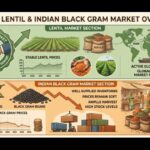 Lentil Market Steady as Indian Black Gram Stays Soft but Well Supplied
 Lentil Market Holds Steady as Indian Green Gram Stocks Cap Upside