
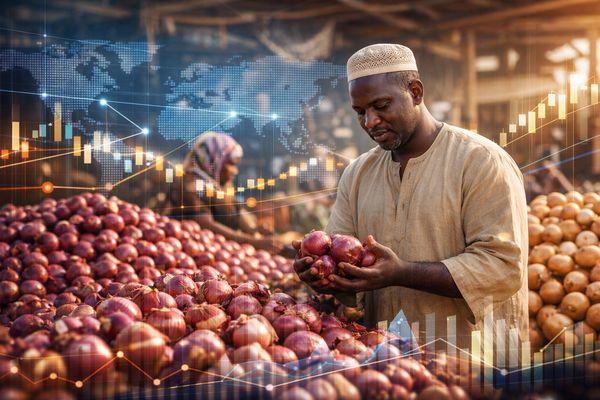
The Gambia’s new onion value chain pact is a structurally bullish development for domestic supply security, but near‑term price effects will hinge on how quickly aggregation and marketing systems become operational. Global and regional onion prices remain broadly stable, suggesting the main impact will be on Gambian import reliance and farmer income stability rather than immediate price spikes.
The agreement between the ROOTS Project, the National Food Security Processing and Marketing Corporation (NFSPMC) and the national vegetable growers’ federation marks a shift from fragmented, informal marketing to a coordinated national aggregation framework. This comes at a time when West African onion trade is under scrutiny for its vulnerability to supply shocks and policy shifts, and when Senegal and Mali remain key regional suppliers. With May weather in The Gambia transitioning towards the humid pre‑rainy season, the initiative is timely for managing highly perishable onion harvests and reducing post‑harvest losses.
Exclusive Offers on CMBroker

Onion powder
grade - B
FOB 1.25 €/kg
(from IN)

Onion powder
white
FOB 1.52 €/kg
(from IN)

Onion
powder
FOB 2.60 €/kg
(from IN)
📈 Prices & Market Tone
Global and regional wholesale onion prices are relatively steady, with no major short‑term shock evident. The more relevant signal from current quotations is a modest easing in processed onion derivatives, suggesting comfortable raw material availability and competitive export offers.
| Product | Origin | Term | Latest price (EUR/kg) | 1–3 week change |
|---|---|---|---|---|
| Onion, fresh (conventional) | Egypt | FOB | 0.80 | ▼ from 0.82 |
| Onion powder, white | India | FOB | 1.52 | ▼ from 1.54 |
| Onion powder, organic | India | FOB | 2.60 | ▼ from 2.62 |
| Onion flakes, organic | India | FOB | 5.03 | ▼ from 5.05 |
| Crispy fried onions | Poland | FCA | 2.39 | ▲ from 2.36 |
For Gambian stakeholders, these levels indicate that imported onions and processed products remain readily available at competitive prices. However, the new domestic aggregation framework and the seasonal moratorium on onion imports reported by officials are likely to tighten the local balance in favour of domestic produce during the main marketing window, cushioning farmers against low‑price competition from external suppliers.
🌍 Supply & Demand: What the New Pact Changes
The domestic onion sector in The Gambia is dominated by smallholders in the North Bank and West Coast Regions, with chronic constraints in storage, handling and market access. The new Memorandum of Understanding formalises coordination between ROOTS (as value‑chain catalyst), NFSPMC (as national aggregator and stabiliser) and SOSOLASO, which will organise supply from vegetable grower cooperatives.
By addressing post‑harvest losses and fragmented marketing, the pact effectively increases usable domestic supply without necessarily expanding planted area in the short term. Officials also signal a strategic goal of import substitution: replacing a portion of current onion imports with better‑channelled local output, aligning with wider West African moves to rely more on regional production and less on overseas shipments.
📊 Fundamentals & Policy Drivers
The initiative is driven primarily by three structural factors: (1) limited and volatile incomes for smallholder onion producers; (2) high post‑harvest losses due to poor storage and logistics; and (3) exposure to global supply chain disruptions and import price volatility. Gambian trade officials explicitly link the pact to the need for resilient domestic food systems amid global uncertainty.
NFSPMC’s role as a national aggregator is central: it can act as a buyer and market stabiliser, smoothing seasonal gluts that previously depressed farmgate prices and led to waste. SOSOLASO, as a federation of vegetable growers’ cooperatives, offers scale and coordination on the supply side. Strong cross‑ministerial backing from agriculture and trade authorities increases implementation credibility, reducing policy risk for private traders engaging with the new system.
Regionally, onions are a cornerstone of West African intra‑regional trade, with Senegal, Mali, Nigeria and others supplying neighbours during seasonal gaps. Recent policy steps such as Senegal’s tighter management of onion imports underline a broader trend towards protecting domestic producers and managing food inflation, reinforcing the rationale for Gambia’s shift towards a more structured domestic value chain.
🌦 Weather & Short‑Term Operational Outlook
May marks the transition towards the rainy season in The Gambia, with rising temperatures, high humidity and the onset of occasional showers along the coast and in the North Bank. Typical conditions involve hot days, warm nights and gradually increasing rainfall probability through the month, conditions that raise disease and spoilage risks for perishable crops like onions if storage and logistics are weak.
Over the next 30–90 days, the practical impact of the MoU will depend on how quickly NFSPMC and SOSOLASO operationalise aggregation points, transport arrangements and payment mechanisms with cooperatives. Without rapid progress, the current season’s harvests may still face significant post‑harvest losses. With effective implementation, however, improved aggregation and quicker off‑take can materially reduce wastage during this climatologically challenging period.
📆 6–12 Month Outlook & Strategic Implications
Over a six to 12‑month horizon, the main metrics of success will be (i) measurable reductions in post‑harvest onion losses, (ii) more stable and possibly higher net farm incomes, and (iii) a visible decline in the share of domestic consumption met by imports. Given existing gaps in cold storage and rural transport, full optimisation of the value chain is unlikely within a single season, but the institutional framework now exists to attract incremental investment.
Regionally, formalising domestic supply is likely to slightly soften Gambia’s demand for imported onions from Senegal, Mali and beyond, especially if backed by seasonal moratoria on imports during local harvest peaks. At the same time, the broader West African onion network remains highly interdependent and partly informal, so Gambia’s reforms may also serve as a pilot for more structured aggregation mechanisms elsewhere. For international traders, The Gambia may gradually transition from a pure import market to a more balanced, partially self‑sufficient buyer with defined marketing windows.
🧭 Trading Outlook & Recommendations
- Importers into The Gambia: Plan for tighter regulatory control and potential seasonal volume caps as domestic aggregation scales up. Focus on off‑season windows and higher‑value segments (e.g. specific grades, processed products) less directly targeted by local production.
- Regional suppliers (Senegal, Mali, Nigeria): Monitor Gambian policy signals and NFSPMC purchasing behaviour. Expect somewhat lower spot demand during Gambia’s peak harvests if domestic aggregation performs as intended.
- Local cooperatives and traders: Prioritise rapid engagement with NFSPMC and SOSOLASO platforms to secure structured off‑take contracts. Investment in basic storage, grading and packing will yield disproportionate returns under the new system.
- Food manufacturers & retailers: Use the emerging framework to develop local sourcing programmes, locking in supply at predictable prices while supporting brand narratives around domestic value chains and food security.
📉 Short 3‑Day Price & Directional View
- Fresh onions, FOB Egypt: Prices around 0.80 EUR/kg are expected to remain broadly stable over the next three days, with no major new drivers visible.
- Dehydrated onions (powder & flakes), FOB India: Slightly softer tone after recent small declines; sideways to marginally weaker pricing likely in the very short term amid comfortable supply.
- Processed fried onions, FCA Poland: Marginal firming from earlier levels suggests cost‑pass‑through and steady demand; near‑term outlook is flat to slightly firmer.
Related posts:
 Indian Dehydrated Onion Eases, Egyptian Fresh Onions Stable on Solid Supply
 Indian Onion Market Under Pressure as Rabi Glut Meets Export Slump
 Onion Prices Steady as Polish Demand Meets Stable India & Egypt Supply
 Maharashtra Seeks Crop Relief After Nashik Losses, Raising Concerns Over Indian Onion Supply
 Onion FOB Prices Hold Steady as India and Egypt Enjoy Weather Tailwind
 Polish Onion Prices Ease as Egyptian Supply Builds and Weather Stays Mild