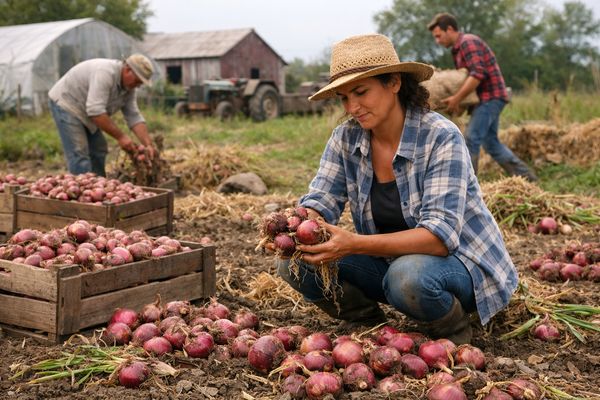
India’s onion market is locked in a supply-driven downturn, with rabi arrivals overwhelming weak domestic and export demand and keeping prices close to or below production costs. In the next 2–3 weeks, only limited price relief is likely unless Gulf exports normalise or farmers sharply slow selling.
India’s key wholesale markets are saturated with rabi onions as farmers rush product to market and export channels underperform. At Delhi’s Azadpur hub on 29 April, prices across origins hovered around cost of cultivation, while unsold stocks from the previous session were compounded by fresh arrivals, leaving around 65 truckloads in the yard and a sizeable portion expected to remain unsold. At the same time, hotel and restaurant sector demand is under pressure from higher commercial LPG prices, and conflict-related shipping disruptions have cut Gulf exports, pushing surplus volumes back into domestic channels.
Exclusive Offers on CMBroker

Onions fried
crispy freid onions
FCA 2.39 €/kg
(from PL)

Onion powder
white
FOB 1.54 €/kg
(from IN)

Onion powder
grade - B
FOB 1.27 €/kg
(from IN)
📈 Prices & Market Tone
Wholesale onion prices at Azadpur on 29 April were broadly stable but depressed, with origin-wise quotes per 40 kg as follows: Rajasthan USD 3.37–4.65, Bengal USD 3.37–4.22, Madhya Pradesh USD 4.22–6.33, Pune USD 6.33–7.17, and Nashik USD 5.91–6.75. On a per‑kilo basis this implies roughly USD 0.08–0.16/kg, leaving many farmers selling at or below cost.
Physical market tone is weak to resigned. Around 31 truckloads of onions were carried over as unsold from the previous session, with 34 new truckloads arriving, pushing total same‑day availability to about 65 truckloads. With a significant part of this volume again likely to remain unsold, traders and commission agents are cautious about taking on additional stock, anticipating prolonged pressure rather than a quick rebound.
🌍 Supply & Demand Balance
The core driver of the downturn is a bumper rabi harvest arriving faster than the market can absorb. Unseasonal rains and rising summer temperatures are encouraging farmers to harvest and dispatch earlier to avoid field and storage losses, front‑loading arrivals into wholesale markets. This rush compresses the marketing window and intensifies competition among sellers.
On the demand side, two key pillars have weakened simultaneously. First, exports to Gulf destinations such as Bahrain, Oman, the UAE and Saudi Arabia are estimated to be down by about 20%, as conflict in West Asia and related shipping and logistics issues disrupt normal flows. Second, hotel and restaurant demand in India has softened following a sharp rise in commercial LPG cylinder prices and availability constraints, reducing one of the largest bulk‑buying segments in the domestic market.
📊 Fundamentals & Processing Market Links
The current oversupply is forcing many farmers to liquidate rather than store onions. Investment in cold storage is being deferred because prevailing prices do not justify the additional cost and risk. Stockists therefore face a market where supply remains heavy, but willingness to hold inventory is limited, adding to short‑term price vulnerability.
For processed onion products, the depressed fresh‑onion environment in India underpins attractive raw‑material costs. Recent indicative export offers converted to EUR show, for example, Indian onion powder (white) around EUR 1.54/kg FOB New Delhi, grade B powder around EUR 1.27/kg, and organic onion powder near EUR 2.62/kg, while organic onion flakes are offered around EUR 5.05/kg. Fresh Egyptian onions for export are roughly EUR 0.82/kg FOB. These levels keep Indian dehydrated and powdered onion highly competitive for European and global buyers.
⛅ Weather & Logistics Watch
Weather remains an indirect but important factor. Unseasonal rains have already prompted earlier harvest and selling decisions, and intensifying summer heat increases the risk of post‑harvest losses for onions held on farm or in non‑refrigerated storage. As temperatures climb further, farmers may slow harvesting once immediate risk to standing crops eases, but this adjustment will lag and is unlikely to rebalance the market in the short term.
Logistics conditions in and around the Persian Gulf are a second crucial watchpoint. Any normalisation of shipping routes and freight services to Bahrain, Oman, the UAE and Saudi Arabia would support a recovery in Indian onion exports. Until there is clarity on freight reliability and costs, however, exporters will be cautious in committing volume, and domestic markets will continue to carry more of the surplus.
📆 2–3 Week Outlook
Given the current pace of rabi arrivals and the export shortfall, onion prices in India are unlikely to stage a meaningful recovery over the next two to three weeks. Wholesale quotes are expected to remain anchored near current low levels as long as unsold truckloads continue to build and hotel/restaurant demand stays muted. The market’s ability to clear surplus stock remains the key short‑term constraint.
A more constructive tone would require either a clear pickup in Gulf export demand as shipping and logistics stabilise, or a marked slowdown in farm‑gate selling as harvest winds down and farmers regain confidence to store. Without one of these shifts, the near‑term scenario is one of extended producer stress and attractive buying opportunities for importers of Indian origin onions and derived products.
💡 Trading Implications
- Importers (fresh & processed): Use the current dip in Indian prices to secure forward coverage for Q2–Q3, especially for onion powder and flakes, while monitoring freight risk ex‑Persian Gulf.
- Food service buyers in Europe: Consider diversifying toward Indian dehydrated onion and Egyptian fresh origin to lock in competitive EUR‑denominated pricing versus potential later‑season volatility.
- Indian producers & traders: Evaluate selective storage only where costs are low and quality can be preserved; otherwise, rapid turnover may limit losses in a market unlikely to rebound quickly.
📍 Short-Term Price Indication (3-Day View)
| Market / Product | Current Indicative Level (EUR/kg) | 3-Day Directional Bias |
|---|---|---|
| India – wholesale fresh onions (domestic, Azadpur equivalent) | ≈ EUR 0.07–0.15/kg | Sideways to slightly lower on persistent oversupply |
| India – onion powder FOB New Delhi (white, conventional) | ≈ EUR 1.54/kg | Stable; raw material cheap, demand steady |
| Egypt – fresh onion FOB Kairo | ≈ EUR 0.82/kg | Stable; competitive versus Indian origin for exports |