
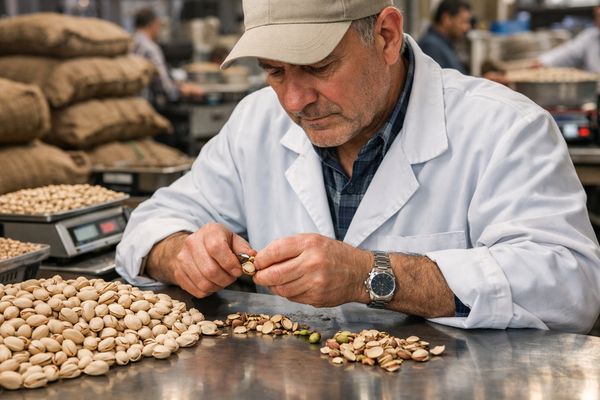
Geopolitical disruptions in West Asia have tightened Iranian pistachio supply, pushing prices 10–20% higher in India over the past two months and lifting global benchmarks to multi‑year highs, with further upside risk if logistics and export restrictions persist.
India’s structurally growing, quality‑sensitive pistachio demand is meeting constrained Iranian export availability and costly alternative routes via air freight or detours around Hormuz, while European buyers face the same squeeze. With the main Indian demand season (June–Diwali) still ahead and conflict in and around Iran unresolved, the market is moving into its strongest consumption window with low flexibility on origin and elevated freight and energy costs. Substitution into other nuts is limited and only partly offsets the shortfall in Iranian pistachios, keeping the market tight.
Exclusive Offers on CMBroker

Pistachio inshell
Ahmadaghaei, 24-26
FOB 9.50 €/kg
(from IR)

Pistachio inshell
Ahmadaghaei, 28-30
FOB 9.26 €/kg
(from IR)

Pistachio inshell
Ahmadaghaei, closed mouth, 24-26
FOB 7.01 €/kg
(from IR)
📈 Prices & Market Mood
At the Indian wholesale level, pistachio prices have risen by roughly 10–20% over the last two months, driven primarily by disruptions to Iranian supply and logistics via the Strait of Hormuz and overland Afghan routes. This mirrors the broader international rally, where benchmark in‑shell pistachio values have climbed to around €9.4/kg, near eight‑year highs, as conflict‑related export bottlenecks intensified from early March.
Indicative current offers for Iranian Ahmadaghaei in‑shell pistachios (FOB Tehran) are around €9.5/kg for 24–26, €9.3/kg for 28–30, and about €7.0/kg for closed‑mouth 24–26, underscoring the premium for open‑mouth grades and the firm underlying price structure. Compared with pre‑conflict levels, this reflects both the direct scarcity of Iranian origin and a risk premium for freight, insurance and longer routes, with spot markets showing heightened intraday volatility.
| Product | Grade / Spec | Origin | Location / Terms | Indicative Price (EUR/kg) |
|---|---|---|---|---|
| Pistachio inshell | Ahmadaghaei 24–26 | Iran | FOB Tehran | €9.50 |
| Pistachio inshell | Ahmadaghaei 28–30 | Iran | FOB Tehran | €9.26 |
| Pistachio inshell | Ahmadaghaei closed‑mouth 24–26 | Iran | FOB Tehran | €7.01 |
🌍 Supply & Demand
Iran remains a core global supplier of pistachios, and its exports are now constrained by both direct conflict‑related damage and heavy disruption to its traditional sea lanes through the Strait of Hormuz as well as overland corridors via Afghanistan. On top of this, Iran has reportedly tightened export controls on nuts and dates, amplifying global scarcity and directly affecting India and Europe, two key destination markets that have built consumer preferences around Iranian quality profiles.
In India, pistachios are no longer purely a festive purchase: year‑round health‑driven consumption, reinforced by quick‑commerce and online delivery models, has structurally raised baseline demand. This means that what would once have been a seasonal squeeze is now hitting a market with elevated underlying throughput. Wholesale buyers are cautious, moderating immediate offtake in response to higher prices, but the main demand wave from June into Diwali is still ahead, suggesting that any unresolved supply issues will coincide with peak seasonal consumption and put further pressure on availability.
European importers are facing the same structural problem: reduced volumes from Iran, simultaneous competition from Middle Eastern processors and confectioners, and limited ability to shift quickly to alternative origins. While the United States is shipping a record crop, much of that volume is already committed, and logistics out of Iran have become both slower and more expensive, keeping delivered‑into‑Europe pistachios tight despite the nominal global production rebound.
📊 Fundamentals & External Drivers
The primary bullish driver is geopolitical: the Iran–Israel–United States conflict has triggered a broader Strait of Hormuz and regional shipping crisis, extending transit times, increasing freight and insurance premia, and forcing some cargoes onto higher‑cost air routes. Even where shipments are allowed through Hormuz during ceasefire windows, backlogs and security protocols mean irregular schedules and greater execution risk, which traders price into offers.
Iran has also implemented its own export restrictions on pistachios and dates, effectively rationing outbound volumes and prioritising domestic needs and political allies. At the same time, global energy and fuel prices have spiked, raising operating costs across farming, processing, cold storage and transport, further supporting elevated nut and dried fruit prices.
Substitution dynamics offer only partial relief. Some Indian traders are experimenting with higher volumes of U.S. almonds and other nuts as substitutes in blended mixes or consumer packs, but Iranian pistachios occupy a distinct premium niche in both flavour and perceived quality. Informal cross‑border flows are reportedly occurring but are high‑risk and unreliable, limiting their capacity to stabilise mainstream supply chains.
🌦️ Weather & Crop Outlook
Weather in key pistachio‑growing regions is not the dominant short‑term price driver compared with logistics and conflict, but it still underpins medium‑term fundamentals. Recent assessments indicate that the current U.S. pistachio crop is strong, while Iranian orchards remain structurally challenged by chronic water stress and, more recently, conflict‑related damage to storage and processing infrastructure.
Over the next few weeks, no major weather shock is expected to radically change near‑term supply; the more immediate risk lies in any further escalation in regional tensions that could again curtail shipping windows through Hormuz or damage export facilities. For buyers, this means that weather‑related downside to prices is likely to be overshadowed by geopolitical risk premia at least through the upcoming Indian festive build‑up.
📆 4–8 Week Market Outlook
Given the ongoing disruption of Iranian trade routes, self‑imposed export restrictions, and the approaching peak demand season in India, pistachio prices are likely to stay elevated with a clear upside bias over the next four to eight weeks. Any further deterioration in regional security or new sanctions affecting logistics or payments could trigger additional spikes, particularly for Iranian grades that are already in short supply.
Conversely, a meaningful and durable easing of tensions around Hormuz—combined with increased availability from alternative origins—would be needed to generate sustained price relief. In the absence of such a scenario, the base case remains a tight global market, continued competition among buyers in Asia, the Middle East, and Europe, and a premium maintained for Iranian open‑mouth, larger‑calibre pistachios.
💼 Trading & Procurement Strategy
- Front‑load strategic coverage: Indian and European buyers with exposure to Iranian origin should consider advancing at least part of their Q3 needs, focusing on critical calibres and specifications, to hedge against further logistics disruptions during the Indian festive build‑up.
- Diversify origin mix: Where quality requirements allow, gradually increase shares of U.S. and Turkish pistachios and complementary nuts (e.g. almonds, cashews) to reduce dependency on Iranian flows without abruptly changing consumer‑facing products.
- Manage grade spreads: Given strong premiums on large open‑mouth Ahmadaghaei, explore more aggressive use of smaller sizes or partial inclusion of closed‑mouth material in industrial applications where visual appearance is less critical.
- Lock in logistics early: Secure freight capacity and insurance well ahead of shipment dates, especially for lanes transiting the Strait of Hormuz, to mitigate the risk of last‑minute cost blowouts.
📍 3‑Day Directional Outlook (Key Hubs, in EUR)
- FOB Iran (Tehran, Iranian in‑shell): Bias slightly higher over the next three days as traders price in continued route uncertainty and firm global demand.
- CIF India (Nhava Sheva, mixed origins): Stable to firmer, with importers cautious on volume but willing to pay up for reliable, near‑term shipments ahead of the seasonal ramp‑up.
- CIF Northern Europe (Rotterdam, mixed origins): Slight upward bias, mainly reflecting elevated freight and insurance premia and intense competition with Middle Eastern buyers for non‑Iranian origins.
Related posts:
 Middle East Conflict Pushes Pistachio Prices to Multi‑Year Highs
 Indian Peanuts Stay Firm as Iran Conflict Lifts Edible Oil Complex
 Iranian Pistachio Gap Keeps Europe Tight Despite Diplomatic Hopes
 Bright Green Gap: How Iranian Pistachio Disruptions Are Reshaping Europe’s Market
 War-Driven Supply Shock Pushes Pistachios to Eight-Year Highs
 California Almonds Struggle as Pistachios Capitalize on Iran Disruption
 West Asia shock squeezes Andhra cashew processors and global buyers