
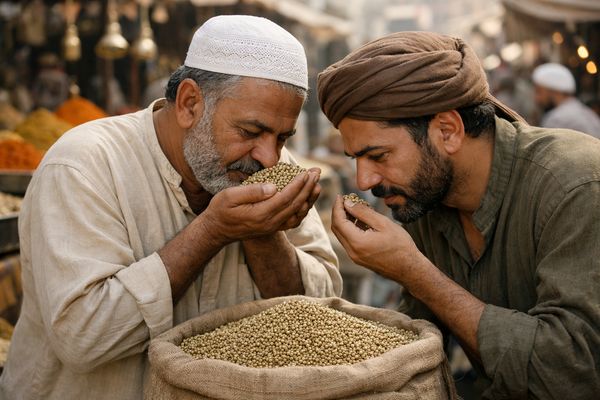
Indian coriander seed is trading with a soft undertone as Delhi wholesale prices drift lower on subdued domestic and export demand, with no major supply shock in sight. The market is expected to stay rangebound with a mild downside bias in the coming weeks, creating an attractive short‑term procurement window for international buyers.
India’s coriander complex has eased alongside a broader retreat in dry spices such as cardamom, mace, nutmeg and cumin, as fresh buying momentum failed to materialise last week. In Delhi wholesale markets, coriander traded mostly between ₹10,500 and ₹11,000 per quintal, with the lower end of the range being tested towards the close, indicating seller‑led pressure rather than tightness. Against this backdrop, India’s broadly adequate rabi crop and muted export enquiries—partly linked to disruptions in Persian Gulf trade routes—are keeping a lid on any near‑term recovery potential.
Exclusive Offers on CMBroker

Coriander seeds
99,9%
FOB 1.00 €/kg
(from IN)

Coriander seeds
whole
FOB 1.99 €/kg
(from IN)

Coriander seeds
double parrot
FOB 1.35 €/kg
(from IN)
📈 Prices & Short-Term Trend
Delhi wholesale coriander prices currently hover around ₹10,500–₹11,000 per quintal, with the market probing the softer side of the range. Based on this band and an indicative exchange rate, this implies an approximate ex‑Delhi value near €1.25/kg, broadly consistent with recent FOB offers for Indian coriander seeds into export channels.
Forward guidance from domestic traders points to a broadly rangebound market over the next 2–4 weeks, with likely oscillations between ₹10,200 and ₹11,200 per quintal. A clear break above the ₹11,500 per quintal mark is seen as unlikely without a material demand shock, such as a surge in export bookings or emerging evidence of below‑average production from major growing states.
| Product | Origin | Location / Term | Latest price (EUR/kg) | 1W change (approx.) |
|---|---|---|---|---|
| Coriander seeds, 99.9% | India | New Delhi, FOB | €1.00 | ↗ (from ~€0.98) |
| Coriander seeds, double parrot | India | New Delhi, FOB | €1.35 | ↗ (from ~€1.33) |
| Coriander seeds, whole, organic | India | New Delhi, FOB | €1.99 | ↘ (from ~€2.01) |
🌍 Supply & Demand Context
Fundamentally, the current price softness is demand‑driven rather than supply‑driven. India’s rabi coriander crop—sown in winter and harvested between March and May—has so far seen no major damage reports from core producing states Rajasthan, Madhya Pradesh and Gujarat. This underpins an overall picture of comfortable availability at the farm and primary market level.
On the demand side, both domestic and export channels are in a seasonal lull. Domestic consumption of coriander, though structurally strong as India’s most widely used spice by volume, typically softens in this period, and this year’s slowdown in buying support has been sharper than usual. Simultaneously, export enquiry from key destinations in the Middle East, Southeast Asia and Europe remains muted, with geopolitical disruptions and higher freight risks in Persian Gulf routes dampening near‑term shipment appetite.
📊 Fundamentals & Trade Flows
India retains its position as the world’s largest producer and exporter of coriander seed, competing mainly with Morocco, Bulgaria and Canada. Indian split and ground coriander play a critical role in European spice blends, curry powders and processed meat applications, meaning that even modest price shifts in Delhi can meaningfully influence procurement economics for EU blenders once passed through the chain.
Current market dynamics suggest that the recent softness will feed into lower replacement costs for European buyers over the next four to six weeks. As export pipelines are replenished at today’s lower Indian wholesale levels, CIF offers into Europe should gradually reflect the weaker origin market, assuming freight and logistics conditions do not deteriorate significantly from current levels.
🌤️ Weather & Crop Outlook
The coriander crop from the current rabi season is essentially set, with harvests between March and May largely completed or in their final stages. No notable adverse weather events have been reported from Rajasthan, Madhya Pradesh or Gujarat that would materially alter the production outlook, supporting the view of an adequate, if not abundant, supply base for 2026.
Near‑term weather in these regions will mainly affect late harvesting and post‑harvest handling rather than yield. Barring isolated local disruptions, weather is therefore not expected to be a near‑term bullish driver for coriander prices and instead reinforces the expectation of a well‑supplied market through early summer.
📆 Price Outlook (2–4 Weeks)
- Base case: Rangebound prices with a soft bias, broadly between ₹10,200 and ₹11,200 per quintal (around €1.22–€1.33/kg at indicative FX).
- Upside risk: A sudden pickup in export bookings from the Middle East or Europe, or credible indications of lower‑than‑expected output in key Indian states.
- Downside risk: Prolonged demand weakness across the broader spice complex or further disruptions in Persian Gulf trade routes that delay restocking cycles.
🧭 Trading & Procurement Recommendations
- European and Middle Eastern buyers: Use the current softness as a tactical procurement window for June–August coverage, particularly for split and ground coriander. Consider layering purchases over the next 2–4 weeks to average into the range rather than timing the absolute bottom.
- Indian exporters: Focus on forward sales to price‑sensitive destinations, leveraging India’s competitive advantage versus other origins while wholesale prices remain subdued. Lock in margins through cautious hedging rather than aggressive long positions.
- Industrial users (global): Review inventory policies and consider modestly extending coverage to benefit from current origin‑level softness, especially if coriander accounts for a significant share of total spice costs.
📍 3‑Day Regional Price Indication (Directional)
- Delhi wholesale (India): Stable to slightly weaker within the ₹10,400–₹10,900 per quintal band (approx. €1.23–€1.29/kg).
- FOB New Delhi, India (export grades): Mostly sideways in EUR terms, with mild downward pressure if demand stays soft.
- FOB Egypt (coriander seeds): Competitive but broadly aligned with Indian levels; relative spreads likely to remain narrow in the very short term.
Related posts:
 Soft undertone in Indian coriander seeds opens a tactical buying window
 Coriander Prices Edge Higher as Indian Harvest Peaks and Egyptian Supply Stays Steady
 Indian Coriander Edges Softer as Heat, Peak Arrivals Test Buyers
 Cinnamon Market: Soft Indian Tone, Firm Cassia Floor, Weather in Focus
 Cumin prices slipping despite tighter Indian supply – window opens for European buyers
 Coriander Prices Steady to Firm as Indian New Crop Caps Upside
 Clove Prices Soften as Hormuz Tensions Freeze Indian Buying
 Indian Coriander Defies Soft Spice Complex as Demand Tightens Post‑Harvest