
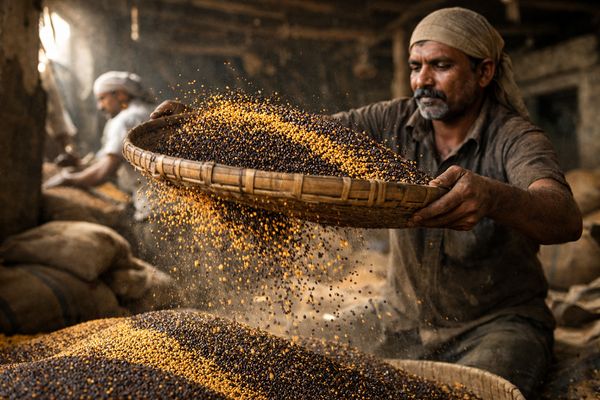
Indian mustard seed prices are breaking higher as biofuel policy signals and the Strait of Hormuz crisis tighten the global vegetable oil balance, with further upside likely in the near term. European and Asian buyers face a structurally firmer floor for mustard and related oils as crude oil stays elevated and India leans more aggressively into ethanol blending.
India’s physical mustard complex has logged a second consecutive session of strong gains, led by Rajasthan and Haryana mandis, while mustard oil has tracked seeds higher and cake values hold firm. The move is rooted less in short‑term supply stress and more in a structural re‑rating of oilseed demand, as markets price in a future where edible oils increasingly compete with fuel tanks. Global crude benchmarks, already lifted by the partial blockade of the Strait of Hormuz, and firmer sentiment in wider vegoils add a bullish layer that importers should not ignore.
Exclusive Offers on CMBroker

Mustard seeds
yellow, micro, sortex
99.95%
FOB 0.89 €/kg
(from IN)

Mustard seeds
yellow, bold, sortex
99.95%
FOB 0.99 €/kg
(from IN)

Mustard seeds
brown, micro, sortex
FOB 0.79 €/kg
(from IN)
📈 Prices & Market Sentiment
Across India’s key producing states, mustard seed rallied sharply on Monday, extending the previous session’s gains and reinforcing a bullish short‑term tone. In Jaipur, conditioned mustard reached about EUR 80.50 per quintal (≈USD 87.50), up roughly EUR 1.35 on the day. Ramganj and Bara mandis in Rajasthan firmed to around EUR 71.10–71.70 per quintal, while major Haryana markets including Charkhi Dadri, Hansi, Bhiwani, Narnaul and Palwal closed between roughly EUR 72.10 and EUR 74.20 per quintal, posting intraday increases equivalent to EUR 2.15–6.30 per quintal.
Mustard oil has mirrored the seed rally. Delhi values climbed to roughly EUR 157.00 per quintal (≈USD 170.83), and Jaipur edged higher to around EUR 160.00 per quintal. Mustard cake, by contrast, remained stable at about EUR 29.25–30.40 per quintal, suggesting that current strength is concentrated in the oil component rather than the feed segment. Indicative export offers from New Delhi for sortex‑grade mustard seeds show modest week‑on‑week increases, with yellow bold types around EUR 0.99/kg FOB and brown bold types near EUR 0.70/kg FOB as of early May, underscoring the firming trend.
| Product | Location / Term | Approx. Price (EUR) |
|---|---|---|
| Mustard seed, Jaipur, conditioned | Spot, mandi | ~80.5 / qtl |
| Mustard seed, Rajasthan (Ramganj/Bara) | Spot, mandi | ~71.1–71.7 / qtl |
| Mustard seed, Haryana hubs | Spot, mandis | ~72.1–74.2 / qtl |
| Mustard oil, Delhi | Spot | ~157 / qtl |
| Mustard oil, Jaipur | Spot | ~160 / qtl |
| Mustard seed, yellow bold sortex | New Delhi, FOB export | ~0.99 / kg |
| Mustard seed, brown bold sortex | New Delhi, FOB export | ~0.70 / kg |
🌍 Policy, Crude & Global Vegoil Linkages
The immediate catalyst for India’s rally is a strong policy signal: New Delhi’s ambition to move towards petrol blends with up to 100 percent ethanol over time. Recent government notifications around E20 nationwide from April 2026 and fresh commentary on E85–E100 flex‑fuel pathways have convinced traders that edible oils, including mustard and soybean, may increasingly be drawn into the biofuel complex, providing a durable demand floor beyond food uses.1 This comes on top of an already organised sugar‑ethanol lobby supportive of higher blending mandates, reinforcing expectations that oilseed‑based feedstocks will gain strategic value.
Geopolitics is amplifying the signal. Since late February, Iran’s effective closure and harassment of shipping through the Strait of Hormuz has created the largest crude supply disruption in modern history, slashing tanker traffic and driving Brent sharply higher. The benchmark recently traded in the EUR 105–115 per barrel equivalent, with intraday spikes reported up to around EUR 116–128 as security incidents escalated and OECD inventories drew down.2 Ongoing military efforts to secure the strait have so far failed to normalise flows, keeping energy markets tight and biofuels economically attractive.
In edible oils, the mustard rally aligns with generally firm sentiment. While Malaysian palm oil futures have eased slightly below MYR 4,600/t on currency and short‑term soy oil weakness, levels remain historically elevated, and traders expect renewed upside if crude and biofuel demand stay strong.3 The net effect is a tightening of the global vegetable oil balance, in which India’s mustard complex plays a key regional role for both food and biodiesel players.
📊 Fundamentals & Market Structure
The latest session’s jump in Indian mustard prices is notable for occurring alongside higher, not lower, arrivals. Daily inflows at producing mandis have risen from roughly 900,000 to 1,000,000 bags (around 100,000 quintals), signaling that farmers and stockists are responding to higher prices by increasing sales, not retreating. This pattern is typical of a genuine demand‑driven bull move rather than a short‑covering squeeze or a temporary supply shock.
Processors are seeing improved oil realizations while cake values remain steady, supporting crush margins and encouraging higher throughput. The anticipated diversion of a portion of mustard oil into biofuel channels over time could structurally lift the oil share of the complex, while demand for cake in the feed sector appears well‑anchored. At the same time, the rally is stoking a domestic debate: some market participants question whether using edible oils for fuel is appropriate given affordability concerns for cooking oil among lower‑income households, raising the risk of future policy fine‑tuning or targeted subsidies.
From a positioning standpoint, the strong back‑to‑back sessions and discussion of further upside into the EUR 82–87 per quintal band (≈USD 90–95) suggest growing speculative participation. However, the presence of rising physical arrivals and robust oil demand implies that speculative length is, for now, aligned with improving fundamentals rather than detached from them. Any abrupt correction in crude or a reversal of biofuel rhetoric, however, could trigger rapid profit‑taking from these positions.
⛅ Weather & Crop Outlook
Near‑term weather in India’s northern oilseed belt is seasonally warm but not disruptive, with no major frost or excess‑rain threats reported. The current price action is therefore not driven by weather stress but by policy and macro factors. Looking ahead, monsoon onset and distribution will be important for the next sowing cycle and for competing kharif oilseeds, but immediate mustard availability is primarily a function of marketing pace rather than crop risk.
Internationally, weather in Southeast Asia remains a secondary watchpoint through its impact on palm oil yields; so far, minor fluctuations in rainfall and temperature have not altered the broad outlook, which continues to be overshadowed by currency and demand‑side drivers. For mustard specifically, no acute weather‑driven supply shock is currently evident, leaving the market concentrated on energy, policy and speculative behavior in the coming weeks.
📆 Short‑Term Outlook & Trading Ideas
Over the next two to four weeks, India’s mustard market is poised to remain firm to higher, with the EUR 82–87 per quintal band for benchmark Jaipur quality increasingly plausible if ethanol blending plans move closer to formal implementation and crude stays elevated. The core upside drivers are: (1) a structural re‑rating of oilseed demand via biofuel channels, (2) persistently high crude benchmarks amid the Hormuz crisis, and (3) supportive global vegoil pricing. The primary downside risk is a sharp, sustained retreat in crude prices, which would erode biofuel economics and curb speculative enthusiasm.
- Importers / food‑industry buyers: Consider accelerating coverage for Q3 needs at current levels, particularly for higher‑grade yellow mustard, while staggering purchases to manage volatility. A blend of spot and short‑dated forward buying can balance supply security with price risk.
- Processors / crushers: Elevated oil values and steady cake prices support continued active crushing. Locking in margins via partial forward sales of oil while maintaining flexibility on seed procurement may hedge against a sudden crude‑led correction.
- Speculative participants: The trend remains up, but sensitivity to headlines around the Strait of Hormuz and India’s ethanol policy is high. Tight stop‑loss discipline is advisable, especially if Brent were to retreat decisively below the EUR 95–100 per barrel zone.
- European biodiesel and vegoil users: Factor in a structurally tighter floor for mustard and related oils in Q3, and reassess cross‑price spreads versus rapeseed and sunflower oil when planning feedstock switches.
📍 3‑Day Indicative Direction (EUR)
- India domestic mandis (Jaipur benchmark): Bias modestly higher to sideways around ~EUR 80–82 per quintal as bullish sentiment persists but recent gains invite some consolidation.
- FOB New Delhi, yellow mustard (sortex): Mild upside risk from ~EUR 0.99/kg as export parity adjusts to stronger domestic prices and firm crude.
- FOB New Delhi, brown mustard (sortex): Slightly firmer tone from ~EUR 0.70/kg, with price moves likely narrower than for yellow types given relative demand depth.
Related posts:
 Mustard Seed Prices Firm as Indian Mills Accelerate Procurement
 Indian Mustard Seed Prices Edge Higher on Record Crop and Strong Demand
 Indian Mustard Seed Prices Ease Further as Big Crop and Summer Heat Cap Upside
 Indian Mustard Seed Finds a Floor as Global Edible Oils Rebound
 Mustard Seeds Hold Firm as Palm Oil Rally Supports Indian Market
 Indian Mustard Seed Under Harvest Pressure but Supported by Strong Edible Oils
 Indian Mustard Seed Prices Hold Steady as Heatwave Looms Over Key Belt