
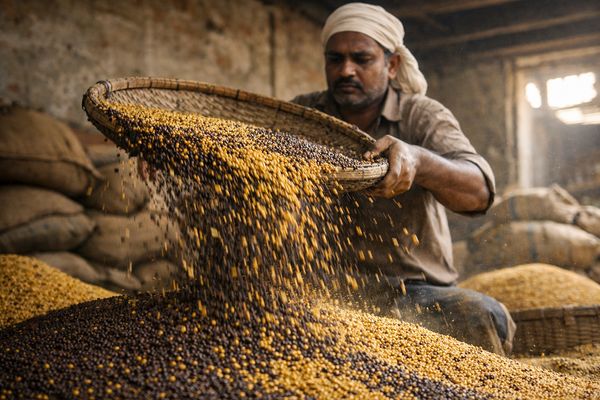
Indian mustard seed is stabilising after days of sideways trade, with higher arrivals largely absorbed by renewed branded mill buying and support from a late rally in global edible oil markets. Spot values look set to consolidate in a relatively tight band, with imported vegetable oil benchmarks remaining the key short‑term driver for any breakout.
India’s benchmark Jaipur market held mustard seed prices steady around EUR 70 per quintal on 29 April, even as daily arrivals from producing states climbed for the third consecutive session to roughly 550,000 tonnes. The market tone has turned slightly more constructive: branded processors have started to lift bid prices into the close, while firmer palm and soyoil futures are feeding into domestic oil and cake values. For European crushers and condiment manufacturers, Indian mustard oil offers an early signal for seed direction into mid‑May.
Exclusive Offers on CMBroker

Mustard seeds
yellow, micro, sortex
99.95%
FOB 0.88 €/kg
(from IN)

Mustard seeds
yellow, bold, sortex
99.95%
FOB 0.98 €/kg
(from IN)

Mustard seeds
brown, micro, sortex
FOB 0.78 €/kg
(from IN)
📈 Prices & Spreads
At Jaipur, conditioned mustard seed hovered near EUR 70 per quintal on 29 April, unchanged on the day despite a further rise in arrivals. In Hapur (Uttar Pradesh), spot seed firmed modestly by about EUR 0.25–0.30 per quintal to an estimated EUR 65.7–66.0 per quintal as local oil mill demand emerged.
Mustard oil prices at traditional cold‑pressed (kachchi ghani) mills remain relatively firm: indications translate to roughly EUR 140–142 per 10 kg across key centres, with Kolkata and Kota near the lower end of the range and Mumbai at the upper end. Mustard oil cake has also edged higher, with central Rajasthan markets near EUR 27 per quintal, signalling steady offtake from the feed sector.
Export‑oriented offers from New Delhi confirm a broadly stable international picture. Late‑April quotes cluster around EUR 0.78–0.98/kg FOB/FCA depending on seed type and specification, with yellow bold sortex near the top of the range and brown bold varieties discounted. Over April, most grades have moved within a very narrow EUR 0.02–0.04/kg band, underscoring the present consolidation phase.
🌍 Supply, Demand & Weather
On the supply side, arrivals into producing‑state mandis have risen to about 1.1 million bags (roughly 550,000 tonnes) per day, marking three consecutive working sessions of higher inflows. Favourable weather in key mustard‑growing belts is allowing farmers to market freshly harvested seed smoothly, preventing any weather‑driven disruptions and keeping near‑term physical availability comfortable.
Despite this, oil mills are no longer entirely absent from the market. While many processors had restricted purchases earlier in the session—citing adequate short‑term stocks and cautious procurement amid rising arrivals—branded mustard oil companies stepped up buying late in the day, nudging bid prices higher. This pattern suggests that downside is being selectively bought, especially by brands keen to cover forward oil demand without waiting for a deeper correction.
Domestic demand for mustard oil and cake remains seasonally steady. Mustard retains a premium niche in North and East India due to its flavour profile, while cake is firmly integrated into local feed rations. On the export side, European buyers of mustard‑based condiments and speciality oils are watching Indian values closely, but subdued volatility and stable spreads against competing oils currently favour gradual, rather than urgent, coverage.
📊 External Drivers & Fundamentals
The most important external driver is the global edible oil complex. Malaysian palm oil futures for July have recently rebounded by about 0.9%, while Chicago soyoil for July gained roughly 0.7%, prompting short‑covering across the complex. The palm rally was largely linked to a crude oil price upswing, even though medium‑term fundamentals still point to seasonal inventory builds in Malaysia and expanding South American soyoil exports.
For Indian mustard, this means spot prices are tightly correlated with imported edible oil costs. If palm and soyoil weaken again on comfortable stocks and strong South American supply, they will cap any sustained mustard seed rally by increasing competition in the domestic edible oil blend. Conversely, a continued firm tone in palm and soyoil—especially if driven by energy markets or logistics bottlenecks—would directly support mustard oil prices and, by extension, seed values at Jaipur and other hubs.
Structurally, the mustard balance sheet in India appears adequate for now: robust arrivals, friendly weather, and only moderate stock‑building at mills argue against a sharp squeeze. However, the fact that branded processors are prepared to lift seed purchase prices modestly on days of global strength shows that commercial coverage is not yet fully complete and that the market is sensitive to international cues.
📆 Short‑Term Outlook (2 Weeks)
Spot mustard seed prices in India are expected to consolidate in a corridor of roughly EUR 68–71 per quintal over the next fortnight. Rising daily arrivals and comfortable near‑term supply will likely cap the upside, particularly if imported oil prices soften again. At the same time, branded oil mill buying on dips and resilient oil and cake demand should provide a firm floor on significant intraday weakness.
The primary wildcard remains the direction of global edible oil benchmarks. A sustained recovery in Malaysian palm oil and Chicago soyoil would quickly translate into firmer mustard oil quotes, improving crush margins and encouraging more aggressive seed buying. In contrast, any renewed sell‑off in palm and soyoil futures would keep Indian mustard values trapped in a sideways, range‑bound pattern, with only local basis adjustments and quality spreads offering trading opportunities.
Weather is likely to play a secondary role in the immediate horizon. With harvesting largely complete and conditions favourable in producing belts, the risk of weather‑driven supply shocks is low for now. The focus instead is on the pace of farmer selling versus mill procurement and on international vegetable oil price moves.
🧭 Trading & Procurement Guidance
- Importers & crushers (EU): Use the current consolidation in Indian mustard seed and oil as an opportunity to secure partial coverage for late Q2 at current EUR‑denominated levels. Prioritise flexible shipment windows to benefit if global oils soften again.
- Branded oil mills (India): Maintain a buy‑on‑dips strategy within the projected EUR 68–71/quintal band. Avoid aggressive forward coverage unless palm and soyoil show a sustained multi‑session uptrend, as fundamentals in the broader vegoil complex remain relatively soft.
- Feed and cake buyers: With oil cake values firming but still near EUR 27/quintal, stagger purchases rather than chasing rallies. Rising seed arrivals argue against a sharp cake shortage in the near term.
- Speculative participants: Focus on spread trades between mustard seed and benchmark imported oils rather than outright direction. Volatility is likely to be more pronounced in palm/soyoil futures than in domestic mustard, which is currently range‑bound.
📍 3‑Day Directional View
| Market | Product | 3‑Day Bias | Comment (EUR terms) |
|---|---|---|---|
| Jaipur (IN) | Mustard seed | Sideways / slightly firm | Likely to hold near EUR 70/quintal; mild support from global oils and branded mill buying. |
| New Delhi (IN, export) | Mustard seed FOB | Stable | Export offers seen steady around EUR 0.8–1.0/kg; limited room for downside unless palm/soyoil retreat. |
| Key EU ports | Imported mustard seed | Sideways | CIF indications expected to track stable Indian FOB plus freight; FX moves a larger driver than origin prices short‑term. |
Related posts:
 Cumin prices ease as Indian demand cools, but seasonal floor in sight
 Indian Mustard Seed Under Harvest Pressure but Supported by Strong Edible Oils
 Indian Mustard Seed Prices Hold Steady as Heatwave Looms Over Key Belt
 Indian Mustard Seed Prices Firm as Arrivals Tighten and Oil Complex Stays Mixed
 Indian Mustard Seed Prices Ease as Heatwave Builds Over Key Growing Belt
 Indian Nutmeg Finds a Floor as Rains Disrupt Kerala Spice Belt
 Indian Mustard Seed Prices Ease as New Crop Pressure Builds
 Indian Mustard Seed Prices Edge Higher as Arrivals Slow and Weather Stays Supportive