
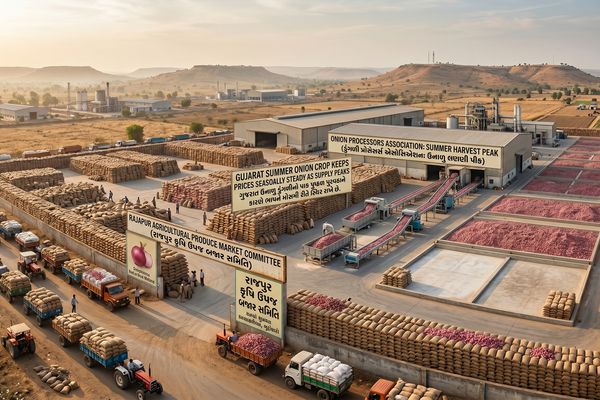
Onion prices in Gujarat are holding broadly steady to soft as the summer harvest continues to clear local wholesale markets, keeping a lid on any sharp price spikes despite rising farm costs and tight irrigation conditions.
Onion remains a daily dietary essential in India, and Gujarat’s summer crop plays a key seasonal role in balancing consumer inflation concerns with farmer margins. Late-season arrivals from March–May plantings are still flowing into major wholesale markets such as Rajkot and key Saurashtra centres, underpinning an actively traded but well-supplied market. Against this backdrop, higher fertiliser, pesticide, seed and labour costs are squeezing grower profitability, while the closure of the Narmada canal is pushing parts of Surendranagar and Banaskantha toward costlier bore-well irrigation. Looking ahead, prices are expected to stay largely range-bound until the kharif onion crop begins to enter the pipeline later in the year.
📈 Prices & Seasonal Pattern
Onion prices across Gujarat’s wholesale markets currently reflect a classic late-summer pattern: adequate supply, firm demand, and limited upward price momentum. Market behaviour is being shaped by the tail end of the summer harvest, with residual volumes still being cleared before farmers pivot fully to kharif sowing.
This seasonal context tends to cap prices, as buyers remain well covered by ongoing arrivals and have little incentive to chase the market higher. At the same time, onions’ status as a staple and health-linked product supports stable demand even at elevated temperature levels, preventing a deeper price slide and keeping overall values in a steady-to-soft band rather than outright weak.
🌍 Supply, Irrigation & Competing Crops
Supply from Gujarat’s summer crop, harvested mainly between March and May, is in its late arrival phase, with steady inflows reported into wholesale markets in Rajkot and Saurashtra. This flow is sufficient to satisfy both consumption and export-oriented processing needs, but the supply window is visibly narrowing as farmers exhaust remaining marketable stocks.
Irrigation is emerging as a structural concern after the closure of the Narmada canal network on 30 April 2026. In canal-dependent belts of Surendranagar and Banaskantha, summer onions and other vegetables are now reliant on deep bore wells for residual watering. This raises operating costs and heightens sensitivity to groundwater conditions, especially as early kharif cotton and peanut sowing—expected to pick up from around 15–20 May—competes directly for the same water and labour resources.
📊 Farm Economics & Cost-Price Squeeze
Farmers across Gujarat report sustained inflation in key inputs—fertilisers, pesticides, seeds and labour—while output prices for onions have softened relative to earlier peaks. According to farmer representatives in Amreli, such as the Bharatiya Kisan Sangh leadership, this dynamic is eroding farm incomes and heightening the perceived risk of continued onion cultivation during the costly summer season.
For onion growers specifically, the cost-pressure is intensified by seasonal labour constraints. Summer migration curtails the availability of field and handling workers just when harvest, grading and market dispatch operations are at their peak. Despite these higher costs, current wholesale prices remain anchored by ample supply, meaning producers have limited ability to pass on expenses to the market in the short term.
☀️ Weather & Near-Term Market Stability
Weather across Gujarat in early May is dominated by hot to very hot conditions, typical for the pre-monsoon period, with maximum temperatures widely in the upper-30s to mid-40s °C over the coming week. This environment supports rapid curing and drying of harvested onions, helping maintain quality in storage and during transit, but also increases irrigation demand for any remaining standing crops and newly sown fields.
With the Narmada canal closed, this heat-driven water requirement must increasingly be met through groundwater, lifting energy and pumping costs for growers in canal-dependent zones. However, as the bulk of the summer onion crop has already been harvested and is moving through the supply chain, near-term price effects from weather are expected to be modest, mainly reinforcing the existing steady-to-soft price tone rather than triggering major volatility.
🌐 Export & European Buyer Perspective
Gujarat is a key supplier of dehydrated onion and onion-based products to European buyers, and the present phase of the summer season offers a relatively favourable procurement window. With late-summer arrivals still feeding processors and traders, export-oriented supply is available at competitive, seasonally moderated prices.
As the summer supply window begins to narrow and attention shifts toward kharif sowing, the risk profile for export prices tilts gradually upward. A meaningful and sustained price recovery is more likely later, as the kharif crop’s progress and monsoon performance become clearer. European buyers seeking volume and quality should therefore aim to lock in requirements during the current steady-price phase, before the usual monsoon-related uncertainties begin to be priced into offers.
📆 2–4 Week Market Outlook
Over the next two to four weeks, Gujarat’s onion market is expected to remain broadly stable, with a slight soft bias as remaining summer stocks continue to move through wholesale channels. The transition from summer harvest clearance to kharif field preparation will gradually tighten available fresh supply, but not sharply enough to drive immediate price spikes.
Any notable upside in prices before the kharif crop enters the supply chain later in the year appears unlikely under current conditions. Instead, the key variables to watch will be groundwater availability in canal-dependent districts, actual progress of early kharif sowing, and any policy or logistical disruptions that might temporarily affect movements from producing belts to major markets.
💡 Trading & Procurement Recommendations
- Domestic wholesalers in Gujarat: Maintain normal-to-slightly-above-normal inventories while late summer arrivals are still smooth; focus on quality selection rather than aggressive price bids, as near-term upside appears limited.
- Retailers and foodservice buyers: Use the current steady price environment to secure short- to medium-term coverage, prioritising onions with good shelf life in anticipation of monsoon-related logistics risks later in the season.
- European dehydrated onion buyers: Advance procurement now to benefit from competitive summer-season pricing and adequate quality before the supply window narrows and monsoon risk premia start to lift export offers.
- Producers in canal-dependent areas: Carefully evaluate water and energy costs for any residual summer cultivation; consider balancing onion area with less water-intensive kharif crops where groundwater is under stress.
📉 Short-Term Price Direction (3-Day View)
Given ongoing late-summer arrivals and stable demand, onion prices in Gujarat’s key wholesale markets (e.g. Rajkot and Saurashtra hubs) are expected over the next three days to:
- Remain broadly unchanged to marginally softer in EUR terms, reflecting comfortable supply.
- Show limited intraday volatility, with any dips likely cushioned by active local and processing demand.
- Continue trading within their recent seasonal range, with no strong catalysts yet visible for a sharp move in either direction.
Related posts:
 Polish Onion Processing Prices Hold Firm as Fresh Market Tightens in Europe
 Gambia’s Onion Market Pact: From Import Dependence to Coordinated Domestic Supply
 Indian Dehydrated Onion Eases, Egyptian Fresh Onions Stable on Solid Supply
 Indian Pink Onion Crunch: Weather-Hit Garwa Crop Meets Weak Prices
 European Potato Market: Dry Start to Season Keeps Prices Supported
 Onion Prices Steady as Polish Demand Meets Stable India & Egypt Supply
 Maharashtra Seeks Crop Relief After Nashik Losses, Raising Concerns Over Indian Onion Supply
 Onion FOB Prices Hold Steady as India and Egypt Enjoy Weather Tailwind