
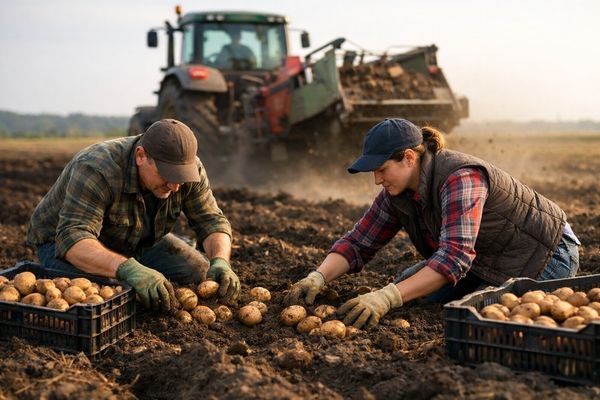
Planting of potatoes across Europe is progressing well overall, but emerging dryness in central and eastern regions introduces early yield risk that is likely to underpin prices rather than depress them. For now, spot potato starch values in EUR remain broadly stable, yet weather in coming weeks will be decisive for the 2026 crop’s price direction.
The current campaign is characterised by good field access and early sowing in many northern and eastern regions thanks to a relatively dry late winter, contrasted with local delays in cooler or wetter pockets such as Ireland and south‑eastern Europe. At the same time, below‑average precipitation in central, northern and eastern Europe is starting to erode soil moisture, especially in eastern Germany and Poland. This combination of timely planting but rising moisture risk keeps the balance of price risks tilted slightly to the upside for potatoes and derivatives.
Exclusive Offers on CMBroker

Potato starch
powder
FCA 0.85 €/kg
(from PL)
📈 Prices & Market Mood
Potato starch offers from Poland (Lodz, FCA) are currently indicated around EUR 0.85/kg, essentially unchanged over the past week and about 3–4% above early April levels, confirming a firm but not overheated market tone. The absence of significant price corrections despite the smooth sowing start suggests that buyers are already pricing in some weather‑related yield risk later in the season rather than expecting an outright surplus.
🌍 Supply & Sowing Progress
Across the main producing countries, sowing progress is generally satisfactory. In Germany, potatoes are being planted under roughly average conditions, with some areas slightly slower due to earlier cool soils. In the Netherlands and Belgium, field preparation is well advanced and planting has just started after a relatively dry early spring, giving good access to fields and supporting timely acreage establishment.
In France, sowing is moving at an average pace and is somewhat more advanced in drier western regions. Poland benefits from dry and mild conditions since late winter, enabling an early start of the sowing campaign; however, rising soil moisture deficits already pose a concern for uniform emergence and early growth. Elsewhere in northern and central Europe (notably Denmark, Sweden and Czechia), dry weather has favoured rapid or even early sowing, increasing the likelihood of an ample area but also exposing crops to early‑season moisture risk.
In south‑eastern Europe, particularly Romania, low soil temperatures have delayed field operations, potentially pushing harvest windows later and increasing exposure to summer heat and dryness. In southern Europe (Spain, Portugal, Italy, Greece), fieldwork continues under generally favourable conditions, though episodes of abundant rainfall have intermittently interrupted operations rather than causing systemic damage. In the far north, such as Finland, sowing has not yet started, which is fully consistent with the usual seasonal calendar and thus neutral for the market at this stage.
📊 Weather, Soil Moisture & Yield Risk
A distinct precipitation deficit dominates much of central and eastern Europe and parts of the west and north, with many areas receiving less than 30 mm since late winter, equivalent to 50% or less of long‑term averages. In eastern Germany and Poland, a prolonged rainfall shortfall since early March has already reduced soil moisture; while recent showers have offered partial relief, additional rainfall will be essential as potato water demand rises towards tuber initiation and flowering.
Similar emerging moisture deficits are reported in Austria, Slovenia, Hungary, Slovakia, Czechia and adjacent regions. Conditions are not yet critical, but the combination of normal to advanced crop stages and limited precipitation means yield potential could start to erode quickly if the dry pattern continues. Further east, in western and northern Ukraine, winter crops have resumed growth under a rainfall deficit; soil moisture remains adequate for now, but the region is poised for rapid onset of water stress without improved rainfall, which could tighten regional feed and starch markets if it persists.
Temperature patterns show a surplus in Finland, most of Sweden and the Baltic countries, north‑eastern Poland, north‑western France and northern/central Italy, with average daily temperatures up to 6°C above the long‑term mean. Elsewhere in Europe, temperatures are mildly above average, supporting fast fieldwork and early crop development. Localised cold events in north‑eastern Hungary, north‑western Romania and Türkiye, with minima below –5°C, have so far not generated widespread damage but underscore the risk of local stand losses.
For the coming three days, short‑term forecasts point to mostly dry and sunny conditions in key potato areas of Germany and Poland, with daytime highs around 15–19°C and cool nights, while northern France should see more sunshine and pleasant temperatures near 21–22°C. This pattern will favour continued planting and early crop establishment but will do little to rebuild soil moisture, keeping the focus firmly on rainfall prospects in May.
📉 Regional Imbalances & Other Crops
In northern and central Italy, a minor but persistent precipitation deficit has already led some farmers to irrigate winter crops. While direct impacts on potatoes and cereals remain limited so far, continued dryness could tighten irrigation water budgets later in the season, raising production costs and potentially constraining yields. In contrast, southern and central Italy, together with southern Türkiye, have experienced abundant rainfall and, in some durum wheat areas, lodging and waterlogging; potatoes in those regions may face localised delays or quality risks, but overall European supply remains more influenced by the drier central‑northern belt.
Cold spells and heavy precipitation episodes in North Africa and parts of Türkiye highlight wider regional weather volatility, but for the European potato balance these developments are secondary. More critical is the sustained deficit in wet days across much of central and eastern Europe—often 2–5 days fewer than average, and up to 10 fewer in north‑western Spain, along the Adriatic coast and in northern Romania and south‑western Ukraine—which compounds the risk of a tightening moisture profile during crucial growth stages.
📆 Trading Outlook & Strategy
- For processors and starch buyers: With potato starch at about EUR 0.85/kg and soil moisture declining in several key regions, consider extending coverage modestly into early summer to hedge against potential weather‑driven price spikes, while avoiding over‑commitment before clearer yield signals emerge.
- For growers: Prioritise moisture conservation and irrigation planning in eastern Germany, Poland and central Europe, as continued dryness could cut yield potential and support higher prices later, improving margins for those able to secure stable yields.
- For traders: The market currently prices in balanced fundamentals with a weather risk premium; short positions look risky unless forecasts turn decisively wetter. Monitor May rainfall closely in central and eastern Europe for the next directional cue.
📍 3‑Day Directional Price Indication (EUR)
| Market | Product | Current Indicative Level (EUR/kg) | 3‑Day Bias |
|---|---|---|---|
| Poland (Lodz, FCA) | Potato starch | 0.85 | Slightly firm to stable (weather‑risk premium intact) |
Related posts:
 Polish Potato Starch Prices Hold Firm as Weather Turns Colder and Dry
 Potato Markets Under Pressure: Why Post‑Harvest Value Now Matters Most
 Tighter Spring Window Supports Firm Potato Prices as California Leads
 Potato Oversupply in Poland: Crisis for Growers, Stable Starch Prices
 Taiwan’s New Potato Import Rules Support Trade While Oversupply Caps Prices
 Polish Potato Starch Prices Hold Firm as Spring Season Begins
 Polish Potato Market under Heavy Pressure from Surplus Stocks
 EU Potato Market: Cost Shock Triggers Cautious Planting and Tightening Risks