
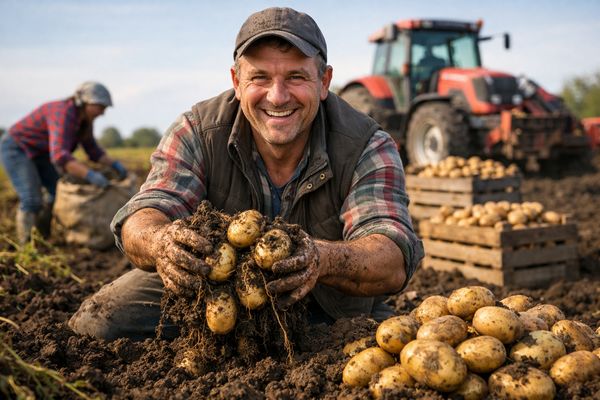
Severe oversupply keeps the Polish potato sector in deep crisis, with many growers facing insolvency despite formally having contracts, while processed segments like potato starch trade at relatively stable but demand-constrained prices.
After last year’s strong harvest and acreage expansion in Poland and across Europe, warehouse stocks remain heavy and market power has shifted further towards processors and retail chains, exposing structural weaknesses in contracts, quality assessment and export logistics.
Exclusive Offers on CMBroker

Potato starch
powder
FCA 0.85 €/kg
(from PL)
📈 Prices & Market Mood
Farm-gate potato prices in Poland are very low, often failing to cover rising production and storage costs. Legal experts highlight that even fully contracted growers are hit, as processors refuse to take volumes beyond minimum contractual tonnages or seek to renegotiate terms. At the same time, industrial potato markets in core EU producers such as Belgium and the Netherlands show free-market prices close to zero for surplus processing potatoes, underlining the severity of the European glut.
In contrast, potato starch prices in Poland show short-term stability. FCA Lodz quotations around EUR 0.85/kg in April 2026 reflect a modest firming versus early spring but remain constrained by weak EU industrial demand and abundant raw potato availability. This divergence – depressed raw potato prices but relatively steady starch values – illustrates how value-added segments can partly cushion the shock, though not enough to absorb the massive surplus of table and processing potatoes.
| Product | Location / Term | Latest price (EUR) | Trend vs early April |
|---|---|---|---|
| Potato starch | Lodz, FCA | 0.85 / kg | Firm, +~4% m/m |
| Fresh potatoes (wholesale range) | Major PL markets | ~0.12–0.28 / kg | Stable at low level |
🌍 Supply & Demand Balance
The current crisis is fundamentally driven by oversupply. Polish growers expanded potato acreage last season, reacting to weak margins in cereals and sugar beet and hoping potatoes would offer better income. Similar decisions were taken in key EU producers such as Germany, the Netherlands and Belgium, resulting in a synchronized jump in planted area and, thanks to good yields, record-high stocks across the continent. This has overwhelmed buyers, with collection centers, distilleries and biogas plants effectively saturated.
Globally, Europe is also facing stronger competition from Asia. Rapid expansion of potato area and processing capacity in China and India has turned Europe from a traditional net exporter into a growing importer of processed products such as starch, flakes, fries and snacks. This undercuts EU processors on cost and further limits the outlet for European raw material. As a result, even structurally strong processors are in no hurry to take additional volumes, while some EU markets report farmers disposing of potatoes at symbolic or zero prices simply to clear storage.
📊 Structural & Contractual Issues
The oversupply shock has revealed deep structural weaknesses in grower–buyer relations. In many Polish regions only a few large processors or traders dominate, and transport costs reinforce their bargaining power by effectively limiting farmers to one or two buyers. Contract farming, which should in theory stabilise income and volumes, is not delivering this protection. Contracted yields are often set conservatively, allowing buyers wide discretion on whether to accept surplus tonnage above the contracted baseline.
In previous tight years, processors frequently took all delivered volumes, including above-contract yields, even when quality was below stated specifications. In the current glut they are instead refusing part of the crop, delaying collection or invoking alleged quality defects. The methodology for quality assessment is usually defined unilaterally in contracts and implemented by the buyer’s own staff, without easy recourse to accredited independent laboratories. This leaves farmers with limited tools to contest downgrades or rejections and shifts most commercial risk onto the producer.
🌦 Weather & Short-Term Crop Risk (Poland)
Weather in key Polish potato regions such as the Lodz voivodeship is seasonally cool but generally favourable for fieldwork. Forecasts for the coming days indicate daytime temperatures mostly between 8–14°C with cool nights and limited precipitation, conditions that support ongoing planting without major delays.
Given the enormous stocks still in storage and the already large area planted last season, near-term price dynamics will be driven far more by demand, policy and storage decisions than by immediate weather risks. Nevertheless, if current planting proceeds unhindered and a normal to good yield is achieved again, the risk of prolonged oversupply into the 2026/27 season will increase sharply unless production is deliberately curtailed.
🏛 Policy, Logistics & Grower Strategies
Growers and legal advisors increasingly call for urgent state intervention to avert a wave of insolvencies. Proposed measures include crisis-reserve financed per-hectare aid for potato plantings, targeted fertilizer and input subsidies, and above all some form of intervention purchase or compensation for unmarketable stocks. There is also a strong argument for simplifying export procedures, as Poland faces additional phytosanitary and administrative restrictions that hamper efforts to ship surpluses to third countries.
Beyond emergency support, the sector requires deeper structural reforms. Farmers are encouraged to form stronger producer groups and cooperatives to negotiate more balanced contracts, standardise and externalise quality testing, and design automatic risk-sharing mechanisms for extreme oversupply. Without such collective bargaining power, individual farms remain price takers exposed to both volatile markets and unilateral contract interpretations by processors and retail chains.
📆 Trading & Risk Management Outlook
- Growers: Prioritise cash-flow and storage-cost control. Consider early, even low-priced disposals of lower-quality lots to avoid further deterioration and quality disputes later in the season. Carefully reassess 2026/27 planting intentions, especially for purely speculative industrial volumes.
- Processors & starch buyers: Current starch prices around EUR 0.85/kg look well-supported by cheap raw potatoes and contained energy costs. Locking in medium-term contracts may be attractive, while retaining some flexibility in case of further demand weakness in industrial applications.
- Traders & exporters: Monitor policy moves in Poland and neighbouring EU states on crisis support and potential intervention purchase schemes. Explore cross-border arbitrage where domestic oversupply coexists with regional quality shortages, but factor in tightened logistics and phytosanitary constraints.
📉 3‑Day Price Indication (EUR, Directional)
- Poland – farm-gate table/processing potatoes: Very low levels broadly equivalent to ~0.10–0.25 EUR/kg depending on region and quality; sideways to slightly softer over the next 3 days given persistent stock pressure and limited outlet growth.
- Poland – potato starch, FCA Lodz: Around 0.85 EUR/kg; expected to remain stable in the next 3 days, with adequate raw supply and steady but cautious buyer interest.
Related posts:
 Taiwan’s New Potato Import Rules Support Trade While Oversupply Caps Prices
 Polish Potato Starch Prices Hold Firm as Spring Season Begins
 Polish Potato Market under Heavy Pressure from Surplus Stocks
 EU Potato Market: Cost Shock Triggers Cautious Planting and Tightening Risks
 Potato Oversupply Crushes Prices in Poland and Across the EU
 Polish Potato Starch Prices Firm Up on Tight Supply and Strong Processing Demand
 Softening Onion Complex: Poland Fried Onions Edge Lower as India and Egypt Weigh on Prices
 Pakistan’s Potato Exports to Russia Reopen: What It Means for Prices