
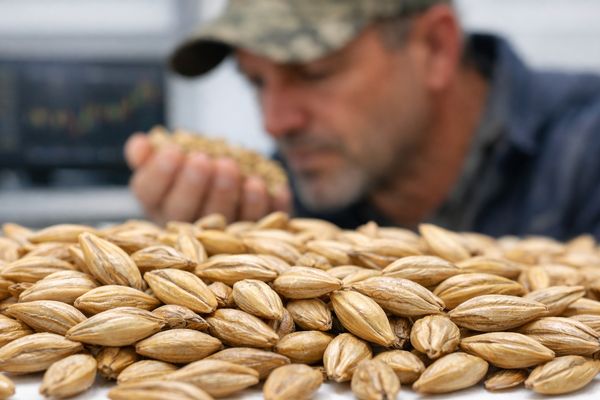
Barley prices are broadly steady, with nearby futures on the Sydney exchange flat and Ukrainian physical offers holding in a tight range, signaling a balanced but firm feed grain market. Mild support is coming from higher corn and wheat benchmarks, while weather in key origins is being watched more closely than demand.
Barley is trading sideways rather than trending, but the structure of the curve and regional basis levels matter. Australian SFE feed barley futures show little day‑to‑day movement, suggesting that the market has largely priced in current supply and demand expectations. At the same time, export and inland prices in Ukraine remain competitive in euro terms, keeping Black Sea barley well positioned into price‑sensitive destinations. With EU dryness risk creeping onto traders’ radar and feed users still well covered in the near term, the market leans cautiously supportive but lacks a strong catalyst either way.
Exclusive Offers on CMBroker

Barley seeds
Cattle feed
FOB 0.19 €/kg
(from UA)

Barley seeds
feed grade, moisture: 14 % max
98%
FCA 0.23 €/kg
(from UA)

Barley seeds
feed grade, moisture: 14 % max
98%
FCA 0.24 €/kg
(from UA)
📈 Prices & Futures Structure
The latest Sydney Futures Exchange (SFE) feed barley strip is almost unchanged across nearby and deferred contracts, highlighting a very flat forward curve:
- May 2026: 319.50 AUD/t (unchanged on 21 April 2026)
- Jul–Nov 2026: 327.00 AUD/t, all unchanged with no traded volume reported
- Jan 2027: 335.00 AUD/t (+0.50 AUD/t, +0.15%)
- Mar 2027: 345.00 AUD/t (+0.50 AUD/t, +0.14%)
- Further out, Jan 2028 and Jan 2029 hold around 361.00 AUD/t with only marginal upticks
This slight contango, with deferred contracts only modestly above nearby months, points to an absence of acute short‑term supply stress. The market is effectively paying just a small premium for storage and risk over the next two to three years, consistent with comfortable but not burdensome inventory expectations.
Converting indicative Australian futures levels to euro terms (using approximate current FX) keeps SFE barley broadly aligned with Black Sea export ideas reported for first‑crop 2026, reinforcing the impression of a globally coherent feed barley price structure.
📊 Physical Market & Basis: Ukraine Staying Competitive
Current Ukrainian barley seed and feed offers confirm a stable local and export market in early April:
| Product | Origin / Term | Latest Price (EUR/kg) | Trend vs. Previous | Last Update |
|---|---|---|---|---|
| Barley seeds, cattle feed | UA, Odesa, FOB | 0.19 | Stable (0.19 → 0.19) | 17 Apr 2026 |
| Barley seeds, feed grade 98% | UA, Odesa, FCA | 0.24 | Flat to slightly softer (0.25 → 0.24) | 17 Apr 2026 |
| Barley seeds, feed grade 98% | UA, Kyiv, FCA | 0.23 | Stable | 17 Apr 2026 |
In euro per tonne, these levels correspond roughly to 190–240 EUR/t depending on quality, origin and delivery term, squarely in line with previously reported Ukrainian FOB indications around 180–190 EUR/t and confirming that Ukraine remains one of the most competitive feed barley origins into MENA and Asian demand hubs.
Importantly, these offers have been remarkably stable over the past three weeks, with only a marginal easing at Odesa FCA and a small uptick on FOB cattle‑feed barley earlier in April. That pattern is consistent with external commentary that Ukrainian barley prices are broadly steady, taking their cue from feed wheat and corn rather than showing an independent rally or sell‑off.
🌍 Supply, Demand & Weather Signals
On the supply side, the flat SFE curve and stable Black Sea offers suggest that the market currently assumes normal 2026 harvest outcomes in both Australia and the northern hemisphere. However, regional signals bear watching:
- Australia: Local market reports indicate that feed barley strengthened through March and early April as domestic users sought coverage amid drier concerns in parts of the east, even as global futures stayed relatively calm.
- EU: Recent commentary highlights a lack of rainfall in several EU grain regions over the past month, with upcoming forecasts likely to be traded closely by participants as crops move through key development stages.
- Ukraine: Weather has generally allowed good spring fieldwork, and no acute new weather shock has emerged in the last days, keeping production expectations broadly unchanged for now.
Demand remains anchored in the feed sector. In Ukraine and the Black Sea, barley continues to compete against corn and feed wheat, with recent firming in corn port bids adding a mild layer of support to the broader feed complex. In export markets such as China and MENA, barley is increasingly evaluated against alternative feed grains and oilseed meals, which limits the scope for an isolated barley rally without a wider feed grain push.
📌 Key Market Drivers Right Now
- Flat futures, modest contango: The SFE strip from May 2026 through early 2029 shows only incremental price gains, pointing to a market that is comfortable with forward supply and storage rather than fearing shortages.
- Black Sea competitiveness: Ukrainian barley offers around 0.19–0.24 EUR/kg at key hubs in Odesa and Kyiv indicate that Ukraine can still place barley into price‑sensitive destinations, capping upside on other origins.
- Feed grain spillovers: Corn and wheat developments, especially at Black Sea ports, remain the main directional driver for barley, with any sustained rally in corn likely to pull barley higher via substitution.
- Weather risk premium: Emerging dryness signals in parts of the EU and ongoing seasonal uncertainty in Australia could inject risk premium quickly if yield prospects deteriorate from current assumptions.
📆 Outlook & Trading Recommendations
The overall outlook for the next few weeks is for a broadly sideways barley market with a slight upward bias if feed wheat and corn continue to firm or if weather in major producers turns more clearly adverse. Conversely, any softening in corn or an improvement in EU moisture profiles would likely cap barley gains and could pressure Black Sea offers.
🎯 Trading & Procurement Pointers
- Feed buyers (EU & MENA): Consider securing a portion of Q3–Q4 2026 coverage at current Ukrainian and Black Sea equivalent levels, which look historically competitive in EUR terms while futures curves remain flat.
- Producers in Ukraine: With local offers steady and external demand cautious but present, gradual, scale‑up sales on modest price upticks may be preferable to aggressive forward selling, especially ahead of clearer harvest weather signals.
- Australian growers: The slight contango and domestic strength argue for flexible hedging: maintain some futures cover but keep scope to benefit if weather issues boost local basis later in the season.
📍 3‑Day Price Indication (Directional, in EUR)
- Black Sea (FOB Odesa, feed barley): Around 185–195 EUR/t equivalent; bias: steady to mildly firmer if corn stays supported.
- Ukraine inland (FCA Kyiv/Odesa feed grade): Roughly 230–240 EUR/t; bias: stable, with limited near‑term downside given tight farm selling and balanced demand.
- SFE Australia (nearby equivalent in EUR/t): Roughly aligned with 190–200 EUR/t; bias: stable, but highly sensitive to updated domestic weather forecasts.
Related posts:
 Barley Market Edges Higher on SFE Gains While Black Sea Prices Stay Flat
 Rice market steadies as CBOT futures firm and Asian export prices ease
 Rice market softens as CBOT retreats and Asian FOB offers edge lower
 Oat futures stabilize after recent sell-off while physical prices stay flat
 Ukraine’s Barley Market Steadies Under New Export Floor Prices
 Barley market steady on SFE while Black Sea feed barley edges softer
 Barley market: flat SFE curve, firm Black Sea, cautious EU buyers
 Barley Market Softens Slightly While Forward Curve Stays Firm