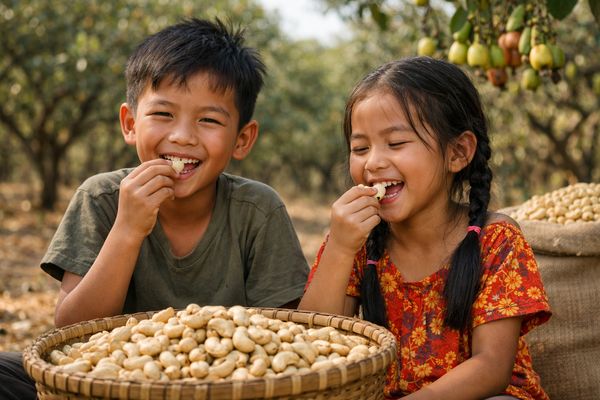
Cambodian Kampong Thom cashew nuts gaining Geographical Indication (GI) status come at a moment of broadly stable but uncertain global cashew prices, creating a new, clearly defined premium niche rather than a broad price shock.
The GI move strengthens Cambodia’s shift from bulk raw nut exports to branded, value-added cashews with higher price potential and tighter quality control, particularly into the EU, US, Japan and South Korea. At the same time, benchmark kernel prices from India, Vietnam and Europe show only marginal week‑on‑week changes, suggesting buyers have room to selectively pay up for origin-labelled lots while keeping average procurement costs under control. Over 25,000 Cambodian growers stand to benefit from better differentiation and export access as GI enforcement, traceability and new processing investments ramp up.
Exclusive Offers on CMBroker

Cashew kernels
W450
FOB 6.17 €/kg
(from IN)

Cashew kernels
W320
FOB 8.55 €/kg
(from IN)

Cashew kernels
W320
FOB 6.87 €/kg
(from IN)
📈 Prices & Premium Structure
Cashew kernel prices are currently stable to slightly firmer across key grades, with only a few euro‑cent moves over recent weeks. This underpins a relatively calm background against which Cambodia’s new GI cashews can position as a premium.
| Origin / Location | Grade | Terms | Latest Price (EUR/kg) |
|---|---|---|---|
| India, New Delhi | W320, conventional | FOB | ≈ 6.87 |
| India, New Delhi | W320, organic | FOB | ≈ 8.55 |
| Vietnam, Hanoi | WW320, conventional | FOB | ≈ 6.80 |
| Netherlands, Dordrecht | WW320, conventional | FCA | ≈ 4.90 |
Across the last three weeks, Indian and Vietnamese kernel offers have moved by roughly ±0.05–0.10 EUR/kg at most, while European ex‑warehouse prices remain flat. This indicates that fundamental supply–demand balances are not under acute stress, allowing room for origin‑based premiums like the new Kampong Thom GI cashew to emerge without immediately repricing the whole complex.
🌍 Supply, Demand & Cambodia’s GI Pivot
Cambodia’s decision to grant GI status to Kampong Thom cashew nuts is a structural, not cyclical, shift. The GI protects the name, ties the product to a specific terroir and traditional methods, and mandates strict specifications, traceability and inspection. This is expected to raise consumer confidence and support higher value realisation for more than 25,000 growers in the province.
Recent sector commentary highlights that the global cashew market is currently described as stable but with underlying uncertainty, partly due to a weaker, delayed 2026 harvest in West Africa, the leading raw cashew nut region. Estimated output there could fall by high single to low double digits versus last year, which may tighten raw nut availability later in the season and lend a mild, supportive tone to kernel prices if demand holds up.
On the demand side, Vietnam’s export rebound in March 2026 – with customs data pointing to a sharp month‑on‑month increase in shipped volume and value – signals that major consuming regions, especially the US and China, remain active buyers after a slow start to the year. This reinforces the case for differentiated, high‑quality supply, as buyers seek both price efficiency on standard grades and storytelling for premium retail and foodservice segments.
📊 Fundamentals & GI-Driven Value Addition
The GI framework is central to Cambodia’s broader strategy to move beyond commodity exports into branded, high‑value agricultural goods. Kampong Thom cashews and Oddar Meanchey mango now join an existing portfolio of 12 GI‑registered products, such as Kampot pepper and Mondulkiri wild honey, all of which leverage origin, quality and uniqueness to command higher prices in export markets.
GI‑certified cashews must comply with detailed production rules, including quality parameters for kernel size and flavour, traceability systems from farm to pack, and third‑party inspections. This is expected to reduce counterfeiting and misuse of the Kampong Thom name, helping to secure long‑term brand equity. For international buyers—especially in the EU, where GI recognition has strong commercial value—this offers more predictable quality and a clear sustainability and rural‑development narrative.
Parallel policy efforts target a rapid increase in domestic processing. Cambodia aims to lift processing capacity to at least 25% of its crop by 2027 and 50% by 2032, up from the single‑digit shares recently processed locally. New investment announcements, including a proposed cashew processing plant in Kampong Thom, are aligned with this ambition and should gradually shift the country from raw nut exports toward finished kernels and branded retail products, allowing it to capture more of the value chain.
⛅ Weather & Crop Outlook (Key Regions)
Weather risks are currently concentrated in West Africa, where a delayed and weaker 2026 harvest has already been flagged by industry bodies as a key driver of uncertainty. While short‑term rainfall outlooks differ among countries, any additional moisture stress or logistical delays could further constrain raw nut flows to Asian processors later in the year, adding a mild bullish undertone to kernel prices.
In Cambodia, recent reports focus less on immediate weather stress and more on structural value‑chain upgrades. No acute weather‑driven supply threat has been highlighted in the latest public updates; instead, the emphasis is on investment, processing capacity and market access, suggesting a relatively normal production backdrop for Kampong Thom cashews in 2026.
📆 Trading Outlook & Strategy
- Buyers (roasters, packers, retailers): Use the current stable price environment to secure forward coverage on standard grades (W320/WW320, W240) while selectively allocating a small share of the portfolio to GI‑labelled Kampong Thom cashews as a premium line, especially for EU and high‑end Asian channels.
- Importers & traders: Monitor West African crop realisations and Vietnamese import and export flows closely; a further downward revision in raw nut supply could justify moderate price increases, but the present stability argues for staggered procurement rather than aggressive front‑loading.
- Cambodian stakeholders: Prioritise rapid implementation of traceability, inspection and branding for Kampong Thom GI cashews so that the premium positioning can translate into concrete contract price differentials in upcoming negotiation rounds.
📉 Short-Term Price Direction (Next 3 Days)
- India (FOB New Delhi, kernel grades): Sideways to mildly firm; tightness in higher grades possible but broad market still well supplied.
- Vietnam (FOB Haiphong/Hanoi, kernel grades): Stable with a slight upward bias as strong March exports support processor pricing discipline.
- EU (FCA Netherlands, imported kernels): Largely flat; any immediate moves are likely to reflect FX and freight adjustments more than fundamental shifts, with Kampong Thom GI cashew offers expected to test modest premiums as they enter the market.