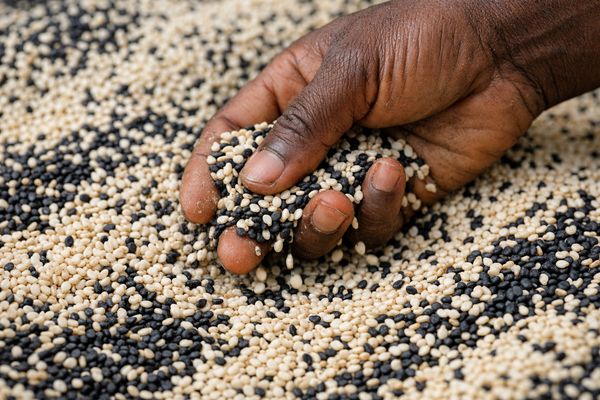
Chadian hulled sesame prices in Europe are edging slightly lower but remain broadly stable, with soft international demand and ample global supply preventing any meaningful rally in the very short term.
Global sesame markets are trading sideways as Indian exporters continue to liquidate old-crop stocks and South African offers stay aggressive, while Chinese port inventories remain comfortable. For Chadian-origin sesame, the key short‑term drivers are lacklustre demand from Europe and the Middle East, pressure from discounted Indian grades and generally benign seasonal weather expectations in the central Sahel. Freight and energy markets remain a background risk as crude oil has firmed again on renewed geopolitical concerns, but this has not yet translated into a clear up‑move in sesame export values.
Exclusive Offers on CMBroker

Sesame seeds
hulled
99,95%
FCA 1.65 €/kg
(from DE)

Sesame seeds
hulled, EU-Grade
99.97%
FOB 1.47 €/kg
(from IN)

Sesame seeds
hulled, EU-Grade
99.98%
FOB 1.49 €/kg
(from IN)
📈 Prices & Spreads
Chadian hulled sesame (FCA EU) is trading around EUR 1.65/kg, fractionally below last week and broadly flat over the past month in euro terms. Indian hulled export grades (FOB) are priced lower, roughly in the EUR 1.30–1.50/kg band for white hulled qualities, creating a persistent discount of about EUR 0.15–0.30/kg versus Chadian origin once freight is included. Egyptian natural sesame offers remain comparatively firm near EUR 1.50–2.00/kg FOB, keeping Chadian product competitively positioned in the hulled white segment into Europe.
| Origin / Type | Location & Term | Current price (EUR/kg) | 1-week move (approx.) |
|---|---|---|---|
| Chad hulled white 99.95% | EU hub, FCA | ≈1.65 | ↘ marginal (about -0.6%) |
| India hulled white, EU-grade | New Delhi, FOB | ≈1.30–1.50 | ↔ to slightly softer |
| India natural white | New Delhi, FOB | ≈1.15–1.30 | ↔ under pressure |
| Egypt natural / golden | Cairo, FOB | ≈1.50–2.00 | ↔ stable |
🌍 Supply, Demand & Trade Flows
Globally, sesame fundamentals are comfortable. Indian sowing in key states such as Gujarat is running above last year’s levels, while exporters have been liquidating old-crop stocks to free up capital, keeping export prices capped. At the same time, South African origin is competing aggressively in white and mixed-color grades, especially into Asian markets, which further limits upside for other exporters.
Demand remains largely hand‑to‑mouth, with European and Middle Eastern buyers avoiding forward coverage amid ample nearby availability and comfortable Chinese port inventories reported at over 280,000 tonnes. For Chadian sesame, which depends heavily on exports, this translates into slower spot interest and more selective buying, particularly for high-purity hulled grades. Competition from discounted Indian natural and hulled sesame into the EU and MENA adds additional pressure on Chadian sellers to maintain narrow premiums.
🌦 Weather & Crop Conditions (Chad Focus)
The latest 2026 seasonal climate outlook for the Sahel indicates near‑normal to slightly above‑normal rainfall for the central Sahel belt, including much of Chad’s sesame‑growing zone. While onset dates and intra‑season dry spells still need close monitoring, the overall forecast suggests broadly favourable moisture conditions for the upcoming main planting window, without clear drought signals at this stage.
Regional early‑season monitoring for the wider East and Central African belt also points to near‑normal conditions, though temperatures are expected to be hotter‑than‑average, which could occasionally stress crops on lighter soils if rainfall is erratic. For now, there is no weather‑driven bullish catalyst for Chadian sesame prices in the next few weeks, but buyers should track updates from regional climate services as planting progresses.
📊 Fundamental Drivers & External Factors
In India, recent market commentary highlights subdued sesame demand and weak prices, with exports in the first months of 2026 running significantly below the previous year and local wholesale sesamum prices trading well under the official minimum support price. This underscores a broadly oversupplied global environment in which incremental demand is easily met by Indian and southern African origin, limiting Chadian bargaining power.
Across the wider oilseed complex, global vegetable oil prospects remain comfortable according to recent multilateral outlooks, reinforcing a generally non‑inflationary backdrop for niche oilseeds like sesame. Energy markets are firmer, with crude oil prices supported by geopolitical risks in the Middle East, which could modestly increase freight and processing costs if sustained, but this has not yet fed through into a broad sesame rally.
📌 Trading Outlook & Strategy
- Buyers (Europe / MENA): Near‑term price risk appears limited on the upside; consider continuing hand‑to‑mouth coverage but be prepared to lock in Q3–Q4 volumes if Indian sowing weather deteriorates or freight spikes.
- Chadian exporters: Maintain price discipline but expect buyers to benchmark aggressively against Indian FOB. Offering small discounts for prompt, high‑purity lots could help preserve market share while avoiding deep concessions.
- Speculative participants: With abundant supply and no clear weather shock, the market favours range‑trading strategies rather than directional longs; watch Indian acreage updates and Sahel rainfall anomalies for any shift in fundamentals.
📆 3‑Day Regional Price Indication (EUR, Directional)
- Chad origin, hulled white 99.95%, FCA EU hub: Around EUR 1.64–1.67/kg; bias: sideways to slightly soft as buyers resist higher offers.
- India hulled white, EU‑grade, FOB New Delhi: Around EUR 1.30–1.50/kg equivalent; bias: sideways with ongoing old‑crop liquidation.
- Egypt natural / golden, FOB Cairo: Around EUR 1.50–2.00/kg; bias: stable, supported by regional demand but capped by cheaper Indian alternatives.