
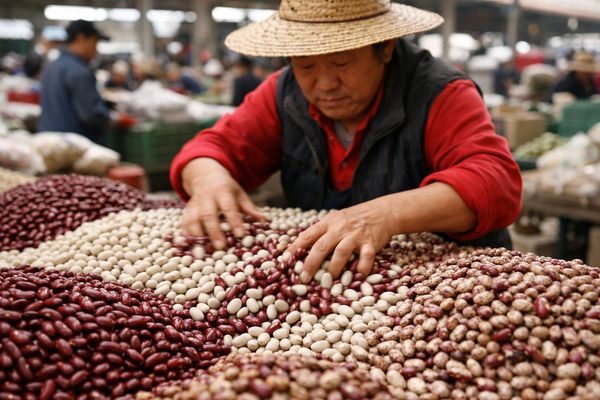
Chinese bean FOB prices are edging slightly lower in late April, with most varieties down EUR 0.01/kg week-on-week, while overall levels remain historically firm. Stable export demand for higher‑grade kidney and adzuki beans is preventing a sharper correction, but softer domestic feed and oilseed markets are limiting upside.
China’s bean market moves into early May with a mildly softer tone but no sign of a sharp break. Export flows to South Asia, the Middle East and parts of Europe remain active, underpinning premiums for large white and organic beans. Domestic demand is seasonally moderate after the spring festivals, and weaker oilseed/soy complex sentiment keeps buyers price‑sensitive. Weather in Northeast China is broadly favourable for early planting after mid‑April storms, suggesting few immediate supply shocks. Overall, the market looks range‑bound, with modest downside risk if export interest pauses.
Exclusive Offers on CMBroker

Mung beans
organic
99.5%
FOB 1.56 €/kg
(from CN)

Mung beans
3.8 mm up
99.5%
FOB 1.47 €/kg
(from CN)

Kidney beans
small, black, organic
99.5%
FOB 1.10 €/kg
(from CN)
📈 Prices & Spreads
FOB Beijing bean prices (converted to EUR/kg, approximate from late‑April USD levels and current EUR/USD near 1.07) show a small week‑on‑week easing:
| Product (CN, FOB Beijing) | Type | Organic | Latest price (EUR/kg) | WoW change (EUR/kg) |
|---|---|---|---|---|
| Mung beans | 3.8 mm up | No | ≈1.37 | -0.01 |
| Mung beans | Organic | Yes | ≈1.45 | -0.01 |
| Kidney beans | Black | No | ≈0.95 | 0.00 |
| Kidney beans | Dark red | No | ≈1.13 | -0.01 |
| Kidney beans | Large white | No | ≈1.86 | -0.01 |
| Adzuki beans | Red | No | ≈1.21 | +0.01 |
| Adzuki beans | Red | Organic | ≈1.29 | +0.01 |
Recent Chinese market commentary confirms a broadly steady to slightly firm tone for adzuki and black beans, with conventional red adzuki beans quoted around EUR 1.31/kg FOB equivalent in late April, supported by higher black bean costs and limited stock pressure. Outside China, Brazilian dark red and brown‑eye kidney beans near EUR 1.32–1.37/kg and UK white beans around EUR 1.26–1.55/kg keep Chinese premium large white and organic beans at a clear quality‑driven premium.
🌍 Supply, Demand & Trade Flows
China’s beans market enters May with stable internal availability. Imports of pulses and beans from South/Southeast Asia and East Africa expanded in early 2026, improving raw material coverage for domestic processors and exporters. At the same time, outbound demand from India, Russia, Yemen and parts of Europe remains robust, particularly for higher‑grade kidney and adzuki beans, absorbing exportable surplus and supporting FOB quotes.
Macro conditions are neutral‑to‑supportive. China’s broader agricultural price index has edged higher in Q1 2026, driven by steady food demand in Asia, including pulses. However, soft soybean futures on Dalian and weaker domestic meal prices highlight a cautious sentiment in the wider oilseed and protein complex. This spillover tempers upside for beans used in feed and processed foods, encouraging buyers to negotiate hard and favour short‑term coverage.
🌦️ Weather & Crop Outlook (China, CN)
Key dry bean and pulse areas in Northeast China (Heilongjiang, Jilin, eastern Inner Mongolia) have moved past the mid‑April extratropical storm event that produced localized tornado damage in parts of Heilongjiang and Jilin. Current short‑term forecasts for Jilin and surrounding provinces point to predominantly sunny to partly cloudy conditions with seasonally mild daytime temperatures at the start of May, suitable for soil drying and ongoing field preparation.
The combination of adequate soil moisture from previous rains and generally favourable early‑May weather reduces immediate production risk for 2026/27 bean plantings. No large‑scale planting delays or flood‑related disruptions are reported in recent national and regional agricultural updates, leaving supply expectations broadly stable for now. Weather remains a background watch‑factor rather than an active bullish driver in the very near term.
📊 Market Drivers & Fundamentals
- Costs & competition: Higher internal black bean costs are lending support to prices of related bean categories, including adzuki and some kidney segments, limiting downside despite soft end‑user demand.
- Global protein complex: International oilseed markets remain range‑bound; weaker soybean futures and cautious fund positioning keep overall protein ingredient sentiment subdued, capping aggressive price rallies in food and feed beans.
- Trade & macro backdrop: China’s external trade data show continued resilience, with imports and exports both growing, sustaining logistics flows and demand from emerging markets that rely on Chinese beans.
📆 Short-Term Outlook & Trading Ideas
- Price trend (3–7 days): Expect a slightly soft to sideways move for most Chinese mung and conventional kidney beans, with a bias toward a further EUR 0.01–0.02/kg easing if export inquiries pause ahead of new‑crop clarity.
- Adzuki & specialty beans: Red adzuki and premium organic kidney beans are likely to remain relatively better supported on tight quality stocks and firm export niches; downside appears limited without a macro demand shock.
- Buyer strategy: Importers can continue staggered buying for near‑term needs, using current mild weakness to secure coverage, but avoid over‑extending forward positions until clearer signals on Northeast China planting progress and any early‑season weather issues.
- Seller strategy: Chinese exporters may maintain offer discipline on higher‑grade lots while being flexible on volume‑based discounts for plain mung and black beans to preserve shipment pace.
📍 3‑Day Regional Price Indication (CN, FOB)
Assuming a stable EUR/USD and no major weather or policy shocks, indicative directional outlook for the next three days (May 1–3, 2026) for FOB China beans is as follows:
| Product (CN FOB) | Current level (EUR/kg) | 3‑day bias |
|---|---|---|
| Mung beans, conventional | ≈1.37 | Slightly lower to sideways (‑0.5% to 0%) |
| Mung beans, organic | ≈1.45 | Sideways |
| Kidney beans, black | ≈0.95 | Sideways |
| Kidney beans, dark red | ≈1.13 | Slightly lower |
| Kidney beans, large white | ≈1.86 | Sideways to slightly lower |
| Adzuki beans, red (conv.) | ≈1.21 | Sideways to slightly higher on firm export demand |
Volatility is expected to stay low in the very near term, with any sharp moves more likely to stem from currency shifts or abrupt changes in export demand rather than domestic fundamentals.
Related posts:
 China Bean Market: Black Bean Costs Supportside as Demand Stays Soft
 Canadian Lentils Edge Lower but Red Premium Holds as Prairie Weather Turns Risky
 Mexican Chickpea FOB Prices Ease Slightly as India Trades Sideways
 Brazil–UK Bean Prices Ease Slightly as Weather Stays Quiet
 Chinese Bean FOB Prices Ease Slightly as Global Pulse Demand Stays Firm
 Pigeon Pea Market Turns Sideways as Indian Prices Slip Below Support