
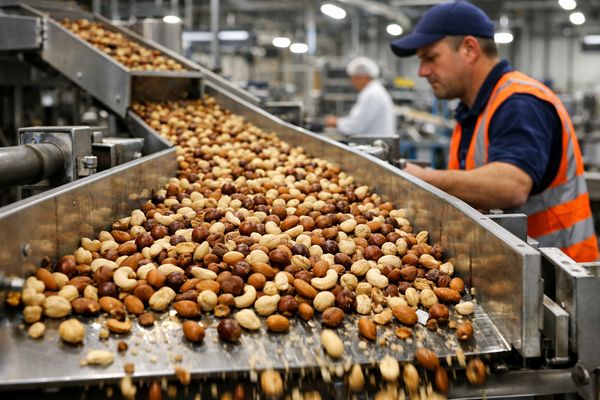
German and wider European fruit sectors are gradually pivoting toward nut production as warmer, drier conditions favour walnuts, almonds and hazelnuts over traditional stone fruit – a structural change that will slowly reshape regional supply but leave Europe import-dependent for the foreseeable future.
Nut cultivation is gaining traction in climatically advantaged zones such as Rheinhessen and the southern Palatinate, where growers are planting tens of thousands of walnut and almond trees as part of long-term diversification strategies. While still a niche in overall fruit production, local nuts are being positioned as differentiated, regional products rather than bulk competition to imports.
Exclusive Offers on CMBroker

Brazil nuts
medium
FCA 6.50 €/kg
(from NL)
📈 Prices
Spot indications for bulk imported nuts in northwest Europe remain largely stable. For example, Brazil nuts in Dordrecht (NL, FCA, conventional, medium) are currently offered around EUR 6.50/kg, unchanged over the past three weeks, signalling a balanced short-term market with no acute supply shocks or demand surges visible in wholesale quotations.
| Product | Location / Term | Latest Price (EUR/kg) | 1-week Change | 3-week Change |
|---|---|---|---|---|
| Brazil nuts, medium | Dordrecht (NL), FCA | 6.50 | 0% | 0% |
🌍 Supply & Demand
Structural supply in Central Europe is slowly re-orienting toward nuts as climate risks for sour cherries, plums and mirabelle increase. Walnuts, almonds, hazelnuts and even pecans benefit from greater resilience to summer droughts, requiring moisture mainly in spring but tolerating drier conditions later in the season. This agronomic edge is driving new orchards in traditionally fruit-oriented regions.
Despite this momentum, domestic German nut output remains marginal compared with overall fruit production. More than 99% of nuts and almonds consumed are still imported, so European demand continues to be largely met by traditional export origins. In practice, the current expansion mostly influences niche, regional market segments and branding opportunities, rather than significantly altering the continental balance sheet in the short term.
📊 Fundamentals & Constraints
Nut trees require specific high-quality sites, often similar to vineyards or apricot orchards. This limits scale-up potential to selected areas, slowing any rapid shift in production capacity. While warmer conditions enlarge the potential cultivation zone, location choices remain critical for almonds in particular, constraining how quickly regional output can grow.
Post-harvest infrastructure is another bottleneck. Cleaning, drying, cracking, sorting and packaging capacity is still underdeveloped in many new production zones, raising costs and creating quality risks if drying is inadequate. In addition, plant protection and pest management remain active research fields, with growers seeking more resilient varieties and improved cultivation practices to safeguard yields and quality.
☀️ Weather & Regional Outlook
Current planting strategies reflect a medium- to long-term bet on continued warming and more frequent summer dryness across Central and Western Europe. Nuts’ relative tolerance to water stress in summer and their ability to capitalise on warmer growing seasons underpin the investment case for new orchards in Germany and the UK, where walnuts in particular are now performing better than under historically cooler conditions.
In the near term, spring moisture remains a key factor for successful establishment of young plantations. Growers will continue to monitor rainfall distribution and irrigation needs carefully, as early-season water deficits can still limit tree development despite improved summer resilience.
📆 Trading Outlook (1–3 months)
- Importers/roasters: With local European nut supply still tiny, maintain primary sourcing from established export origins; use emerging German and UK volumes selectively for regional and premium product lines rather than core volume coverage.
- Food manufacturers/retailers: Consider positioning locally produced nuts as climate-adapted, sustainable alternatives with regional branding, but plan pricing and volumes on the assumption that imports will remain dominant for several seasons.
- Growers/investors: Focus on top-quality sites and secure access to drying and processing capacity before expanding acreage; infrastructure and plant protection solutions will be decisive for long-term profitability.
📉 Short-Term Price Direction (3-day view)
- Northwest Europe (e.g., NL hubs): Brazil nut prices around EUR 6.50/kg are expected to remain flat over the next three days, with no major demand or supply shocks indicated.
- Continental Europe (Germany/Benelux retail & industry): Stable to slightly firm undertone in nuts overall, driven more by logistics and currency than by any immediate change in local European production.
- Local German niche nuts (walnuts/almonds): Limited spot liquidity; price discovery remains highly regional and largely unchanged in the very short term.
Related posts:
 US–India Trade Talks Set to Reshape Global Nuts Flows
 Walnuts in Europe: Climate-Driven Supply Shift, Stable Prices for Now
 Cashew market caught between strong supply and fragile demand
 Brazil Nuts Flat in Dordrecht Despite Stronger Origins
 War-Driven Supply Shock Pushes Pistachios to Eight-Year Highs
 Peanut Butter Drives a Structural Shift in the Global Peanut Market
 Almonds: Export-Driven Rebound Meets Cautious Price Optimism
 Australian Almonds: Strong Season, Weather Risks and Quality-Driven Pricing