
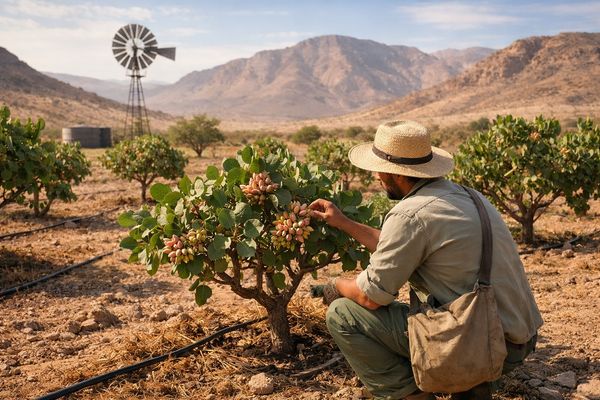
Pistachio prices remain elevated on tight global supply and Iran-related disruptions, creating an attractive window for South Africa’s ambitious expansion push in the Northern Cape.
South Africa is rapidly positioning the Karoo and Northern Cape as a new pistachio hub, using favourable climate, irrigation from the Orange River and long-term financing to build orchards that could reach 60,000 tonnes a year within a decade. This comes as concentrated global production in the U.S., Iran and Turkey faces geopolitical risk and supply shocks, supporting high price levels and strong importer interest in diversifying origin. The capital intensity, long lead time to breakeven and strict water management remain key execution risks, but if managed well, South Africa could capture 5–8% of global trade and emerge as a structurally important alternative supplier.
Exclusive Offers on CMBroker

Pistachio inshell
Ahmadaghaei, 24-26
FOB 9.50 €/kg
(from IR)

Pistachio inshell
Ahmadaghaei, 28-30
FOB 9.26 €/kg
(from IR)

Pistachio inshell
Ahmadaghaei, closed mouth, 24-26
FOB 7.01 €/kg
(from IR)
📈 Prices & Market Context
Global pistachio prices are currently strong, with benchmark levels around EUR 33–35/kg for high-quality product (approx. USD 36/kg), reflecting recent supply disruptions in major producing regions and robust demand growth in snacks and food processing. South African investors are responding to this price environment with accelerated orchard developments, betting that structurally tight supply and diversification away from Iran will keep prices attractive through the next decade.
While detailed spot quotes vary by origin and grade, the overarching picture is of a firm, supply-driven market rather than a demand shock. Importers are showing willingness to trial new origins to manage geopolitical and logistical risk, which underpins the business case for South African pistachios despite their higher early-stage cost base.
🌍 Supply & Demand Dynamics
Global pistachio supply remains heavily concentrated: the United States, Iran and Turkey together account for more than 85% of production. Disruptions in Iran, including sanctions-related logistics and more recent geopolitical tensions, have constrained flows and contributed to higher international prices, opening a strategic gap for new entrants. Against this backdrop, South Africa’s current output of about 20 tonnes is negligible but symbolically important as a proof of concept.
On the demand side, consumption continues to grow, driven by health-conscious snacking, premium confectionery and wider use in industrial food applications. Buyers in Europe, the Middle East and Asia are increasingly focused on supply chain resilience rather than purely lowest-cost origin. This encourages trial contracts with emerging suppliers, especially where quality and reliability standards can be met, which is central to South Africa’s export strategy.
📊 South Africa’s Expansion Strategy & Fundamentals
The core of South Africa’s plan lies in large-scale orchards in the Karoo and broader Northern Cape, where hot summers, adequate winter chill, low rainfall and access to irrigation from the Orange River offer a strong agro-climatic fit. Current production is minimal, but stakeholders are targeting up to 60,000 tonnes annually within roughly ten years, equivalent to 5–8% of the global market if current world volumes persist. This would shift South Africa from experimental to systemically relevant origin status.
Expansion is capital intensive. Industry estimates indicate that developing 2,000 hectares of pistachio orchards requires around EUR 49–52 million (approx. USD 53 million), covering tree stock, irrigation infrastructure and operating costs during the non-bearing years. Structured, long-tenor financing aligned with pistachio’s economics—breakeven around year eight and productive lifespans over 50 years—is being put in place so growers are not forced into early cash-flow pressure, a critical enabler of scale.
The crop’s long life and high value also offer broader economic benefits. Every 1,000 hectares could support roughly 800 direct and indirect jobs across farming, processing and logistics. This dovetails with South Africa’s goal of diversifying away from lower-margin, climate‑exposed crops like corn and wheat towards export-oriented, higher-value horticulture. Outgrower models are part of the plan, aiming to broaden farmer participation and spread skills and income opportunities along the value chain.
🌦️ Weather & Water Management Outlook
Recent weather patterns in the Northern Cape have oscillated between dry, fire-prone conditions and episodes of thunderstorms and localised flooding, underscoring the region’s climatic volatility. National and regional outlooks for late April point to continued periods of dryness interspersed with showers and storms over parts of the province, highlighting the need for resilient orchards and robust infrastructure.
For pistachios, the key medium-term factor is not short-lived rainfall events but secure, well-managed irrigation. The crop is resilient to arid conditions but highly dependent on controlled water supply, making efficient irrigation systems, on-farm storage and careful allocation essential. Given early drought advisories and ongoing caution around water resources in the broader Cape regions, growers will need to prioritise water efficiency technologies and risk planning to ensure the long-term sustainability of orchards.
🧭 Strategic & Trading Outlook
South Africa’s pistachio build‑out is taking place against a backdrop of tight global fundamentals. U.S. kernel shipments have been running ahead of last season and inventories are trending lower, while Iran faces export headwinds linked to sanctions and regional tensions, both supportive of firm price levels into the medium term. At the same time, higher energy and freight costs tied to Middle East risks keep logistics from key origins elevated, further boosting the appeal of diversified sourcing.
- For growers and investors in South Africa: The current high-price, supply-constrained environment validates ongoing orchard expansion, but project viability hinges on disciplined water management, cost control and access to long-dated finance. Early movers with strong technical support and export partnerships are best placed.
- For international buyers: Consider pilot volumes and forward contracts with emerging South African producers to diversify origin risk, especially for premium and branded lines where origin differentiation can be marketed.
- For traders: Maintain a moderately bullish bias on pistachios in EUR terms while monitoring developments in Iran–U.S. negotiations, weather in California and Turkey, and South Africa’s planting pace. Price setbacks driven by temporary macro or currency moves may offer entry opportunities for end‑user hedging.
📆 3‑Day Price Indication (EUR)
Given persistently tight global fundamentals and ongoing geopolitical risk around Iranian exports, pistachio prices in Europe are expected to remain firm over the next three trading days. No meaningful relief in export availability from major origins is anticipated in this very short window.
| Market | Product | 3‑Day Outlook (EUR/kg) | Direction |
|---|---|---|---|
| EU import (CIF, mixed origins) | In‑shell, standard grades | ≈ 33–36 | Sideways to slightly firm |
| EU import (CIF, premium) | In‑shell & kernels, high grades | ≈ 36–40 | Firm |
Short term, the key watchpoints are any escalation in Middle East tensions affecting Iranian shipments, U.S. export pace and freight volatility. For South African stakeholders, these conditions reinforce the attractiveness of long-term pistachio investment but should not distract from the fundamental need to secure water, agronomic expertise and market access.
Related posts:
 Pistachio Kernels Tighten as Shipments Outpace Supply
 Salmonella Recall in Canada Meets Tight Global Pistachio Supply
 Iranian Pistachio Gap Keeps Europe Tight Despite Diplomatic Hopes
 Bright Green Gap: How Iranian Pistachio Disruptions Are Reshaping Europe’s Market
 Spain Opens Door to China: What the New Pistachio Protocol Means for Prices