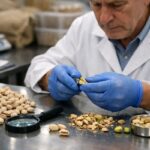
Pistachio kernels are moving at a record pace in 2025/26 while marketable finished inventory has dropped to its lowest March level in recent years, tightening spot supply even in an on-year crop. The result is a market where logistics and contracting, rather than raw crop size, are the key price drivers for the months ahead.
Finished kernel stocks have been drawn down quickly as strong demand and higher shipment velocity absorb supply faster than in recent seasons. At the same time, raw material inventories (closed-shell and shelling stock) remain ample, giving processors flexibility but not necessarily translating into immediate spot kernel availability. Buyers without forward cover face a more challenging environment, with supply allocation increasingly managed through contracts and processing priorities. Weather in key origins is seasonally benign, so near-term market focus stays on inventory structure, contract execution, and timing of additional shelling rather than on crop risk.
Exclusive Offers on CMBroker

Pistachio inshell
Ahmadaghaei, 24-26
FOB 9.50 €/kg
(from IR)

Pistachio inshell
Ahmadaghaei, 28-30
FOB 9.26 €/kg
(from IR)

Pistachio inshell
Ahmadaghaei, closed mouth, 24-26
FOB 7.01 €/kg
(from IR)
📈 Prices & Market Tone
Indicative FOB prices for Iranian in-shell pistachios (Ahmadaghaei) are broadly steady, with offers around EUR 8.8–9.1 per kg for 24–26 and 28–30 counts, and roughly EUR 6.5 per kg for closed-mouth 24–26 material (converted from recent USD levels). These levels are consistent with a market that is firm on kernels but still relatively well supplied in raw in-shell stock.
The tightening in marketable finished kernels, combined with strong shipment data, is exerting upward pressure on kernel replacement values and limiting discounts for prompt nearby positions. In contrast, the availability of closed-shell inventory and shelling stock helps cap outright price spikes, particularly for more flexible, deferred delivery windows.
🌍 Supply & Demand Dynamics
Through March 2026, kernel shipments reached 75.3 million pounds gross weight, equivalent to 167.3 million pounds on an in-shell basis. This is 20.1% above March 2024 and 11.1% above March 2025, with current season shipments already surpassing prior full-season benchmarks at the same point in the marketing year. Kernels account for 19.7% of total shipments on an in-shell-equivalent basis versus 21.5% in 2025 and 15.5% in 2024, highlighting gradual shifts in product form preferences and processing strategies.
The ongoing on-year crop cycle in 2025/26 supports higher overall pistachio output, yet demand growth has more than matched this larger supply. The combination of strong kernel off-take and evolving product mix means that even in a season of good raw availability, deliverable kernel stocks for prompt shipment are tightening. Buyers have been active in securing forward contracts, which are increasingly absorbing the incremental volumes generated by the larger crop.
📊 Inventory & Processing Flexibility
Adjusted kernel inventory in March 2026 stood at 116.6 million pounds gross kernel weight (259.2 million pounds in-shell), down 6.2% year on year and 8.6% versus 2024. Kernels now represent 16.1% of total adjusted inventory on an in-shell-equivalent basis, compared with 21.3% in 2025 and 18.8% in 2024. This structural decline underlines how a growing share of available kernels is tied up in forward commitments rather than accessible on the open spot market.
Marketable finished kernel inventory is particularly tight at 41.3 million pounds at the end of March, 26.9% below 2025 and 36.4% below 2024. Industry indications suggest that a sizeable portion of this reported inventory is already committed, meaning effective free stocks are even lower. At the same time, raw material inventories have increased: marketable closed-shell inventory is 87.0 million pounds (39.1 million pounds kernel-equivalent), with shelling stock at 47.0 million pounds (21.2 million pounds kernel-equivalent). Together, potential kernel supply capacity totals 101.6 million pounds, up 12.6% from March 2025, providing substantial processing flexibility but not an immediate solution to near-term kernel tightness.
🌦️ Weather Outlook & Crop Context
Key producing regions such as Kerman Province in Iran and California’s Central Valley are currently experiencing seasonally mild to warm conditions with a mix of sunshine and some cloud cover, but no acute weather stress in the coming week. Temperature ranges around 26–30°C in Kerman and low-to-mid 20s°C in Fresno support normal orchard development without major short-term yield threats.
With the 2025/26 season classified as an on-year in the alternate bearing cycle, baseline expectations point to continued volume availability into 2026/27. Absent significant weather shocks, supply-side risks in the short term appear limited. Instead, the key uncertainty lies in the pace of shipments through the summer and the share of raw material that will be converted into kernels versus sold in in-shell form.
📆 Market Outlook & Trading Recommendations
Over the next 30–90 days, kernel shipment volumes are likely to keep climbing toward seasonal peaks, while marketable finished inventory remains constrained at historically low levels for this stage of the year. Processors will juggle contract execution and spot demand when deciding how aggressively to convert closed-shell and shelling stock into kernels, making week-to-week availability volatile. Sudden demand spikes, especially from major importing regions, could translate quickly into firmer nearby prices given the narrow inventory buffer.
On a 6–12 month horizon, the on-year crop should maintain overall supply, but if shipment velocity stays above prior-year trends, total season shipments could exceed the 123.0 million pound benchmark reached in 2024/25. The declining share of marketable kernels within total inventory suggests a structurally tighter spot market over time, with an increasing share of the crop pre-allocated via forward contracts. This favours disciplined procurement strategies over opportunistic spot buying.
🧭 Focused Trading Guidance
- Kernel buyers (roasters, packers): Increase forward coverage for Q3–Q4 2026, especially for specific sizes and grades, as current finished kernel inventory is unusually low and heavily committed.
- In-shell buyers: Consider taking advantage of relatively more comfortable closed-shell availability for flexible, later delivery periods, but avoid overreliance on last-minute kernel conversion for urgent needs.
- Producers & processors: Prioritize margin management by aligning shelling schedules with higher-value kernel contracts and maintaining optionality on in-shell sales where demand is robust.
- Traders: Expect firmer nearby kernel differentials versus in-shell, with opportunities in time spreads between prompt and deferred positions as processing schedules adjust.
📍 3‑Day Directional Outlook (EUR basis)
| Market | Product | Direction (3 days) | Comment |
|---|---|---|---|
| Tehran FOB | In-shell Ahmadaghaei 24–30 | ⬆️ to ➡️ | Underlying kernel tightness supports a mildly firm tone; raw availability caps sharp gains. |
| Export EU CIF (indic.) | Kernels, standard grades | ⬆️ | Low marketable finished inventory and strong shipment pace keep nearby kernel offers supported. |
| Export MENA CIF (indic.) | In-shell & kernels mix | ➡️ | Healthy raw stocks and steady demand suggest stable levels with a slight upside bias for kernels. |