
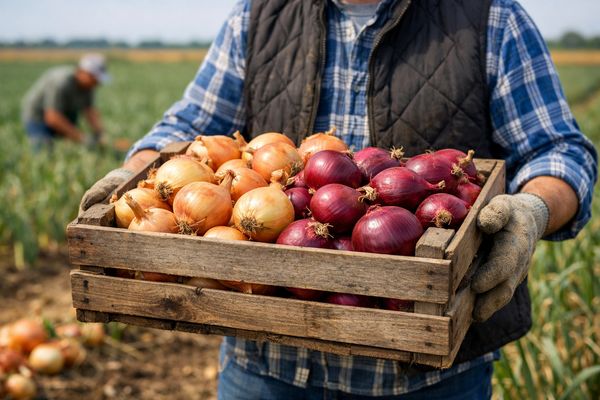
Dutch onion exports are moving into a clear two‑tier market, with premium-quality lots tightening and commanding higher prices while lower grades accumulate and struggle to clear. Strong demand from Brazil, the UK, Italy and Eastern Europe underpins volumes, but widening quality gaps are starting to dictate pricing and trading strategies.
Dutch onions remain one of Europe’s key export products this spring, in contrast to a subdued potato export sector. Export flows to Brazil, the UK, Italy and Eastern Europe are active, while red onions enjoy broad, size‑segmented demand across Germany, southern Europe and England. At the same time, ongoing disruptions on Red Sea and Gulf shipping routes are complicating white onion import logistics into Italy and sustaining elevated freight costs on Asia–Europe corridors, indirectly supporting European origin pricing. In the coming weeks, pre‑Pentecost restocking and the expected return of Brazilian buying are likely to test how far the emerging premium price tier can stretch before alternative origins and qualities cap further gains.
Exclusive Offers on CMBroker

Onion powder
grade - B
FOB 1.25 €/kg
(from IN)

Onion powder
white
FOB 1.52 €/kg
(from IN)

Onion
powder
FOB 2.60 €/kg
(from IN)
📈 Prices & Market Structure
Export prices for Dutch yellow onions have firmed modestly in early May 2026, with a clear spread emerging between standard and premium grades. Yellow 50–70 mm are now quoted around EUR 0.15–0.16/kg (up from EUR 0.13–0.14/kg), while good-quality 60–80 mm onions start at roughly EUR 0.20/kg on an export basis from the Netherlands. Premium availability is tightening, and exporters increasingly differentiate sharply between higher-grade and lower-grade stock.
Processed onion products show a mixed but broadly stable picture. Indicative recent offers from India and Poland suggest onion powder around EUR 1.25–1.52/kg FOB New Delhi (conventional) and EUR 2.60/kg for organic powder, onion flakes near EUR 5.03/kg, and crispy fried onions from Poland about EUR 2.39/kg FCA. These levels point to relatively contained volatility in processing segments compared with the more dynamic fresh export market.
| Product | Origin | Specification | Latest Price (EUR/kg) | Trend vs. late April |
|---|---|---|---|---|
| Yellow onions 50–70 mm | Netherlands | Export, bulk | 0.15–0.16 | Firming |
| Yellow onions 60–80 mm (good quality) | Netherlands | Export, bulk | ≥0.20 | Firming (premium) |
| Fresh onions | Egypt | Conventional FOB | ≈0.80 | Slightly weaker |
| Onion powder (conv.) | India | White / grade B FOB | 1.25–1.52 | Stable to slightly lower |
| Onion powder (organic) | India | FOB | 2.60 | Stable |
| Onion flakes (organic) | India | FOB | 5.03 | Stable |
| Crispy fried onions | Poland | FCA | 2.39 | Slightly higher |
🌍 Supply, Demand & Trade Flows
Dutch export demand is broad-based. Brazil absorbed significant volumes in April and, after a short lull, is expected to return to the market later in May. The UK is performing well, Italy continues to draw sizable yellow onion volumes, and Eastern European buyers in Serbia, Kosovo, Croatia, the Czech Republic and Hungary form a steady complementary demand base. This geographic diversification is helping exporters place both standard and higher-grade product.
On the supply side, the Dutch harvest is at a stage where quality differentiation becomes increasingly pronounced. Stocks of top-grade yellow onions are steadily depleting, while lower-quality lots are accumulating at packing stations. At the same time, first enquiries for Egyptian red onions are emerging, signalling additional competition ahead in the red segment, while New Zealand onions, usually a late-season factor, have so far attracted limited attention.
📊 Quality Spread, Logistics & External Drivers
The most important structural development is the widening quality spread within Dutch stocks. Exporters report that “the very best onions” are now scarce, and that this scarcity is driving a premium tier above the standard market. As the season advances, the market is expected to settle into two distinct price levels: one for limited premium-quality onions and another, more competitive level for lower-quality or visually inferior lots that must still be cleared.
Logistics remain a key external driver. Disrupted shipping through the Red Sea and, more recently, broader Gulf and Hormuz-related tensions have forced many vessels on Asia–Europe and Asia–Mediterranean routes to divert around the Cape of Good Hope, lengthening transit times and lifting freight costs. These higher freight rates make long-distance sea-freighted white onions into Italy less attractive, reinforcing the role of Dutch and nearby European origins where transit is shorter and more reliable under current conditions.
🌦️ Weather & Crop Conditions (Key Regions)
In the Netherlands, early May weather has been comparatively warm with episodes of heavy showers and thunderstorms in multiple provinces, following a KNMI code yellow warning on May 2. For stored onions this has limited direct impact, but fieldwork, new crop establishment and logistics can be briefly disrupted by intense rainfall and local hail. For now, there is no indication of widespread damage, but the situation bears monitoring if storm patterns persist.
Elsewhere in Europe, early-season onion production has been affected in some regions by irregular rainfall patterns, such as in parts of Spain where late precipitation altered early fresh onion output profiles. These localized effects may modestly support prices for early European onions but do not yet appear to change the overall balance for Dutch exports in the current storage-driven phase.
📆 Short- and Medium-Term Outlook
In the next 30–90 days, several demand pulses are in focus. Brazilian buyers are expected to re-enter later in May after a brief hiatus, while European markets typically see a pre‑Pentecost restocking uptick around week 21. This seasonal pattern should underpin export volumes, especially for good-quality graded onions and for red onions, which currently enjoy strong, size-specific demand into Germany, southern Europe and England.
Over a 6–12 month horizon, additional supply from Egypt’s red onion campaign and later arrivals from New Zealand are likely to cap further upside for standard grades. However, if the actual volume of remaining premium-quality Dutch onions proves smaller than currently assumed, the upper price tier could remain elevated into early summer, even as lower grades face more intense competition. Global shipping disruptions and high freight rates will remain a background risk factor, particularly for long-haul trade lanes that compete with European origins.
💡 Trading Recommendations
- Exporters (Netherlands): Prioritise tight grading and clear quality segmentation; lock in forward sales for premium 60–80 mm lots where buyers accept current price ideas, as scarcity and holiday restocking support the premium tier.
- Importers in Brazil, UK, Italy, Eastern Europe: Consider advancing purchases for late May–June, especially for higher-grade yellows and red onions, to hedge against further tightening of top-quality European stocks and ongoing freight volatility.
- Industrial users & packers: For non-premium applications, explore a mix of Dutch lower-grade onions, Egyptian fresh supply and Indian processed products to contain raw material costs while premium fresh prices remain firm.
- Risk management: Monitor freight markets and Gulf/Red Sea developments closely; sudden changes in routing or fuel prices could quickly alter import parity between European and non-European origins.
📍 3-Day Regional Price Indication (Directional)
- Netherlands (export, yellow 50–70 mm): EUR 0.15–0.16/kg; bias slightly firmer on good shipping quality.
- Netherlands (export, yellow 60–80 mm premium): ≥ EUR 0.20/kg; stable to slightly firmer as pre‑Pentecost demand builds.
- Egypt (fresh onions FOB): Around EUR 0.80/kg; mild downward bias amid competition from northern suppliers and logistics noise.
- Processed onion products (India, Poland): Largely sideways over the next days, with only minor moves expected absent a sharp shift in freight or energy markets.
Related posts:
 Gambia’s Onion Market Pact: From Import Dependence to Coordinated Domestic Supply
 Dutch Seed Potato Market Correction Puts Pressure on Growers but Not a Crisis
 Indian Dehydrated Onion Eases, Egyptian Fresh Onions Stable on Solid Supply
 Indian Onion Market Under Pressure as Rabi Glut Meets Export Slump
 Onion Prices Steady as Polish Demand Meets Stable India & Egypt Supply
 Sweet Red Momentum: California Specialty Onions Signal Premium Shift