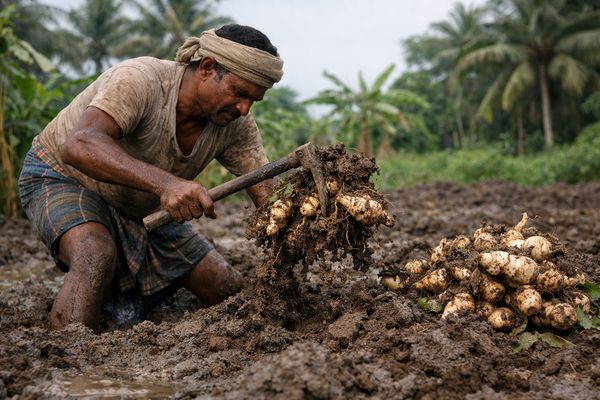
Indian organic arrowroot powder FOB New Delhi is drifting marginally lower in early May, with euro‑equivalent prices easing on soft spot demand while fundamentals remain relatively tight. The nearby focus is shifting quickly to weather and monsoon risks, which could become a key driver for late‑2026 supply.
Indian specialty starch buyers are taking a wait‑and‑see approach, with only light replenishment as they monitor broader agro-commodity price softness and fresh weather guidance. IMD now signals above‑normal all‑India rainfall for May but a below‑normal southwest monsoon overall for June–September 2026, setting up a complex weather backdrop for rain‑fed arrowroot in Kerala, Tamil Nadu and eastern states. For now, the physical market in New Delhi feels balanced to slightly heavy on near‑term supply, but risk premia could rebuild if monsoon performance disappoints.
Exclusive Offers on CMBroker

Arrowroot powder
Powder - average
99%
FOB 2.13 €/kg
(from IN)
📈 Prices & Market Tone
Export offers for organic arrowroot powder (99% purity, FOB New Delhi, origin India) are roughly in the mid‑€1.90s per kg, converting from recent USD‑denominated levels, and have eased by about 1–2% over the last fortnight. This mirrors a broader softening across several Indian specialty spices and roots, where buyers are pushing back against earlier highs and negotiating small discounts rather than aggressively restocking.
Spot liquidity is thin, with European and Middle Eastern buyers mostly covering nearby needs only. Domestic health‑food and gluten‑free demand in India continues to expand, but at a moderate pace and without signs of panic buying, helping to cap upside moves in export offers.
| Product | Location / Term | Latest price (EUR/kg) | 1‑week change | 4‑week trend |
|---|---|---|---|---|
| Arrowroot powder, organic, 99% | FOB New Delhi, IN | ≈ €1.95 | ▼ ~1% | Soft bias, narrow range |
🌍 Supply, Demand & Weather Context
Indian arrowroot is concentrated in rain‑fed pockets of Kerala, Tamil Nadu and parts of eastern and northern India, with planting typically from late May to early June, closely tied to the onset of the southwest monsoon. IMD’s latest seasonal outlook projects the 2026 southwest monsoon rainfall at about 92% of the long‑period average, classed as below normal, due to emerging El Niño conditions.
At the same time, IMD’s May 2026 monthly outlook points to above‑normal rainfall and mostly normal to below‑normal maximum temperatures across large parts of India, offering short‑term moisture relief and better conditions for land preparation in southern and eastern arrowroot belts. Reservoir levels, however, remain below average in several regions, increasing medium‑term water‑stress risk if monsoon rains underperform.
On the demand side, global interest in organic and allergen‑free starches remains strong, with India positioned as a key supplier of niche organic ingredients. That said, softer prices in related Indian agro‑exports such as dried ginger and chillies indicate some buyer fatigue and improved availability of alternative ingredients, tempering short‑term upside for arrowroot.
📊 Fundamentals & Key Drivers
- Planting window risk: Arrowroot planting around May–June means any delay or uneven onset of the monsoon could trim planted area or yield potential in 2026/27, particularly in Kerala and Tamil Nadu where irrigation is limited.
- Monsoon outlook: IMD confirms a below‑normal monsoon forecast linked to developing El Niño, raising the probability of intra‑season dry spells, even if May itself is wetter than usual.
- Weather in key hubs: Short‑range forecasts for north India flag alternating spells of heat and pre‑monsoon thunderstorms around Delhi and the Gangetic belt, which may intermittently disrupt logistics but are unlikely to materially change supply.
- Organic niche resilience: Broader organic export demand remains structurally firm, supported by certification and traceability systems that favour Indian suppliers, cushioning downside in certified niche products like organic arrowroot.
📆 Trading Outlook (Next 2–4 Weeks)
- Bias: Mildly bearish to sideways on FOB New Delhi prices in EUR, with room for a further 1–2% softening if planting progresses normally and broader agro‑markets stay under pressure.
- Risk to view: A poor or delayed early monsoon signal in southern India, or an escalation of El Niño concerns, could quickly add a weather premium of €0.05–0.10/kg on forward offers.
- For buyers: Consider staggered coverage, locking in a first tranche at current levels while keeping flexibility to add if prices dip further in May.
- For sellers: Maintain offer discipline; avoid heavy forward sales beyond existing raw‑material cover until greater clarity on June–July rainfall emerges.
📉 3‑Day Regional Price Indication (FOB New Delhi, IN)
- Day 1–3: Prices for organic arrowroot powder FOB New Delhi are expected to remain broadly stable in euro terms, with at most a marginal downward bias (<1%), as trade flows are thin and no major weather or logistics shocks are anticipated in the very near term.