
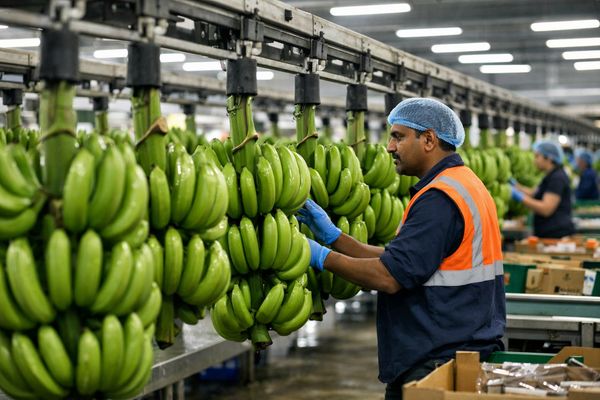
Indian banana exports are under mounting pressure from surging freight costs and stricter quality demands, while European banana snack prices remain broadly stable in EUR terms. Export margins are being squeezed, forcing some Indian suppliers to reassess their exposure to Gulf and West Asian routes and to prioritise quality control to protect market access.
India’s position as a competitive banana supplier to the Middle East is now challenged by tripled freight rates, extended transit times and tighter enforcement of ripening and food safety rules. At the same time, the European banana chips segment shows only marginal price moves, signalling a relatively balanced supply–demand situation for value‑added products. Importers and processors should focus on logistics risk management and quality assurance, as procurement opportunities may emerge from India’s export disruptions.
Exclusive Offers on CMBroker

Banana dried chips
Chips, whole
FOB 3.40 €/kg
(from VN)

Banana dried chips
Chips, whole
FCA 2.90 €/kg
(from NL)

Banana dried chips
Chips, broken
FCA 1.87 €/kg
(from NL)
📈 Prices & Current Market Signals
Spot prices for banana-based snacks in Europe and Asia are largely steady. Recent offers show:
| Product | Origin | Location / Terms | Latest Price (EUR/kg) | 1W Price Change |
|---|---|---|---|---|
| Banana dried chips, whole (conv.) | Viet Nam | Hanoi, FOB | 3.40 | ▼ from 3.43 |
| Banana dried chips, whole (organic) | Philippines | Dordrecht (NL), FCA | 2.90 | ▶ unchanged |
| Banana dried chips, whole (conv.) | Philippines | Dordrecht (NL), FCA | 2.37 | ▶ unchanged |
| Banana dried chips, broken (conv.) | Philippines | Dordrecht (NL), FCA | 1.87 | ▶ unchanged |
This stability in EU‑landed chip prices contrasts with rising farm‑gate prices in India’s fresh banana sector, where export‑grade fruit is facing higher local bids as overseas shipments are constrained by logistics and quality hurdles.
🌍 Supply, Demand & Trade Flows
India exports only a small share of its total banana production, but that share is critical for farmers and exporters connected to Gulf and West Asian markets. Freight costs on these corridors have reportedly tripled compared with normal levels, leading to a drop in shipped volumes of around one‑third and sharply eroding export margins.
Quality and handling are an equally important constraint. Extended transit times through disrupted sea routes raise the risk of chilling injury, over‑ripeness and cosmetic damage. Exporters face tighter buyer specifications, rising rejection risk and higher claims, all of which reduce effective realisations even when headline prices appear attractive. As a result, more export‑quality bananas risk being diverted back to domestic markets, pressuring local prices in producing regions while reducing availability for traditional importers.
At the same time, European fresh banana wholesale prices are relatively stable to slightly firm, with recent box prices in Eastern Europe translating to roughly EUR 1.80–1.90/kg, reflecting steady demand and still‑adequate supply from Latin America and other origins. Demand for processed banana products, such as chips and dried snacks, remains robust, underpinned by snacking and bakery sectors, helping support current EUR price levels despite modest competition from other tropical fruits.
📊 Fundamentals & Policy Backdrop
Indian exporters are being hit by a combination of elevated base freight rates and multiple surcharges linked to Red Sea and Gulf security risks, including emergency contingency, war risk and fuel surcharges that together can lift all‑in shipping costs by 20–40%. These cost surges significantly narrow the viable price window for bananas, given their relatively low unit value and strict cold‑chain requirements.
On the quality side, Indian authorities have intensified enforcement against the illegal use of calcium carbide and improper ripening agents in fruits such as bananas, mangoes and papayas. While positive for food safety and long‑term market reputation, this raises near‑term compliance costs for smaller exporters and packhouses that must invest in compliant ethylene‑based ripening systems and better traceability.
Global outlook data for early 2026 point to a moderately bullish export price bias for key banana origins, including India, Ecuador and Brazil, reflecting higher costs, disease pressures and firm demand. However, India’s specific freight and quality bottlenecks mean it may underperform relative to Latin American competitors in key destination markets until logistics normalise and quality systems improve.
🌦️ Weather & Production Outlook
Near‑term weather in major Indian banana belts (Maharashtra, Tamil Nadu, Andhra Pradesh) is entering the pre‑monsoon phase, with rising temperatures and scattered showers. No widespread acute weather shock is currently indicated, but localised heat stress can affect fruit size and shelf life, requiring careful harvesting and post‑harvest management to keep export quality intact.
Globally, weather‑related constraints remain a medium‑term risk, especially in Central and South America where tropical storms and disease (including TR4) continue to threaten output. For now, however, European markets appear adequately supplied, which is consistent with the stable EUR prices for banana snacks and only modest firmness in fresh banana quotations.
📆 Market & Trading Outlook
- Short term (next 1–3 months): Indian banana export flows to Gulf and West Asia are likely to remain subdued as long as freight surcharges stay elevated, keeping farm‑gate prices in India relatively high while limiting volume growth offshore.
- Medium term (Q3 2026): If shipping conditions stabilise and some surcharges ease, India could regain competitiveness, but only exporters with strong quality systems, reliable cold chains and disciplined ripening practices will fully benefit.
- Processed products: EU banana chip prices in EUR are expected to trade sideways with a mild upward bias if fresh‑fruit logistics tighten further, as snack manufacturers may look to secure forward cover.
🎯 Focused Recommendations
- Importers in the EU & Middle East: Secure diversified supply across India, the Philippines and Latin America; consider partial forward coverage at current EUR levels for chips and dried products, given relatively low downside risk versus logistics‑driven upside.
- Indian exporters: Prioritise high‑value, quality‑sensitive buyers and negotiate freight and surcharge terms aggressively. Invest in ripening and quality control to minimise claims, and be prepared to rebalance some volumes towards domestic or regional markets when freight peaks.
- Industrial users & snack producers: Use today’s stable chip prices to lock in contracts where possible, but include freight and surcharge adjustment clauses to avoid unexpected cost pass‑throughs later in the year.
📉 3‑Day Directional Outlook (EUR Focus)
- EU fresh bananas (wholesale): Stable to slightly firm in EUR/kg, supported by steady demand and structurally higher logistics costs.
- EU banana chips (conventional & organic): Sideways; spot prices in the 1.8–3.4 EUR/kg range are expected to hold, with limited immediate downside.
- Indian export parity (CIF Gulf, implied): Upward pressure from freight and surcharges keeps effective CIF‑equivalent EUR levels elevated, suggesting continued pressure on volumes rather than prices.
Related posts:
 Banana Chips Market Steady as PH Underbids Vietnam Amid Emerging El Niño Risk
 Chinese Dried Apple Cubes: Flat-to-Firm Prices as Freight Costs Stabilise
 Chilean Prunes Ease from Recent Highs as Freight Costs Cap Downside
 South Africa’s Citrus Exports Navigate Hormuz Disruption as Rerouting Raises Freight Costs but Preserves Middle East Supply
 Banana Chips Market Holds Steady as PH–VN Weather Stays Supportive
 Indian Pineapple Under Heat and Demand Pressure as Prices Drop Below Costs