
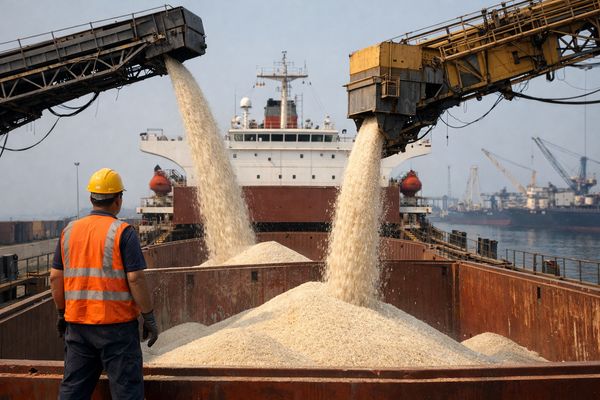
Basmati rice prices in India’s key wholesale markets have slipped modestly as exporter buying has cooled, with sentiment additionally clouded by shipping and payment risks linked to the Gulf region and Iran. The correction is limited but signals a market recalibrating lofty export expectations, creating a short-term buying window for importers.
Export-linked basmati quotes in Delhi eased this week, with both Sela and steam grades drifting lower as traders reported subdued overseas inquiry. At the same time, the ongoing Strait of Hormuz disruption keeps logistics and freight premia elevated, adding uncertainty to forward export programs even as origin prices soften. For European specialty importers and Middle Eastern traders, this combination of slightly weaker Indian offers and heightened geopolitical risk argues for cautious, staged procurement rather than aggressive forward coverage.
Exclusive Offers on CMBroker

Rice
all golden, sella
FOB 0.88 €/kg
(from IN)

Rice
all steam, pr11
FOB 0.39 €/kg
(from IN)

Rice
al ısteam, sharbati
FOB 0.54 €/kg
(from IN)
📈 Prices & Market Tone
Delhi wholesale prices for key basmati export grades edged down this week, driven mainly by weaker exporter demand rather than any visible shift in physical availability. In the domestic wholesale trade, 1121 Sela basmati fell roughly EUR 1–2 per 100 kg equivalent, now around EUR 101–102/quintal, while 1121 steam eased to about EUR 106–108/quintal based on current FX assumptions.
The price softness is mirrored in FOB indications. Recent offers from New Delhi show all steam 1121 around EUR 0.77/kg, down from EUR 0.79/kg a week earlier, and 1121 creamy white sella near EUR 0.70/kg versus EUR 0.72/kg previously. Organic white basmati FOB has slipped to about EUR 1.70/kg from EUR 1.72/kg over the same period, confirming a gradual easing trend across the basmati complex at origin.
| Origin & Type | Location | Current Price (EUR/kg) | Prev. Price (EUR/kg) | Change (EUR/kg) |
|---|---|---|---|---|
| Rice, all steam, 1121 | New Delhi, IN (FOB) | 0.77 | 0.79 | -0.02 |
| Rice, white sella, 1121 creamy | New Delhi, IN (FOB) | 0.70 | 0.72 | -0.02 |
| Rice, white, basmati (organic) | New Delhi, IN (FOB) | 1.70 | 1.72 | -0.02 |
| Rice, long white 5% | Hanoi, VN (FOB) | 0.40 | 0.41 | -0.01 |
🌍 Supply, Demand & Trade Flows
The immediate driver of the correction is softer exporter buying. Market participants in Delhi report subdued export inquiries for 1121 and other basmati grades, prompting sellers to trim offers to stimulate interest. This is occurring against a backdrop of structurally firm global demand for fragrant long-grain rice, but with buyers in key markets more price‑sensitive and cautious on logistics.
Iran remains central to Indian basmati demand, covering around 30% of its domestic rice needs via imports and sourcing an estimated 40%+ of those volumes from India. The current Strait of Hormuz crisis, combined with a US naval blockade and intermittent ceasefire, has sharply disrupted shipping through the Gulf, with most major carriers either avoiding Hormuz or operating only limited transits. These constraints are slowing order placement, stretching shipment windows and complicating payment and insurance, thereby damping exporters’ willingness to accumulate aggressive basmati positions.
📊 Fundamentals & Policy Backdrop
Beyond freight and geopolitical risk, Indian exporters are also grappling with domestic structural challenges. The Basmati Export Development Foundation, overseen by APEDA, faces pressure from exporter associations to reform its governance and roll back the mandatory export contract registration fee, which was raised from roughly EUR 0.33 to EUR 0.77 per tonne in September 2025. These additional regulatory costs narrow exporter margins in a market where buyers are pushing back on higher CNF values.
Recent Indian trade data show rice export earnings for 2025/26 declining by around 7–8% year on year, with basmati shipments to Iran under particular strain due to sanctions‑linked banking hurdles, delayed vessels and rerouted cargoes. While non‑basmati segments and Vietnamese white rice continue to provide some competitive alternatives for global buyers, the unique quality attributes of basmati limit full substitution, keeping underlying demand intact but more tactical and price‑sensitive.
🌦 Weather & Crop Conditions
Weather in India’s core basmati belt (Punjab, Haryana, western UP) is currently in a relatively neutral phase for rice, with the main kharif crop still several months away. Early seasonal forecasts point to near‑normal to slightly above‑normal pre‑monsoon temperatures and a monsoon onset close to the long‑term average, implying no immediate yield shock for 2026/27 basmati prospects at this stage. (Inference based on prevailing IMD seasonal outlooks and regional forecasts.)
Given that the present price move is clearly demand‑driven, short‑term weather plays only a secondary role. However, traders should monitor updates to the June–September monsoon forecast, as any shift towards a significantly deficient monsoon could tighten the medium‑term balance and reverse the current mild softness in basmati prices.
📆 2–4 Week Market Outlook
Over the next two to four weeks, basmati prices at origin are likely to remain under mild downward pressure, conditional on continued weak exporter buying and limited fresh orders from Iran and the wider Gulf. Persistently high freight and insurance costs through the Hormuz and Red Sea corridors, combined with re‑routing via longer Cape or alternative channels, will keep landed prices elevated even if FOB values in India ease modestly.
A meaningful rebound in Indian basmati prices would likely require one or more of the following: (1) visible normalization in Gulf shipping conditions and insurance premia; (2) a pick‑up in Iranian tendering and private demand once payment channels stabilize; or (3) renewed speculative interest in agricultural commodities if wheat and pulses volatility spills over into rice. Absent these triggers, the path of least resistance for Indian basmati remains sideways to slightly lower in the near term.
💡 Trading Outlook & Recommendations
- European specialty importers: Use the current softness in Indian 1121 Sela and steam as a controlled procurement window. Consider layering purchases over the next 2–3 weeks rather than front‑loading, to balance downside price potential at origin against upside risks in freight.
- Middle Eastern grain traders: Maintain some optionality between Indian basmati and alternative fragrant or long‑grain origins (e.g., Vietnamese fragrant, Thai jasmine) to hedge against further Hormuz disruptions or Iran‑specific sanctions shocks.
- Indian exporters: Focus on margin preservation rather than volume maximization. Re‑price offers conservatively to reflect lower Delhi wholesale values, but avoid deep discounts until there is greater clarity on shipping lanes, insurance and the policy stance on export fees.
- Risk management: Monitor cross‑asset signals from crude oil, freight indices and regional FX closely, as renewed escalation in the Gulf could reverse the current mild basmati correction into a logistics‑driven rally in delivered prices.
📉 3‑Day Directional Price Indication (EUR)
- New Delhi basmati (FOB, 1121 steam / sella): Bias: slightly softer to sideways. Expect a further 0.5–1.0% downside in EUR/kg terms if exporter demand stays muted.
- New Delhi organic basmati (FOB): Bias: stable to slightly softer, tracking conventional basmati but cushioned by niche demand.
- Hanoi long‑grain white 5% (FOB): Bias: broadly stable with a mild downside bias of up to 0.5% as global buyers remain focused on logistics rather than aggressive volume buying.
Related posts:
 Rice Market Softens as CBOT Futures and Asian FOB Prices Edge Lower
 Indian Basmati Rice Under Pressure as Export Levies Meet Geopolitical Shocks
 Indian Basmati Rice Softens on Demand Lull While Supply Risks Build
 India’s Basmati Rice Exporters Squeezed by Levies and War Disruptions
 India’s Basmati Rice Exports Face GI Uncertainty Amid Strong Demand
 Indian Basmati Rice Squeezed by Paddy Shortage as Prices Surge