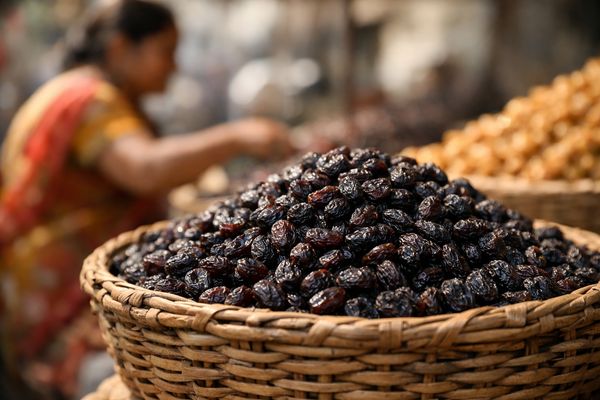
Indian raisin prices are consolidating with a mild downward correction from mid‑April highs, while underlying fundamentals remain broadly supportive. Domestic spot and export offers from New Delhi are a touch softer for most grades, but the ongoing heatwave in Maharashtra and Karnataka keeps quality risks and a modest upside bias in the background. Turkish sultanas in EUR terms remain stable, anchoring global benchmark values and limiting downside for Indian exporters.
India’s key grape–raisin belt in Maharashtra and northern Karnataka is experiencing very hot, dry weather, with maximum temperatures around 40–41°C and no significant rainfall forecast in the next three days, favouring drying but increasing storage and quality risks if cooling and ventilation are inadequate. Export interest in Indian raisins remains firm within a global market characterised by balanced trade flows and steady Turkish supply.
Exclusive Offers on CMBroker

Raisins
golden, grade aa
FCA 2.45 €/kg
(from IN)

Raisins
black, grade aa
FCA 1.80 €/kg
(from IN)

Raisins
brown, grade aa
FCA 1.82 €/kg
(from IN)
📈 Prices & Short-Term Trend
All prices converted approximately to EUR/kg (using 1 USD ≈ 0.93 EUR where needed) and rounded.
| Origin | Location / Term | Product | Latest Price (EUR/kg) | Prev. Price (EUR/kg) | Direction (w/w) |
|---|---|---|---|---|---|
| India | New Delhi, FCA | Golden, grade AA | ≈2.45 | ≈2.50 | ▼ slightly softer |
| India | New Delhi, FCA | Black, grade AA | ≈1.80 | ≈1.87 | ▼ softer |
| India | New Delhi, FCA | Brown, grade AA | ≈1.82 | ≈1.85 | ▼ slightly softer |
| India | New Delhi, FOB | Golden, grade AA | ≈2.28 | ≈2.27 | ▲ marginally firmer |
| India | New Delhi, FOB | Black, grade AA | ≈1.76 | ≈1.75 | ▲ flat‑to‑firm |
| Turkey | Malatya, FOB | Sultanas type 9, grade A | ≈2.34–2.45 | ≈2.34–2.45 | ▶ stable |
The latest offers confirm a mild week‑on‑week easing in Indian FCA New Delhi prices for golden, black and brown raisins after a firming trend through early to mid‑April. Turkish sultanas in Malatya show little week‑to‑week movement in EUR terms, underlining a broadly stable global floor.
🌍 Supply, Demand & Weather
Maharashtra’s Nashik and Sangli clusters remain the primary engine of India’s raisin supply, with hot and dry conditions currently dominating the forecast. Maximum temperatures around 40–41°C and minimal rainfall over the next three days favour rapid drying of any remaining grapes but heighten stress on stored product and cold chains. Northern Karnataka shows a similar pattern with very warm, mostly sunny conditions near 38–39°C, likewise implying good drying but potential quality risks if warehouses lack adequate cooling.
Mid‑April commentary highlighted a developing heatwave pattern across western and central India, which is now well established and supportive for drying but can damage berries and increase moisture‑related spoilage risk in storage if temperature spikes are followed by localised showers. Fresh grape arrivals into Indian markets remain relatively tight and fragmented, with wide price dispersion by region, reinforcing the incentive to channel suitable grades into drying and value‑added processing.
On the demand side, export interest for Indian green and black raisins remains solid, with recent trade sources quoting FOB bands around EUR 2.3–3.2/kg for premium green and EUR 1.7–2.3/kg for black in April. Turkish sultanas continue to see healthy export flows, with recent figures showing weekly shipments ahead of last year and prices in EUR stable at competitive levels. This constrains upside for Indian sellers but also limits downside as buyers diversify origin risk.
📊 Fundamentals & External Factors
Global raisin and sultana fundamentals remain broadly balanced. The latest international dried grape industry data point to stable world production and carry‑in stocks for 2025/26, without evidence of a major surplus that could pressure prices sharply lower. In Turkey, early‑season assessments for the new crop point to mostly normal conditions so far, though analysts continue to flag frost risk in some seedless grape areas; however, this has not yet translated into price spikes.
Macro‑level trade data from Turkey show generally solid dried fruit export earnings in the first quarter, suggesting sustained import demand from Europe and the Middle East. For India, broader agri‑commodity markets are mixed, with some crops facing weak prices despite weather‑related production losses, which may encourage growers and traders to hold raisins slightly longer in search of better realisations. Logistics and container availability on key India–EU and India–Middle East lanes remain manageable, limiting basis volatility.
📆 3‑Day Outlook & Trading Strategy (Region: IN)
Weather outlook (2–4 May 2026):
- Maharashtra (Nashik, Sangli): Hot, dry, and mostly sunny; highs around 40–41°C, lows 24–26°C; no meaningful rainfall expected.
- Northern Karnataka: Very warm, mostly sunny with highs 38–39°C; no significant rain in the near term.
This pattern is neutral‑to‑supportive for drying and handling but warrants close attention to warehouse temperatures and ventilation.
🔎 Trading recommendations (short term, 3–7 days)
- Indian buyers (domestic trade, packers): Use the current slight softening in FCA New Delhi prices for golden and black raisins to secure near‑term coverage, especially for higher grades where downside appears limited by strong export parity and heat‑related quality risks.
- Exporters (India): Maintain offer discipline around current FOB levels; with Turkish sultanas stable, avoid aggressive discounting and focus on premium differentiation (colour, cleanliness, residue status).
- Importers (EU/Middle East): Consider staggered purchases from both India and Turkey; use stable Turkish benchmarks as a hedge while selectively booking Indian volumes where quality‑to‑price is attractive, particularly in golden and black AA grades.
📍 3‑Day Price Indication / Direction (Region IN)
- New Delhi FCA – Golden AA: Around EUR 2.45/kg; bias stable to slightly softer as sellers test demand after mid‑April highs.
- New Delhi FCA – Black AA: Around EUR 1.80/kg; bias stable with limited further downside given export parity.
- New Delhi FCA – Brown AA: Around EUR 1.82/kg; bias stable, tracking black raisins with modest local demand support.
Overall, the Indian raisin market enters early May in a consolidation phase: spot prices have eased back from recent highs, but hot and dry weather, firm export interest, and stable Turkish benchmarks keep the structure mildly supportive rather than bearish.