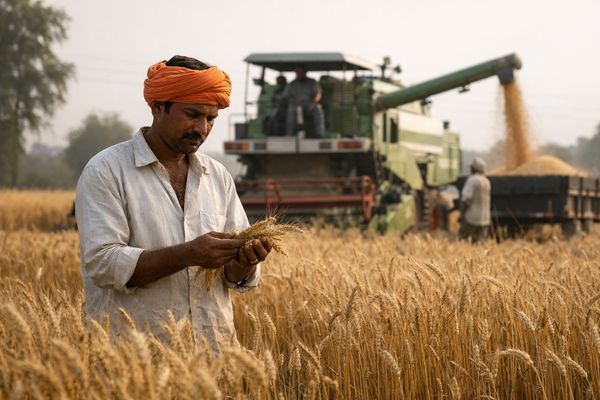
India’s decision to expand wheat exports on the back of a record harvest and ample stocks is reinforcing global supply, limiting upside in international prices while helping domestic farmers avoid distress sales.
Global wheat markets are digesting India’s shift from restrictive exporter to calibrated supplier just as record 2025/26 output and comfortable public stocks improve availability. Domestically, higher export quotas aim to stabilise farmgate prices during peak arrivals without triggering consumer inflation. Internationally, this additional flow joins already competitive Black Sea and EU offers, anchoring FOB benchmarks. Near term, the balance of strong Indian supply, moderate global demand and still-solid inventories points to a mildly bearish tone, with weather and policy fine‑tuning as the main watchpoints.
Exclusive Offers on CMBroker

Wheat
protein min. 11,50%, CBOT
98%
FOB 0.20 €/kg
(from US)

Wheat
protein min. 11,00%
98%
FOB 0.28 €/kg
(from FR)

Wheat
protein min. 11,00%
98%
FOB 0.18 €/kg
(from UA)
📈 Prices
Physical wheat indications remain subdued in key origins, reflecting ample global supply and improved export availability from India. Recent offers show:
| Origin | Spec / Term | Latest price (EUR/kg) | 1–2 week change |
|---|---|---|---|
| US (CBOT type) | 11.5% protein, FOB | 0.20 | ▼ from 0.21 |
| France | 11.0% protein, FOB Paris | 0.28 | ▼ from 0.29 |
| Ukraine | 11.0–12.5% protein, FOB Odesa | 0.18 | ≈ unchanged |
In India, retail prices are reported near EUR 0.35–0.36 per kg (around USD 0.37/kg), broadly stable thanks to high public stocks and managed export flows. The combination of softer international benchmarks and India’s export opening suggests limited upside in the short term unless adverse weather or new trade restrictions emerge.
🌍 Supply & Demand
India is re‑emerging as a meaningful wheat exporter after more than four years of tight restrictions. The government has now authorised a total of about 6 million tonnes of wheat and wheat products for export, including an additional 2.5 million tonnes approved after a fresh review of production, stock levels and domestic prices. This marks a strategic shift towards using exports as an active tool to manage surplus and farmer incomes.
Domestic fundamentals are comfortably balanced. Wheat production in 2025/26 is projected around 120 million tonnes, potentially a new record, underpinned by higher acreage and favourable yield expectations. Public stocks exceeded 22 million tonnes at the start of April, far above the buffer requirement of roughly 7.5 million tonnes, ensuring food security even as export volumes rise. At the same time, procurement in the 2026/27 marketing season has lagged last year by almost 40%, signalling that more grain is initially flowing through private channels and exports rather than into state warehouses.
📊 Fundamentals & Policy
The export expansion is explicitly designed to stabilise domestic markets while supporting farmers during the peak arrival window when prices usually come under pressure. By opening an external outlet, authorities aim to improve market liquidity and reduce the risk of distress sales, particularly in key producing states such as Punjab, Haryana, Madhya Pradesh, Rajasthan and Uttar Pradesh. This “managed opening” contrasts with earlier blanket bans and is calibrated to prevailing stock and price conditions.
Despite slower government procurement towards an ambitious 30 million tonne target, the stock position remains more than adequate. Comfortable reserves give policymakers room to adjust quotas further if production or prices deviate from expectations. For global buyers, India’s re‑entry adds a flexible, price‑sensitive supply source that can help cap rallies but may be scaled back if domestic inflation risks resurface, keeping some policy uncertainty in the medium term.
🌦️ Weather & Short-Term Outlook
Weather in India’s core wheat belt has normalised after earlier concerns about unseasonal rains, and current harvest progress supports expectations of a strong crop. With no major weather shock in sight for the main northern states, production risk in India looks contained in the immediate term, reinforcing the bearish tilt to global balances. Elsewhere, Northern Hemisphere winter wheat conditions are seasonally mixed but without a single dominant threat capable of offsetting India’s surplus alone.
📆 Trading Outlook
- Importers: Use India’s expanded export window and competitive Black Sea and EU prices to extend coverage on dips, focusing on 11–12.5% protein parcels where offers near EUR 0.18–0.20/kg FOB remain attractive.
- Exporters (India): Prioritise early shipment against the current quota, as any rapid tightening in domestic prices or policy reassessment could slow further approvals later in the season.
- Risk managers: Maintain modest downside price hedges but keep upside protection given ongoing policy risk and potential weather surprises into Northern Hemisphere growing stages.
📉 3‑Day Price Indication
- US (FOB, CBOT‑linked 11.5%): Slightly soft to sideways; range expected around EUR 0.19–0.21/kg.
- EU (FOB Paris 11%): Mild downward bias, tracking global pressure, around EUR 0.27–0.29/kg.
- Black Sea / Ukraine (FOB Odesa 11–12.5%): Broadly steady with strong competition, near EUR 0.17–0.18/kg.