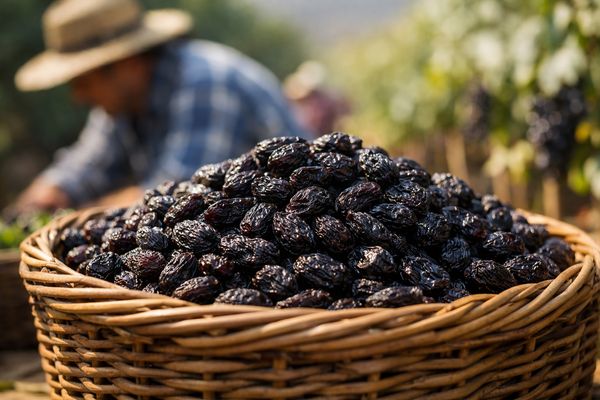
The launch of Chilean vine‑dried raisins into US retail is creating a new premium niche without disrupting conventional raisin supply, while underlying bulk raisin prices in key origins remain broadly stable to slightly softer in EUR terms.
US specialty retailers are gaining access to a visually distinctive, cluster-format raisin that aligns with the rapidly growing cheeseboard and at‑home entertaining segment. With domestic US vine‑dried production having effectively disappeared, Chile’s sun‑dried cluster supply is stepping into a structural gap rather than competing head‑to‑head with loose raisins. Early months will be a test phase: consumer response, deli‑counter placement and cross‑merchandising with cheese and charcuterie will determine whether this concept scales beyond a niche premium accompaniment.
Exclusive Offers on CMBroker

Raisins
golden, grade aa
FOB 2.26 €/kg
(from IN)

Raisins
brown, grade aa
FOB 1.80 €/kg
(from IN)

Raisins
feed, brown
FCA 1.89 €/kg
(from NL)
📈 Prices & Premium Positioning
Bulk raisin benchmarks in India and Turkey have eased modestly in late April and early May, suggesting a slightly softer raw-material cost base in EUR terms. For example, Indian brown grade AA raisins around New Delhi are currently offered at roughly EUR 1.67–1.70/kg FOB equivalent, while golden grade AA is near EUR 2.10/kg, indicating a narrow but stable quality spread. In Europe, standard Chinese sultanas and Turkish RTU raisins delivered to continental hubs are generally trading in a EUR 2.00–2.70/kg band, reflecting balanced supply and demand for mainstream product.
Against this backdrop, Melissa’s Raisins on the Vine clearly occupy a premium tier. The intact cluster format, Chilean origin and specialty positioning for cheeseboards mean retail prices will be driven far more by merchandising value and visual impact than by bulk raisin price benchmarks. Current global price stability therefore supports comfortable margins for this new premium item, provided logistics and shrink are controlled.
🌍 Supply, Demand & Trade Flows
The key structural driver is the effective end of US commercial vine‑dried raisin production; there is no domestic supply competing in this format. Chile steps in as exclusive origin, leveraging established sun‑drying infrastructure in its dry Mediterranean‑climate grape regions to deliver cluster‑dried fruit at scale. Existing free‑trade conditions between Chile and the US help keep landed costs manageable, even for a niche premium product.
On the demand side, raisins already account for roughly one third of global dried fruit sales, but conventional loose raisins offer limited differentiation for premium retailers. The strong expansion of cheeseboard and at‑home entertaining ranges in US grocery has created a dedicated demand pool for visually striking accompaniments. Melissa’s strategy explicitly targets cheese and deli departments, using cross‑merchandising with artisanal cheeses, charcuterie and honeycomb to drive basket value rather than volume alone.
📊 Fundamentals & Market Structure
Fundamentally, Raisins on the Vine introduce a new sub‑segment rather than altering core raisin balances. Bulk supply from India, Turkey, China and Chile continues to underpin the mass‑market raisin and sultana categories, where prices around EUR 1.70–2.70/kg indicate adequate availability. Chile’s role here is highly specialized: the same grape‑growing base that serves table grapes and processed grape products is now channelled into premium cluster‑dried offerings for North America.
Because no conventional US raisin production is displaced, the main market effect is qualitative: the creation of a visible premium tier within the dried fruit aisle and, more importantly, within cheese and deli sets. If this tier gains consumer recognition, it could lift reference price points for other specialty dried fruits and allow retailers and distributors to defend or improve margins across their premium assortment.
📆 Outlook & Weather Considerations
Over the next 30–90 days, the focus will be on initial placement and sell‑through. Early performance data from specialty and premium chains will show how quickly consumers adopt the cluster format, particularly when presented alongside artisanal cheeses. Retailers are likely to trial limited facings and seasonal or weekend promotions to test elasticity at higher price points.
On a 6–12‑month horizon, successful reception could attract competing offers, potentially from other Mediterranean‑climate origins such as South Africa, Spain or Turkey exploring cluster‑format dried grapes. Weather risks in Chile’s key grape regions remain a watchpoint: the concept depends on reliable sun‑drying conditions with low humidity. Any unusually wet or cool spells during the drying season could constrain volumes for future campaigns, reinforcing the product’s premium, limited‑supply character rather than pushing it into mainstream commodity status.
💡 Trading & Procurement Outlook
- Retail buyers (US specialty & premium): Treat Raisins on the Vine as a margin accretive accompaniment, not a volume driver. Start with curated placement in cheese/deli, monitor velocity closely, and avoid deep discounting that could erode premium perception.
- Importers & distributors: Lock in medium‑term supply programs with Chilean partners while bulk raisin prices are stable. Secure quality specifications around cluster integrity and moisture to protect the visual premium.
- Industrial users & packers: Continue to source conventional raisins opportunistically; modest softness in Indian and Turkish offers supports spot and near‑term contracting. The new cluster format is unlikely to compete on price‑sensitive applications but may open small high‑value co‑branding opportunities.
📍 3‑Day Indicative Price & Direction (EUR)
| Origin / Type | Location / Terms | Latest Price (EUR/kg) | 3‑Day Bias |
|---|---|---|---|
| India brown, grade AA | New Delhi, FOB | ≈ 1.67 | Sideways to slightly soft |
| India golden, grade AA | New Delhi, FOB | ≈ 2.10 | Sideways |
| Raisins, feed brown | Dordrecht (NL), FCA | ≈ 1.76 | Stable |
| Chile flame jumbo | Dordrecht (NL), FCA | ≈ 2.27 | Stable |
Premium vine‑dried clusters into the US should maintain a firm price stance over the coming days, with limited sensitivity to minor moves in bulk raisin benchmarks.