
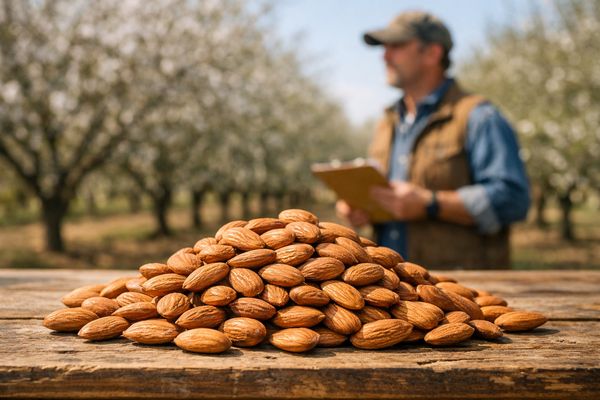
Almond prices are stabilising with a growing upside bias as California’s bearing area slowly contracts and years of production pressure give way to a more balanced supply‑demand picture. While spot values remain broadly steady, forward sentiment is turning supportive on expectations of tighter global availability into the 2025 crop year.
California remains the backbone of global almond trade, and ongoing orchard removals, deficit irrigation and water constraints are starting to show in supply expectations. At the same time, key buyers in India, the EU and China are signalling early demand recovery after a prolonged period of weak consumption. With the 2025 crop still months away, today’s price structure is driven less by confirmed yield data and more by anticipated tightening of stocks and a gradual re‑pricing of risk along the supply chain.
Exclusive Offers on CMBroker

Almonds kernels
carmel, ssr, 18/20
FAS 6.65 €/kg
(from US)

Almonds kernels
natural, 27/30, nonpareil ssr
FOB 9.27 €/kg
(from US)

Almonds kernels
carmel, ssr 20/22
FAS 6.60 €/kg
(from US)
📈 Prices & Current Levels
Indicative kernel offers at the start of May 2026 show a broadly stable market in euro terms. U.S. Nonpareil organic kernels (27/30, FOB Washington D.C.) are quoted around EUR 9.27/kg, while U.S. Carmel SSR types (18/20–20/22, FAS) trade near EUR 6.60–6.65/kg. Spanish Marcona kernels are offered in a higher band between roughly EUR 6.55 and 8.80/kg FOB Madrid, with Valencia and Guara types clustered around EUR 5.50–6.05/kg.
Across the April 9 to May 1 period, these benchmarks have moved only marginally, with changes typically within EUR 0.05/kg. This flat near‑term profile aligns with producer commentary that the market is transitioning from oversupply toward balance rather than experiencing an abrupt price spike. Recent importer‑led softness in India underscores that short‑term corrections remain possible even as the medium‑term structure tightens.
| Origin / Type | Spec | Location & Terms | Latest Price (EUR/kg) |
|---|---|---|---|
| USA Almond kernels | Carmel, SSR 18/20 | Washington D.C., FAS | 6.65 |
| USA Almond kernels | Carmel, SSR 20/22 | Washington D.C., FAS | 6.60 |
| USA Almond kernels | Nonpareil, natural 27/30, organic | Washington D.C., FOB | 9.27 |
| Spain Almond kernels | Marcona 12/14 | Madrid, FOB | 6.55 |
| Spain Almond kernels | Marcona S/16 | Madrid, FOB | 8.80 |
🌍 Supply & Demand Balance
California supplies the majority of the world’s traded almonds, so structural changes in its acreage and cultural practices dominate the global balance sheet. After several years of weak farmgate prices, high input costs and water scarcity, growers have responded by removing orchards and, in many cases, deficit‑irrigating remaining groves. This under‑watering reduces current yields and can permanently damage orchard potential, effectively locking in a lower production base over time.
At the same time, export demand is beginning to re‑engage. India, the EU and China remain the key incremental buyers, and even a modest recovery in these outlets will magnify the price impact of shrinking Californian supply. Recent industry updates highlight that, while total planted area may appear broadly stable on paper, the share of fully productive, well‑irrigated acreage is declining, which is more critical for the tradable surplus than headline hectares alone.
📊 Fundamentals & Policy Drivers
The central structural constraint for California almonds remains water: availability, allocation risk and cost. Where irrigation water is expensive or unreliable, many growers no longer see full irrigation as economically viable at recent price levels, leading to chronic deficit irrigation and, ultimately, orchard removal. Some of the acreage decline therefore reflects permanent financial exit rather than temporary agronomic adjustment, tightening the medium‑term outlook beyond a single crop year.
On the policy and macro side, ongoing trade discussions and tariff frameworks continue to shape demand distribution across key destinations, but current fundamentals are driven more by biological and hydrological limits than by regulatory change. Recent weather outlooks for Central California through May indicate episodic troughs and rainfall events on top of an already wet spring, supporting soil moisture but not fundamentally resolving long‑run water security challenges. Growers remain vulnerable to swings in both seasonal precipitation and allocation decisions from water authorities.
🌦️ Weather & Crop Development
The 2026 bloom in California’s main almond regions is now past, and attention is shifting to nut set and early kernel development. Short‑range forecasts for May 2026 signal periods of renewed precipitation and troughing into California’s central valleys, with notable rain windows expected around early and mid‑May. For existing orchards, this pattern helps maintain soil moisture and may reduce immediate irrigation needs.
However, the more important determinant of medium‑term output is cumulative water storage and allocation, not a single wet spring. Snowpack and reservoir discussions in recent weeks underline that the state’s long‑term water buffer remains fragile, sustaining grower caution around reinvestment. In this context, even normal in‑season weather is unlikely to reverse the multi‑year trend of conservative orchard management and selective removals that underpin the current tightening narrative.
📆 30–90 Day Market Outlook
Over the next one to three months, almond prices will be shaped less by fresh supply data and more by sentiment around tightening inventories and export demand. The new California crop will not begin harvest until August, so the market will trade expectations based on orchard condition reports, USDA updates and Almond Board shipment statistics rather than hard yield numbers. Any signs of stronger shipments to India, Europe or China into late spring would likely translate quickly into firmer forward offers.
Given that several seasons of production pressure are now giving way to a structurally smaller or less productive bearing area, the balance of risk for prices is skewed to the upside. That said, nearby values can still soften temporarily if importers manage short‑term over‑coverage or currency moves, as seen recently in India. Volatility is therefore more likely to be episodic and sentiment‑driven than trend‑defining before concrete crop estimates arrive.
💡 Trading Outlook & Strategy
- Industrial buyers / roasters: Use current flat pricing to extend coverage modestly into Q4 2026, prioritising core Nonpareil and Carmel specs. Avoid over‑extending far forward before clearer crop data, but treat any dips as opportunities to secure additional volume.
- Retail packers in the EU: Consider a gradual shift back toward Californian origin where possible, as declining U.S. supply is likely to lift the global price floor, including for Spanish alternatives. Lock in a portion of requirements now while differentials between origins remain contained.
- Growers and handlers: With supply‑demand dynamics turning more favourable, resist aggressive forward selling at current levels. A staggered selling programme into the summer, tied to key USDA and shipment reports, should capture potential upside while managing inventory risk.
📍 3‑Day Directional Price Indication (EUR)
- USA kernels, Carmel SSR (FAS Washington D.C.): Sideways to slightly firm; bids and offers are expected to remain close to EUR 6.60–6.70/kg with limited liquidity.
- USA Nonpareil organic kernels (FOB Washington D.C.): Stable; trade is likely to continue around EUR 9.20–9.30/kg with a mild upward bias on improved demand enquiries.
- Spanish Marcona & Valencia kernels (FOB Madrid): Range‑bound; prices should hold within current bands (roughly EUR 5.50–8.80/kg) as local supply is adequate but increasingly influenced by firmer Californian sentiment.
Related posts:
 Almond Market Tightens as California Acreage Falls and Demand Firms
 Almond Market Steadies as US Planting Holds, Varietal Mix Shifts
 Indian Almond Market Softens as Importer Selling Outpaces Demand
 Almond Market Softens as Australian Harvest Pressures Indian Prices
 Storm Damage, Fungicide Costs and Stable Prices Shape Almond Market
 Almond Market Holds Steady as Delhi Trade Marks Quiet but Balanced Tone