
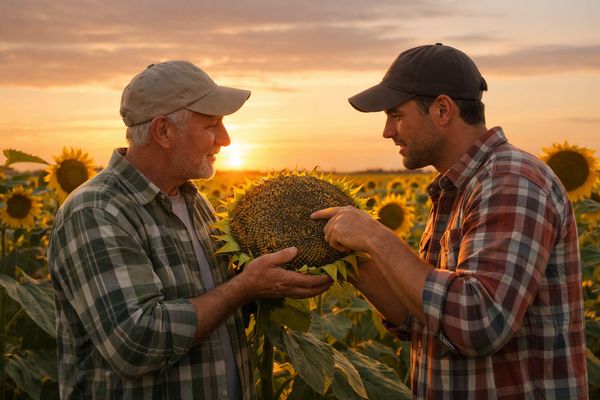
Sunflower markets are trading with a firm undertone into late April, with SAFEX sunflower futures grinding higher and physical seed and kernel prices in key origins edging up in EUR terms. Nearby tightness and resilient crush demand are offsetting expectations for larger 2026/27 crops, keeping downside limited in the short run.
Momentum is modest rather than explosive: South African SAFEX sunflower contracts have gained around 0.5–0.9% day-on-day, while FOB and FCA quotations in Ukraine, Bulgaria and China show incremental week-on-week increases. Strong sunflower meal and oil demand, together with logistics and policy noise around the Black Sea and Russia’s higher export duties on sunflower oil, continue to underpin the complex. Weather is seasonally mixed but without a clear production shock at this stage, so price direction in the coming weeks will hinge on planting pace and early-crop conditions rather than on structural scarcity.
Exclusive Offers on CMBroker

Sunflower seeds
Black with stripe
98%
FOB 1.45 €/kg
(from CN)

Sunflower kernels
hulled, confection
99.95%
FOB 1.19 €/kg
(from CN)

Sunflower kernels
hulled, bakery
99.95%
FOB 1.18 €/kg
(from CN)
📈 Prices & Futures
SAFEX sunflower futures in South Africa moved higher on April 24, 2026, led by the front months. The May 2026 contract settled at 8,777 ZAR/t, up 57 ZAR or 0.65% on the day, while July 2026 closed at 8,985 ZAR/t, gaining 76 ZAR or 0.85%. The Sep 2026 and Dec 2026 positions also advanced, to 9,143 and 9,335 ZAR/t respectively, confirming a gently rising forward curve into year-end.
The single down-move was further out, with March 2027 easing 31 ZAR to 9,100 ZAR/t (-0.34%), while deferred May and Dec 2027 remained unchanged. The structure still signals a premium for 2026 delivery months, consistent with firmer nearby physical markets and some uncertainty around 2026/27 supplies, but not yet pointing to acute tightness.
💶 Indicative physical prices (converted to EUR)
Using approximate FX of 1 USD ≈ 0.94 EUR for conversion of global reference levels, current offers in the brokered market indicate a mildly firmer trend over April, especially for kernels and higher value segments.
| Product | Origin | Delivery terms | Latest price (EUR/kg) | 1–3 week change | Update date |
|---|---|---|---|---|---|
| Sunflower seeds, black with stripe | China (Beijing) | FOB | ≈1.45 EUR/kg | ↑ from ≈1.42 | 24 Apr 2026 |
| Sunflower kernels, hulled confection | China (Beijing) | FOB | ≈1.19 EUR/kg | ↑ from ≈1.16 | 24 Apr 2026 |
| Sunflower seeds, black | Ukraine (Odesa) | FOB | ≈0.58 EUR/kg | Stable month-to-date | 24 Apr 2026 |
| Sunflower kernels, bakery | Bulgaria (Sofia) | FCA | ≈0.99 EUR/kg | ↑ from ≈0.97 | 23 Apr 2026 |
🌍 Supply & Demand
In South Africa, the modest but broad-based rise in SAFEX sunflower futures reflects steady crush demand against a still-finite old-crop balance. Processing plants remain active, with sunflower meal demand underpinned by the global feed complex, as highlighted by recent analyses pointing to recovering sunflower meal trade flows despite earlier disruptions.
Globally, fundamentals are shifting towards more comfortable 2026/27 supplies. The latest USDA oilseeds outlook (April 2026) points to stronger sunflower seed availability driven by larger crops in key producers, including Argentina and the Black Sea region, even as sunflower oil export prices remain supported by strong demand. The EU Commission also projects the 2026 sunflower seed harvest at around 9.6 million tonnes, a three‑year high, which should improve seed availability for crushers and exporters.
In Ukraine, sunflower remains one of the most profitable crops, encouraging farmers to expand sowings. Recent sowing progress data indicate that sunflower planting is already underway across multiple regions, and broader spring industrial crop sowing is advancing steadily. At the same time, local reports show sunflower seed CPT prices in Ukraine firming in April as processors compete for raw material, even while sunflower oil export flows lag and struggle for price support. This divergence supports seed and meal values relative to oil.
Russia’s decision to raise export duties on sunflower oil from April adds another layer of support to seed and meal markets, by tightening netback margins and potentially redirecting demand towards Ukrainian and EU-origin oils and meals. Strong EU export activity in sunflower seed, meal and oil, detailed in recent customs-based statistics, underscores that demand remains solid into both intra-EU and third-country destinations.
📊 Fundamentals & Weather
Fundamentally, the sunflower complex is transitioning from a tight old-crop environment to a potentially more balanced new-crop outlook. EU oilseed output in 2026/27 is projected to rebound to about 33.3 million tonnes, with stronger sunflower seed output a key driver, suggesting more comfortable raw material supplies for crushers later in the season. At the same time, crush margins remain supported by resilient vegetable oil and meal prices, particularly as soft oils such as sunflower, soybean and rapeseed continue to trade firmly in Europe.
Weather-wise, no major global sunflower production threat has emerged in late April. Recent agro‑climatic briefings flag generally mixed but seasonally normal conditions in Ukraine and Eastern Europe, without extreme anomalies so far. However, analysts stress that planting and early vegetative stages are still sensitive to moisture patterns and temperature volatility, and that abnormal weather later in the spring or during flowering could quickly change the supply picture.
In South Africa specifically, the SAFEX structure and basis levels suggest that local fundamentals remain relatively tight near-term. The premium on 2026 delivery months over more distant 2027 contracts mirrors lingering uncertainty over future yields and policy, but does not yet price in a severe deficit. Coupled with global expectations for higher output, this argues for cautious optimism rather than a strongly bullish stance.
📆 Outlook & Trading Strategy
With sunflower seed and kernel prices firming but not spiking, the market appears to be in a consolidation phase. Old‑crop tightness in South Africa and Ukraine, combined with solid meal and oil demand and Russia’s higher export duties on sunflower oil, provide a floor under prices, while the prospect of a larger 2026/27 global crop caps upside. Direction over the next weeks will depend heavily on Black Sea and EU weather during planting and establishment.
🎯 Trading recommendations (short-term, 2–4 weeks)
- Producers (South Africa): Use current strength in SAFEX May–Jul 2026 (8,777–8,985 ZAR/t) to incrementally hedge a portion of expected remaining old‑crop sales. Retain some unpriced volume to participate in any weather‑driven rally during Northern Hemisphere planting.
- Crushers and feed users (EU & MENA): For nearby coverage, secure at least 50–70% of sunflower seed and kernel requirements at current EUR levels, as seed and meal markets are relatively supported while oil remains comparatively weaker. Consider staggering purchases into Q3 as new‑crop clarity improves.
- Importers (Asia & Middle East): Monitor Black Sea logistics and Russian export duty developments closely. Diversify origin mix between Ukraine, EU and Argentina to mitigate policy and freight risk, and be prepared to lock in volumes quickly if weather or geopolitics tighten availability.
- Speculators: Bias towards a mildly long stance in sunflower-linked oilseed baskets, but with tight risk limits, as any confirmation of strong EU and Black Sea crops later this spring could shift sentiment towards a more neutral or even slightly bearish outlook into harvest.
📍 3‑day directional outlook (in EUR terms)
- SAFEX-linked parity (South Africa): Slightly firmer to sideways in EUR-equivalent over the next three sessions, reflecting the existing upward drift and supportive global veg oil complex.
- Black Sea FOB sunflower seeds (Ukraine, Odesa): Stable to marginally higher around 0.58 EUR/kg, with processors maintaining bids amid steady export interest and still-limited oil price gains.
- EU FCA kernels (Bulgaria, Germany): Sideways to slightly firmer near 1.0–1.1 EUR/kg for bakery kernels, as demand from baking and snack segments remains solid and offers only ease if weather turns clearly benign for new-crop across the EU and Black Sea.
Related posts:
 Sunflower Market Firms as SAFEX Lifts and Kernel Offers Edge Higher
 Sunflower Market Steady as SAFEX Firms and Black Sea Prices Hold Range
 Sunflower Market: SAFEX Softens While Black Sea Cash Values Stay Firm
 Sesame Market Edges Firmer on Chad Strength, India Steady Under Emerging Heat Risk
 Ukrainian Flaxseed Edges Higher as EU Buyers Seek Non‑Russian Supply
 Sunflower Market Firms as Oilseeds Complex Lifts SAFEX and Kernel Prices
 Sunflower Market: SAFEX Futures Firm as Black Sea Seeds Hold Steady