
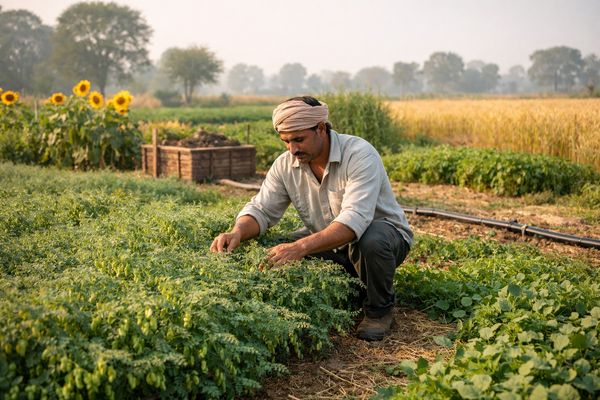
Indian chickpea export prices are broadly steady at elevated levels, with only marginal week‑on‑week moves and a still‑supported forward outlook. Tight domestic balance sheets, firm retail values and hot, early‑summer weather in North India are limiting downside for now.
Indian chickpea markets are consolidating after a firm run‑up through late March and early April. Domestic wholesale prices in New Delhi and Mumbai remain high in rupee terms, and export‑oriented offers are broadly aligned with these elevated levels, helped by limited arrivals and robust mill demand. Weather in North India is now transitioning into the hot summer phase, but with harvest essentially complete, immediate yield risk is low; instead, attention is shifting to how a potentially challenging 2026 monsoon could shape later‑season pulse balances. For the coming three days, New Delhi FOB values are expected to remain range‑bound with only minor intra‑day volatility.
[cmb_offer ids=148,143,149]
📈 Prices & Spreads
All prices converted to EUR at ~1 EUR = 1.08 USD; figures rounded.
| Origin | Location | Specification | Incoterm | Latest price (EUR/kg) | 1-week change |
|---|---|---|---|---|---|
| India | New Delhi | Kabuli 42–44, 12 mm | FOB | ≈0.89 | Flat vs 11 April (USD 0.96) |
| India | New Delhi | Kabuli 44–46, 11 mm | FOB | ≈0.86 | Flat |
| India | New Delhi | Kabuli 46–48, 10 mm | FOB | ≈0.83 | Flat |
| India | New Delhi | Smaller calibres 58–62, 8–9 mm | FOB | ≈0.77–0.80 | Flat |
| Mexico | Mexico City | Kabuli 42–44, 12 mm | FOB | ≈1.20 | Flat w/w |
Recent external price indicators for India show wholesale chickpea values in 2026 averaging around USD 1.89–2.31/kg (≈EUR 1.75–2.14/kg) at retail/wholesale level, confirming strong underlying rupee prices behind the more moderate export‑oriented FOB offers.
🌍 Supply, Demand & Trade Flows
Recent analysis highlights that India’s chickpea market is tight: new‑crop arrivals have lagged expectations, government buffer stocks are relatively low, and imports from Australia have been delayed. This has created a counter‑seasonal firmness during the rabi harvest period, with mills actively buying into strength rather than waiting for deeper harvest discounts.
Medium‑term fundamentals are shaped by a solid but not burdensome rabi pulses harvest, and by policy signals. Earlier estimates pointed to rabi output (including chana) rising modestly year on year, but recent policy commentary also stresses that MSP hikes for chana were among the lowest in the pulse complex, limiting acreage incentives. Combined with record pulse imports in prior seasons, the system carries some cushion, yet domestic demand recovery and limited fresh import buying at current global levels are keeping near‑term balances snug.
⛅ Weather & Crop Conditions (India Focus)
North India, including Delhi and surrounding chana‑growing regions, is now transitioning from a relatively mild, disturbance‑affected early April into a hotter pattern. IMD and media updates describe frequent western disturbances earlier in the month, bringing unseasonal rain and hail, followed by a forecast of maximum temperatures pushing into the low 40s °C around mid‑April in Delhi and the northwest.
With the 2025‑26 rabi chickpea harvest largely complete, this emerging heat mainly affects post‑harvest handling and market logistics rather than yields. Short‑term weather risks include thunderstorms, local hail and strong winds that can disrupt arrivals and warehouse operations in North India, but structural crop damage to chana is now limited. The bigger weather‑related concern for pulses is the risk of a below‑normal 2026 monsoon, flagged in some seasonal commentary, which could tighten pulse balances later in the year if it materialises.
📊 Market Drivers & Price Outlook
- Firm domestic baseline: Retail and wholesale prices for chickpeas in India remain high in local‑currency terms, supporting export indications and limiting downside even as global grain and oilseed markets show mixed trends.
- Limited harvest pressure: Despite the seasonal arrival peak, tight farmer selling and low government stocks are preventing a meaningful break in prices, a pattern confirmed by recent trade analysis.
- Policy & import backdrop: After earlier years of large pulse imports and discussion about duties on chana and yellow peas, the current environment leans toward more cautious import buying. This, together with modest MSP increases for chana, creates a landscape where domestic supply must do most of the work in balancing the market.
- Weather and monsoon risk premium: While immediate rabi crop risk is minimal, emerging signals about a potentially uneven 2026 monsoon keep a small risk premium in pulse markets, especially if early Kharif conditions disappoint.
Given these factors, Indian chickpea FOB prices in New Delhi are likely to remain in a firm, sideways band in the very near term, with only limited scope for correction unless arrivals suddenly accelerate or policy support for imports strengthens.
📆 Trading Outlook (Next 1–2 Weeks)
- Importers/Buyers: For South Asia, Middle East and Mediterranean buyers reliant on Indian Kabuli chickpeas, current New Delhi FOB levels around EUR 0.80–0.90/kg for most sizes look fair relative to domestic fundamentals. Consider staggering purchases over the next 1–3 weeks to capture any brief dips on days of heavier arrivals or softer rupee.
- Indian exporters: With domestic balances tight but not critically so, maintain offers near the current range, using smaller discounts only for prompt shipment lots or off‑grades. Priority should be on managing execution risks around heat, local storms and potential transport disruptions rather than aggressive price cuts.
- Speculative participants (chana futures): Near‑term bias is mildly supportive given the tight physical tone, but the risk/reward for fresh longs is diminishing at current elevated levels. Use any weather‑ or currency‑driven spikes to lighten length ahead of clearer 2026 monsoon guidance.
📍 3‑Day Directional Price Indication (India, EUR)
Based on current fundamentals, weather, and trade flow signals for New Delhi export offers:
| Region / Market | Product | Today (17 Apr) | 18 Apr | 19 Apr | Bias |
|---|---|---|---|---|---|
| New Delhi (IN) | Kabuli 42–44, 12 mm, FOB | ≈0.89 EUR/kg | ≈0.89 EUR/kg | ≈0.88–0.89 EUR/kg | Sideways / very slightly softer intra‑day |
| New Delhi (IN) | Medium 44–48, FOB | ≈0.83–0.86 EUR/kg | ≈0.83–0.86 EUR/kg | ≈0.82–0.85 EUR/kg | Sideways |
| New Delhi (IN) | Smaller 58–62, FOB | ≈0.77–0.80 EUR/kg | ≈0.77–0.80 EUR/kg | ≈0.76–0.79 EUR/kg | Sideways / slight downside on larger arrival days |
Overall, Indian chickpea prices should remain well‑supported over the next three days, with only modest scope for downside and no clear catalyst for a sharp rally in the immediate term.
[cmb_chart ids=148,143,149]
Related posts:
 Indian Chickpea Prices Hold Firm as Heat Builds and Monsoon Risks Loom
 Indian Chickpea Prices Hold Firm as Heat Builds Ahead of Monsoon
 Chickpeas Flat but Firm: India–Mexico Price Update and Short-Term Outlook
 Guar Gum Prices Hold Steady as Heat Builds in India and Vietnam
 Chickpeas: Soft Spot Prices but Weather and Low Stocks Put a Floor Under the Market
 Green Gram Stability Caps Global Lentil Price Upside Near Term
 Kabuli chickpeas rally on Indian supply shortfall and firm export demand
 Indian Chickpeas at a Seasonal Crossroads: Short-Term Dip, Medium-Term Support