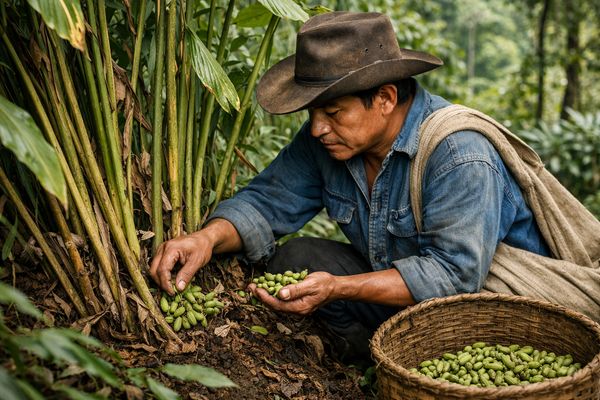
India’s cardamom market is locked in a sharp rally as crop losses in both India and Guatemala collide with booming export demand, leaving little room for near-term price relief. European buyers should prepare for persistently elevated replacement costs and heightened volatility over the next month.
A severe supply-side shock is defining the current cardamom cycle. Unseasonal heavy rainfall in Kerala and Tamil Nadu has cut India’s 2024/25 crop to only 40–50% of last season, while Guatemala is also harvesting roughly half its normal volume. At the same time, exports from India have surged, as high Guatemalan prices keep international demand firmly focused on Indian origin, even at elevated levels. This combination of constrained supply and robust off‑take underpins a distinctly bullish price structure for the coming weeks.
[cmb_offer ids=118,116,114]
📈 Prices & Recent Moves
At the Idukki District Traditional Cardamom Producers Company auction in Kerala, arrivals recently increased to around 64 tonnes, yet aggressive buying pushed the average auction price to about USD 29.54/kg, from USD 26.36/kg at the previous sale. In Delhi’s wholesale spice market, 7.5 mm cardamom has added roughly USD 2.70/kg over two sessions to trade around USD 28.57–29.70/kg.
Using an indicative FX rate of 1 USD ≈ 0.94 EUR, this translates to approximately EUR 25.90–27.90/kg at wholesale level. Current FOB offers in New Delhi for whole green cardamom (non‑organic) broadly align with this elevated structure, with 7.5 mm quality around EUR 23.20/kg and 8 mm around EUR 24.10/kg, while smaller 6.5–6.8 mm grades still command about EUR 21.00/kg.
| Product (IN, New Delhi) | Specification | Delivery term | Latest price (EUR/kg) | Change vs. prev. | Last update |
|---|---|---|---|---|---|
| Cardamom whole | Green 7.5 mm (non‑organic) | FOB | 23.20 | Unchanged | 18 Apr 2026 |
| Cardamom whole | Green 8 mm (non‑organic) | FOB | 24.10 | Unchanged | 18 Apr 2026 |
| Cardamom whole | Green 7–7.2 mm (non‑organic) | FOB | 21.85 | Unchanged | 18 Apr 2026 |
| Cardamom whole | Green 6.0–6.5 mm (organic) | FOB | 16.10 | Unchanged | 18 Apr 2026 |
Overall, the domestic auction rally has translated into firmly supported export offer levels, with little sign yet of meaningful downside correction.
🌍 Supply & Demand Balance
The core driver is a pronounced supply shock in both of the world’s key origins. In India, unseasonal heavy rainfall during critical phases of the growing cycle in Kerala and Tamil Nadu has caused widespread pod drop and quality issues, leaving this season’s output at just 40–50% of last year’s crop. This has sharply reduced the volume of fresh arrivals into major auction centres, even as prices climb.
At the global level, Guatemala – normally providing an important buffer to Indian tightness – is also reporting only about half its typical crop. This parallel shortfall effectively removes the main alternative origin that would usually cap Indian prices, tightening the world balance and amplifying the impact of India’s own losses.
On the demand side, India’s spice board data show cardamom exports of 12,281 tonnes in the first ten months of FY 2024/25, with export earnings of USD 325.37 million. That represents a surge of about 132% in volume and 160% in value versus the same period a year earlier, when only 5,294 tonnes were shipped. Despite higher prices, international buyers remain highly active, supported by strong end‑use in food processing, beverages and flavouring.
📊 Fundamentals & European Perspective
The combination of contracting supply and accelerating exports has left little surplus for inventory rebuilding at origin. Stocks held by traders and exporters are being drawn down into a market that is already structurally tight, which tends to reinforce each price spike at auction and in wholesale channels.
For European spice importers and food manufacturers, this environment translates into sustained high replacement costs and challenging coverage decisions. With both India and Guatemala simultaneously constrained, switching origin offers only limited relief. Moreover, the elevated cost of Guatemalan material makes Indian cardamom comparatively more attractive on a delivered‑Europe basis, helping keep Indian export flows strong despite the rally.
Quality differentials are also likely to widen. Premium larger grades (7.5 mm and above) are facing additional scarcity, reflected in their higher EUR/kg levels versus smaller or mixed grades. Buyers with strict specification requirements may face tighter availability and longer lead times than those able to accept broader size ranges.
📆 Short‑Term Outlook & Weather Angle
The near‑term outlook is firmly bullish. With this season’s Indian production already badly compromised and Guatemala unable to fill the gap, there is no obvious source of quick supply relief. Market participants report no sign of significant price correction on the horizon, and auction dynamics suggest that any dips are likely to attract fresh buying interest from both domestic and export channels.
Weather in the coming weeks will be important mainly in terms of its impact on late‑season picking and the health of standing plants for the next cycle. However, given the magnitude of the existing crop losses, even favourable short‑term weather would not materially repair the current season’s balance. If fresh arrival volumes in the next three to four weeks underperform expectations or if export enquiries remain strong, prices could plausibly test higher levels again from today’s already elevated base.
🧭 Trading Outlook & Risk Management
- Importers (EU/MEA): Consider layering in coverage on near‑by and early new‑crop positions rather than waiting for a correction that may not materialise. Focus on securing core volumes of key sizes (7.5 mm+, powder) and maintain some flexibility on smaller grades to optimise cost.
- Food manufacturers: Review product formulations and packaging sizes to manage higher input costs. Where possible, align promotional calendars with already‑covered raw material to avoid exposure to spot spikes.
- Origin sellers: Use current strength to lock in forward sales selectively while preserving some upside exposure. Monitor export demand closely; aggressive short‑selling against uncertain arrivals carries significant risk in this supply‑constrained year.
- Risk focus: Key upside risks include further downgrades to crop estimates and renewed weather disruptions. Downside risks are limited mainly to a sharp, unexpected demand slowdown or policy interventions that curb exports – neither of which is visible at present.
📍 3‑Day Directional View (EUR, Indicative)
- India, New Delhi – whole green 7.5 mm (FOB): around EUR 23.0–23.5/kg; bias: firmer to sideways over the next 3 days as auction prices stay elevated.
- India, New Delhi – whole green 8 mm (FOB): around EUR 24.0–24.5/kg; bias: firmer, with premium large sizes particularly tight.
- India, New Delhi – smaller grades 6.0–6.8 mm (FOB): roughly EUR 16.0–21.0/kg depending on size and organic status; bias: sideways to slightly higher on spill‑over from top grades and export demand.
[cmb_chart ids=118,116,114]