
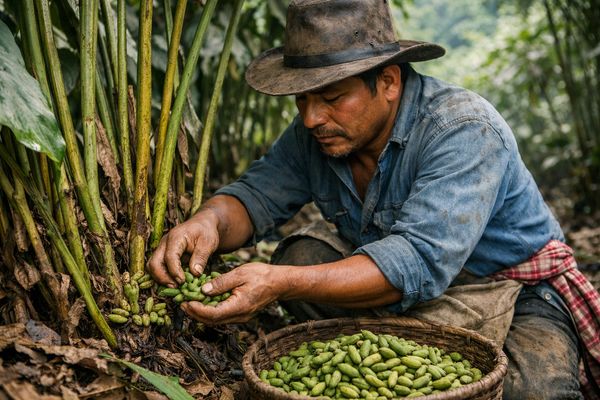
Small cardamom is in the midst of a sharp, supply‑driven rally, with Indian prices pushed higher by tight Kerala arrivals and persistent export demand. Premium 8 mm grades are leading gains, and a move above €30/kg equivalent for best qualities is plausible if export inquiries intensify and new crop flow stays constrained.
The current spike is rooted in genuine physical tightness rather than speculative froth. Crop damage in Kerala has limited new arrivals, especially of top grades, while stockists in producing regions show little appetite to discount. At the same time, steady buying from the Middle East and other traditional export destinations is keeping consuming‑market inventories lean, amplifying price sensitivity to any further supply disruptions.
Exclusive Offers on CMBroker

Cardamom whole
green,7.5-8 mm
FOB 17.90 €/kg
(from IN)

Cardamom whole
green 6.0-6.5 mm
99%
FOB 16.10 €/kg
(from IN)

Cardamom whole
green 7-7.2 mm
FOB 21.85 €/kg
(from IN)
📈 Prices & Market Sentiment
Kerala auction prices climbed from about $25.07/kg on 1 April to $28.31/kg by 13 April, a gain of more than $3.24/kg in under two weeks. By the week ending 21 April, Delhi wholesale levels were around $27.91–$29.02/kg for formula quality and roughly $36.52/kg for best 8 mm grade, confirming a steep quality premium at the top of the market.
Using a working rate of 1 USD ≈ 0.93 EUR, Delhi wholesale values translate to approximately €26–27/kg for formula quality and close to €34/kg for best 8 mm material. Recent offer indications from New Delhi for Indian green whole cardamom (FOB/FCA) likewise show firm, historically elevated levels across sizes, with premium 8 mm lots around €21–24/kg FOB and tight spreads between successive weekly updates, highlighting a stable but firm tone.
| Product (India, New Delhi) | Grade / Size | Terms | Latest Price (EUR/kg) | Change vs. Previous (EUR/kg) | Update date |
|---|---|---|---|---|---|
| Cardamom whole | green, 8 mm | FOB | 24.10 | 0.00 | 18 Apr 2026 |
| Cardamom whole | green 7–7.2 mm | FOB | 21.85 | 0.00 | 18 Apr 2026 |
| Cardamom whole | green 6.0–6.5 mm (organic) | FOB | 16.10 | 0.00 | 18 Apr 2026 |
🌍 Supply & Demand Drivers
Physical tightness in Kerala underpins the rally. Earlier‑season crop damage has curtailed new crop arrivals, and the scarcity of top‑end capsules is particularly acute. While lighter quality material remains more available, stockists are raising offers for premium grades and resisting concessions, suggesting confidence that replacement stocks will not arrive in volume in the very near term.
Export demand provides the second leg of support. Buyers from the Middle East and Gulf Cooperation Council countries, where cardamom is embedded in tea and confectionery culture, continue to procure steadily. This export pull is preventing inventory accumulation in key consuming markets and keeping pipelines thin, so even modest disruptions in Kerala can trigger outsized price reactions.
Globally, Guatemala remains the largest cardamom supplier by volume and India’s main competitor in export markets. However, Indian small cardamom continues to command a clear quality premium, especially for high‑end food and beverage uses. European and Middle Eastern buyers focused on flavor and appearance are therefore facing a tighter and more expensive Indian market, with limited scope to switch origin without compromising on specification.
📊 Fundamentals & Weather Context
Fundamentally, the market is being driven by a mismatch between constrained high‑grade supply and resilient international demand. The absence of aggressive selling by Indian stockists at current levels indicates that, despite the recent rally, many market participants see prices as justified by on‑the‑ground tightness rather than overheated speculation.
In Kerala’s Idukki and Cardamom Hills belt, April typically brings warm conditions and pre‑monsoon showers. Recent local reports point to variable weather with intermittent thunderstorms in parts of the state, which can disrupt harvest logistics but also support plant moisture ahead of the monsoon. At this stage, weather is adding some operational noise rather than fundamentally changing crop prospects, but any localized heavy rain or heat spikes could further complicate arrivals and drying.
📆 Short-Term Outlook (2–4 weeks)
Over the next two to four weeks, small cardamom prices are expected to remain firm around current elevated levels. A sustained move above the equivalent of €30/kg for best grades is possible if export inquiries strengthen and Kerala arrivals underperform expectations, especially for 7.5–8 mm and 8 mm lots.
Downside appears limited in the near term. Only a sudden flush of new crop from Kerala’s growing belt, or a marked pause in Middle Eastern buying, would be sufficient to trigger a meaningful correction. In their absence, the market is likely to trade in a firm to slightly higher band, with volatility concentrated in premium grades.
📌 Trading Outlook & Strategy
- Importers / industrial users: Consider covering near‑term needs promptly, especially for 7.5–8 mm and 8 mm grades, as upside risk dominates while export demand stays firm and Kerala arrivals are constrained.
- Retail packers: Where possible, optimize blends towards slightly smaller grades or mix origins to manage cost escalation, while maintaining a core share of Indian premium material for high‑end lines.
- Producers & stockists: Current valuations are well supported by fundamentals; cautious selling on rallies is advisable, but there is no strong incentive to push volumes aggressively unless local arrivals improve.
- Speculative participants: The balance of risks favors a firm bias, yet the recent steep rally increases vulnerability to sharp corrections if supply surprises to the upside; risk management and tight stop‑losses are essential.
📉 3-Day Directional View (Key Hubs, in EUR terms)
- Kerala auctions: Bias mildly upward to steady as limited high‑grade arrivals and active exporters keep competition strong.
- Delhi wholesale (formula & 8 mm): Steady to firm, with premium 8 mm likely to retain a significant premium over medium grades.
- FOB New Delhi export offers: Stable at elevated levels, with only minor day‑to‑day adjustments expected in the immediate term.
Related posts:
 Large Cardamom Pauses After Rally While Green Grades Stay Firm
 Black Pepper Rally Accelerates as Indian Supply Tightens
 Indian Chilli Prices Hold Firm on Tight Supply and Strong Export Pull
 Indian Coriander Rally Tightens Global Supply and Lifts EU Procurement Risk
 Indian Black Pepper Rallies as Supply Tightens and Stockists Chase Scarcity
 Vietnam Pepper Exports Surge as Supply Tightens and Logistics Bite
 Indian Cardamom Edges Softer as Heat Builds and Export Demand Stays Steady
 Fenugreek Seeds Spike as Indian Spot Supply Tightens