
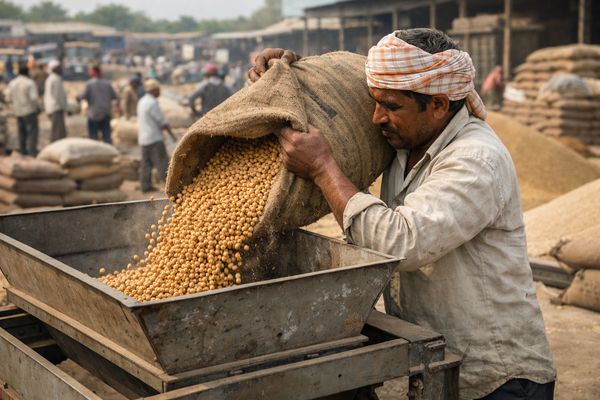
Indian chickpea prices in New Delhi are edging lower in EUR terms after April’s firm tone, but the downside appears modest as government procurement and steady domestic demand continue to provide a floor.
The latest FCA offers from New Delhi show small week‑on‑week declines across most sizes, with large Kabuli chickpeas (42–44, 12 mm) now around EUR 0.93/kg and smaller 60–62 count near EUR 0.73/kg. This softening contrasts with still‑firm chana (desi chickpea) spot quotes in domestic mandis, where prices are broadly holding on balanced arrivals and ongoing government buying at the MSP equivalent. At the same time, India heads into May with an outlook for above‑normal temperatures and more frequent heatwave days in key agricultural states, which adds a medium‑term risk premium even if the current rabi harvest is largely complete.
Exclusive Offers on CMBroker

Chickpeas dried
count 42-44, 12 mm
FCA 0.93 €/kg
(from IN)

Chickpeas dried
count 44-46, 11 mm
FCA 0.92 €/kg
(from IN)

Chickpeas dried
count 46-48, 10 mm
FCA 0.85 €/kg
(from IN)
📈 Prices & Spreads
Using an indicative rate of 1 EUR ≈ 90 INR, current New Delhi offers translate into the following levels:
| Origin | Location / Term | Type (count / size) | Latest price (EUR/kg) | Prev. price (EUR/kg) | WoW change |
|---|---|---|---|---|---|
| India | New Delhi, FCA | 42–44, 12 mm | 0.93 | 0.95 | ▼ ~2% |
| India | New Delhi, FCA | 44–46, 11 mm | 0.92 | 0.94 | ▼ ~2% |
| India | New Delhi, FCA | 46–48, 10 mm | 0.85 | 0.87 | ▼ ~2% |
| India | New Delhi, FCA | 58–60, 9 mm | 0.81 | 0.83 | ▼ ~2% |
| India | New Delhi, FCA | 60–62, 8 mm | 0.73 | 0.74 | ▼ ~1% |
FOB New Delhi offers for Kabuli chickpeas remain modestly above FCA, but have also softened versus late April levels published by trade analysts, which had 42–44, 12 mm closer to EUR 0.88–0.90/kg FOB. The current discount of Indian origin versus Mexican large Kabuli (above EUR 1.25/kg FOB Mexico City) preserves India’s export competitiveness into price‑sensitive destinations.
🌍 Supply, Demand & Policy Drivers
Government data for 2025/26 point to a robust gram (chana) crop of around 11.8 million tonnes, reinforcing India’s position as the dominant global chickpea producer. Recent spot reports from Indian pulse markets indicate that chana prices have been firm relative to other pulses like tur, as arrivals are partly diverted to government agencies buying at the minimum support price (MSP) of roughly INR 5,875/100 kg.
This MSP floor effectively caps downside in farm‑gate and mandi prices and indirectly supports Kabuli values, as farmers and traders can switch between desi and Kabuli sales channels. Export guidance for 2026 stresses that India remains a competitive supplier of Kabuli chickpeas, with solid demand from the Middle East and South Asia for both food and processing use. Freight costs and container availability, while off their peaks, are still highlighted as watchpoints by exporters, limiting how far FOB offers can fall from current levels.
🌦 Weather Outlook (Region: India)
The India Meteorological Department’s latest monthly outlook for May 2026 signals above‑normal temperatures and a higher incidence of heatwave days across several regions, including parts of Gujarat and Maharashtra that are important to India’s pulse belt. While the main 2025/26 rabi chickpea harvest is already advanced, elevated heat may still affect late‑harvested fields and soil moisture conditions ahead of the next sowing cycle.
Current commentary from agronomic sources also notes continuing structural vulnerability of central Indian states such as Madhya Pradesh to heat and land‑degradation stress, underscoring the risk that future pulses output could be more variable if monsoon performance disappoints. For now, however, there is no immediate weather‑driven supply shock priced into New Delhi chickpea offers; instead, logistics and policy remain the key short‑term levers.
📊 Market Tone & Fundamentals
- Harvest & arrivals: The rabi chickpea harvest window (February–May) is in its late stages, with arrivals gradually easing from peak levels but still sufficient to meet domestic demand.
- Competing pulses: Tur has softened on weak demand and import competition, but chana and urad are reported firm, supporting a generally steady pulses complex and helping to stabilise Kabuli chickpea valuations.
- Macro & policy backdrop: Recent government crop estimates and ongoing procurement programmes for rabi pulses reinforce adequate domestic availability while maintaining farmer incentives, suggesting only limited downside for chickpea prices unless export demand weakens sharply.
📆 Short-Term Outlook & Trading Ideas
- Importers (EUR buyers): Use the current ~1–2% dip in New Delhi FCA prices to secure near‑term cover, especially for 42–46 count Kabuli where Indian origin remains clearly cheaper than Mexican offers. Consider layering purchases over the next 1–2 weeks to hedge against possible heat‑related risk premium later in the season.
- Indian exporters: Maintain offer discipline on larger sizes (42–46 count), as MSP‑supported desi chana and firm domestic demand limit downside. For smaller counts (58–62), a slightly more aggressive pricing stance may be needed to move volumes if export demand remains selective.
- Domestic users (millers, packers): With government procurement absorbing a share of arrivals, spot downside appears limited. Consider covering at least a portion of Q2 requirements at current EUR‑equivalent levels while monitoring freight and currency developments.
📍 3‑Day Price Direction (Region: India, New Delhi)
- FCA New Delhi Kabuli chickpeas (all counts): Stable to slightly softer in EUR terms over the next 3 trading days, as post‑harvest supplies remain adequate and no immediate policy shocks are visible.
- FOB New Delhi exports: Largely stable; any further downside is likely to be small (within 1–2%) given MSP support for pulses and still‑firm chana benchmarks in domestic mandis.
Related posts:
 Chinese Lentil FOB Prices Ease Slightly as Imports Stay Capped
 Chinese Bean FOB Prices Ease Slightly as Planting Weather Turns Supportive
 Indian Chickpea Squeeze Sets Bullish Tone for Global Market
 Mexican Chickpea FOB Prices Ease Slightly as India Trades Sideways
 Brazil–UK Bean Prices Ease Slightly as Weather Stays Quiet
 Indian Chickpea Prices Edge Higher as Heatwave Looms Over North India
 Chinese Bean FOB Prices Ease Slightly as Global Pulse Demand Stays Firm