
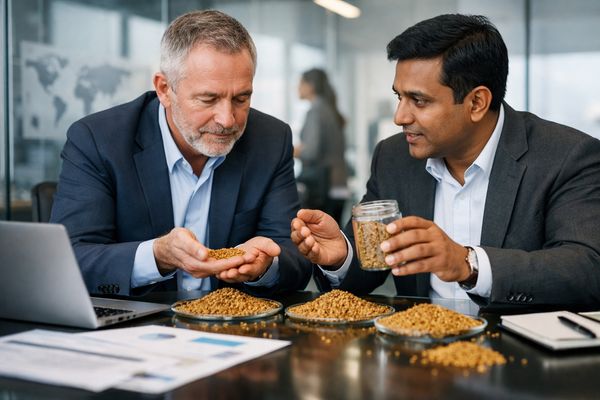
Fenugreek seed markets are trading with a soft undertone as heavy rabi arrivals in India outpace demand and Gulf export buying remains largely absent. Prices are expected to stay rangebound with a downward bias until arrivals ease or meaningful export demand returns.
India’s fenugreek complex is currently characterized by quiet domestic buying, subdued export interest from the Middle East, and only steady offtake from European spice and nutraceutical users. Rabi harvest flows from Rajasthan, Gujarat and Madhya Pradesh are keeping supply ample and reinforcing a slight surplus. For buyers able to commit volumes in the coming weeks, this environment offers an opportunity to secure competitively priced Indian origin before a potential seasonal floor emerges toward late May.
Exclusive Offers on CMBroker

Fenugreek seeds
FAQ, machine clean
FCA 0.61 €/kg
(from IN)

Fenugreek seeds
FOB 0.97 €/kg
(from EG)

Fenugreek seeds
FAQ, machine clean
FOB 0.66 €/kg
(from IN)
📈 Prices & Market Tone
Fenugreek seed prices at Delhi wholesale markets traded last week around ₹12,800–₹13,000 per quintal, equivalent to roughly EUR 1.50–1.55 per kg at prevailing exchange rates. This range reflects a soft but not panicked market: sellers are not aggressively discounting, while buyers show limited urgency, resulting in a generally quiet spot environment.
Export-oriented offers mirror this mild softness. Indian FAQ machine-clean fenugreek seeds ex-New Delhi are currently indicated around EUR 0.60–0.66/kg (FCA/FOB), with 99% purity non-organic lots close to EUR 0.61–0.65/kg. Organic seeds and powder maintain a premium, with recent offers near EUR 0.97/kg for organic whole and about EUR 1.06/kg for organic powder FOB India. Egyptian origin whole seeds are indicated around EUR 0.97/kg FOB, trading at a clear premium to Indian FAQ grades.
🌍 Supply & Demand Drivers
Fenugreek is mainly cultivated in Rajasthan, Gujarat and Madhya Pradesh, closely aligned with mustard and cumin in the northwestern Indian rabi calendar. The March–May harvest is now in full swing, with consistent inflows into producing wholesale markets across all three states. This steady arrival pattern is the primary driver behind the present surplus tone and soft price structure.
On the demand side, domestic Indian buying has been muted, with many traders preferring to sit on the sidelines rather than chase the market lower or higher. Export demand, traditionally led by Middle Eastern buyers at this time of year, has been particularly weak. Geopolitical tensions and trade disruptions in the Persian Gulf region have curtailed what is normally the most active fenugreek import channel, removing a key layer of external price support.
Global offtake from European spice blenders and herbal supplement manufacturers appears stable rather than dynamic. This steady but unspectacular demand helps absorb some Indian surplus but is not strong enough on its own to rebalance the market. As a result, overall fundamentals lean slightly bearish in the very short term, even though long-term structural demand for fenugreek in nutraceutical and pharmaceutical applications remains positive.
📊 Fundamentals & Regional Competitiveness
India remains the world’s dominant producer and exporter of fenugreek seed, with its pricing effectively setting the global reference. The current gap between Indian FAQ grades (around EUR 0.60–0.66/kg FOB) and Egyptian origin (about EUR 0.97/kg FOB) underscores India’s cost advantage in standard quality segments. For buyers in Europe and other third markets, this spread favours Indian origin for bulk applications where quality needs are met by FAQ or standard machine-cleaned material.
Within India, the soft undertone is most clearly a function of strong harvest flows rather than a structural collapse in demand. Stockholding capacity in producing regions is limited, incentivizing ongoing selling into the market. However, traders are reluctant to accelerate sales at significantly lower price levels, suggesting a gradual, supply-driven easing rather than abrupt declines. This pattern supports the idea of a broad trading band rather than a sharply trending market.
From a medium-term perspective, fenugreek’s role in herbal tea, functional foods and blood-sugar-management supplements continues to underpin demand growth in both Europe and other developed markets. While this structural story does not immediately offset today’s harvest pressure, it reduces the risk of a deep or prolonged price slump provided geopolitical disruptions do not further depress Gulf demand.
☁️ Weather & Harvest Outlook
With the rabi harvest window in Rajasthan, Gujarat and Madhya Pradesh running through late May, weather over the next few weeks will matter mainly for the tail end of field operations and post-harvest handling rather than yield formation. At this stage of the season, volumes already moving into the market indicate a broadly successful crop, consistent with the current surplus tone.
Absent any late-season adverse weather or logistical disruptions, arrivals are expected to remain steady in the near term before naturally tapering toward the end of May. This anticipated slowdown in arrivals is one of the key potential catalysts for a stabilization or mild recovery in prices, particularly if it coincides with renewed export inquiry from Middle Eastern or other importers.
📆 Short-Term Outlook (2–4 Weeks)
Over the next two to four weeks, fenugreek prices are likely to remain rangebound with a soft bias as long as current arrival levels persist. The market’s downside is cushioned by sellers’ reluctance to sell aggressively below recent Delhi wholesale ranges and by India’s competitiveness in export markets. However, without a material pickup in export demand, especially from the Middle East, any near-term upside appears limited.
A more constructive tone could emerge toward late May if two conditions coincide: first, a visible tapering in rabi arrivals as harvesting winds down; and second, signs of re-engagement from Gulf buyers once trade and geopolitical uncertainties ease. European herbal supplement manufacturers and spice importers can use this phase to build coverage at competitive prices but may prefer to stagger purchases until clearer signals of a price floor appear.
🧭 Trading Outlook & Recommendations
- Importers in Europe: Use current soft pricing in Indian FAQ and machine-clean grades to secure partial coverage for Q2–Q3 needs. Consider layering purchases to benefit if the soft undertone persists, but avoid being under-covered should a late-May floor develop.
- Middle Eastern buyers: Those able to operate despite regional disruptions may find this an attractive window to re-enter, with Indian origin offering a clear cost advantage over Egyptian supplies.
- Indian traders/exporters: Focus on managing inventory and cash flow through selective sales rather than aggressive discounting. Prepare for potential demand recovery by ensuring quality and documentation are aligned with European nutraceutical and spice requirements.
- Industrial users (nutraceuticals, teas): Consider forward contracting a share of requirements at today’s levels, particularly for higher-spec and organic grades where supply is structurally tighter and premia may widen in a recovery phase.
📍 3-Day Price Indication (Directional)
| Market / Product | Indicative Level (EUR) | Terms | 3-Day Bias |
|---|---|---|---|
| India, Fenugreek seeds FAQ, machine clean | ≈ 0.60–0.66 / kg | FCA/FOB New Delhi | Slightly softer to sideways |
| India, Fenugreek seeds 99% non-organic | ≈ 0.61–0.65 / kg | FOB New Delhi | Sideways |
| India, Fenugreek seeds organic (whole) | ≈ 0.97 / kg | FOB New Delhi | Sideways to slightly softer |
| India, Fenugreek powder organic | ≈ 1.06 / kg | FOB New Delhi | Sideways |
| Egypt, Fenugreek seeds | ≈ 0.97 / kg | FOB Kairo | Sideways |
Related posts:
 Soft undertone in Indian coriander seeds opens a tactical buying window
 Soft Undertone in Indian Coriander Opens Tactical Buying Window
 Turmeric Prices Under Pressure as Exports Slow and Stocks Weigh on Erode
 Indian Fenugreek Seeds: Stable Prices Amid Hot Weather and Harvest Arrivals
 Cinnamon Market: Soft Indian Tone, Firm Cassia Floor, Weather in Focus
 Fenugreek Seeds: Indian Export Prices Hold Firm as Heatwave Looms
 Indian Coriander Defies Soft Spice Complex as Demand Tightens Post‑Harvest