
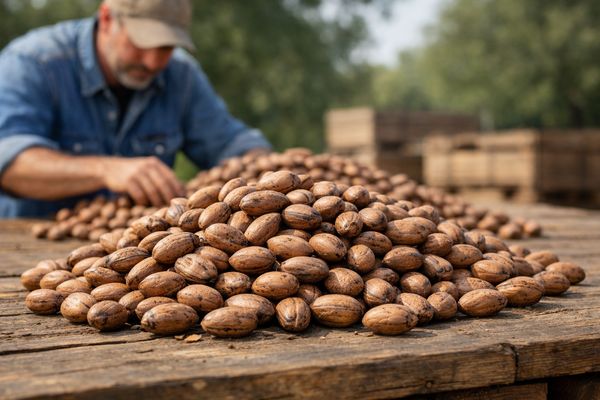
U.S. pecans have shifted into a clearly supply-abundant environment as March 2026 shipments fell sharply year on year while inventories edged above both last season and the five‑year average. With commitments soft and the net long position expanding, prices are under downward pressure despite receipts easing month on month.
The U.S. pecan market is moving from earlier supply tightness to a more comfortable balance, but demand has not kept pace. Season‑to‑date receipts are modestly above both last year and the five‑year norm, while shipments lag double‑digit below. Domestic demand still anchors offtake, yet export flows are weak relative to history, particularly into Asia. Weather in key producing states is generally seasonally warm with some localized storms but no immediate large‑scale threat, leaving demand and inventory management as the dominant short‑term price drivers.
📈 Prices & Market Mood
Market sources indicate pricing is under pressure as inventory builds against subdued demand. Earlier concerns about supply tightness have eased, and the tone has shifted toward buyers’ advantage. With shipments well below historical benchmarks and a growing net long, sellers are likely to compete more aggressively on price, especially for standard grades and older crop.
🌍 Supply & Demand Balance
Supply side
- March 2026 receipts were 31.6 million lbs, down 40% from February (52.3 million lbs), 17% below March 2025, and 13% under the five‑year average.
- Season‑to‑date receipts reached 273.3 million lbs, up 7% year on year and 2% above the five‑year average, confirming a slightly larger available crop.
- Improved pecans dominate the supply mix at 87% of receipts, with native at 5% and substandard at 8%, supporting good availability of higher‑quality product.
- Total inventory rose to 262.8 million lbs, up 5% month on month and 6% above March 2025, broadly in line with the five‑year average.
The inventory structure (36% shelled, 64% in‑shell) and alignment with the five‑year norm underscore that physical availability is no longer constrained. As a result, supply is unlikely to be a supportive factor for prices in the near term.
Demand side
- March shipments were 25.1 million lbs, up 1% month on month but down 21% year on year and 34% below the five‑year average.
- Season‑to‑date shipments totaled 226.9 million lbs, 11% below last year and 19% below the five‑year average, indicating a broad‑based demand slowdown.
- Domestic shipments dominate with 19.1 million lbs in March (76% of total) and 184.5 million lbs season‑to‑date, while exports reached just 6.0 million lbs in March.
- Export destinations in March: Europe 49.9%, Middle East 22.4%, Asia 17.0%, North America 9.1%, Africa 1.7%, highlighting a relatively better pull from Europe versus Asia.
The combination of weak exports and underperforming domestic offtake versus historical averages is the core bearish driver. Unless demand accelerates into late marketing‑year holiday and ingredient buying programmes, stocks are likely to remain burdensome.
📊 Fundamentals & Positioning
- Commitments in March stood at 208.2 million lbs, down 4% from February, 13% below last year, and 7% under the five‑year average.
- The net position widened to +54.6 million lbs, up from +32.5 million lbs in February and well above the five‑year average of +37.0 million lbs.
A higher net long in the face of soft commitments signals increasing unsold stocks. This typically encourages more aggressive selling, discounts on bulk volumes, and greater differentiation by quality and certification. Absent a positive demand surprise, these fundamentals argue for continued soft to weaker pricing over the short term.
🌦️ Weather Snapshot for Key U.S. Pecan Regions
Short‑term weather in major pecan states is seasonally warm with some localized storms but no widespread stress signal. In Georgia, conditions are mostly sunny and warm on May 5–6, with a more humid, stormy period expected on May 7, including potential heavy downpours and localized damaging winds.
In Texas, forecasts point to very warm weather on May 5 followed by gradually cooler but still pleasant conditions through May 7, with more clouds than sun but no major extremes. Overall, the three‑day outlook does not materially change the medium‑term supply picture and leaves current fundamentals demand‑driven.
📆 Trading Outlook & Strategy
- For buyers (importers, roasters, industrial users): The shift to a supply‑abundant market with weak shipments favours patient, staggered purchasing. Consider extending coverage on price dips, especially for improved grades, while keeping some flexibility in case of further downside.
- For growers and shellers: Rising inventories and a higher net long argue for disciplined sales hedging. Prioritize moving older and substandard stock and focus on quality differentiation and certifications to defend premiums.
- For traders: The widening net long and below‑average commitments support a cautiously bearish bias in the near term, with potential for basis softening if demand does not rebound into mid‑year.
📉 3‑Day Directional Price Indication (EUR)
Indicative short‑term outlook for key wholesale markets (converted to EUR):
| Region / Market | Product | 3‑Day Directional View (EUR) |
|---|---|---|
| U.S. export FOB (reference for EU buyers) | Pecans in‑shell & kernels | Slightly softer to stable in EUR terms as abundant stocks meet cautious demand |
| Europe (importer / processor level) | Pecan kernels | Mostly stable in EUR, with mild downside risk where sellers seek to clear inventory |
| Middle East & Asia (CIF, EUR‑equivalent) | Pecan kernels | Stable to slightly weaker as buyers maintain selective, price‑sensitive purchasing |
Over the next three days, the pecan market is expected to trade in a soft undertone, with limited upside catalysts and ongoing pressure from above‑average inventories and underperforming shipments.
Related posts:
 Cashew Market Holds Firm as Tight African Supply Meets Steady Kernel Demand
 South Africa’s Pistachio Gamble: New Supply in a Tight Global Market
 Pistachio Kernels Tighten as Shipments Outpace Supply
 Cashew market caught between strong supply and fragile demand
 India anchors global almond trade as shipments surge but buyers stay cautious