
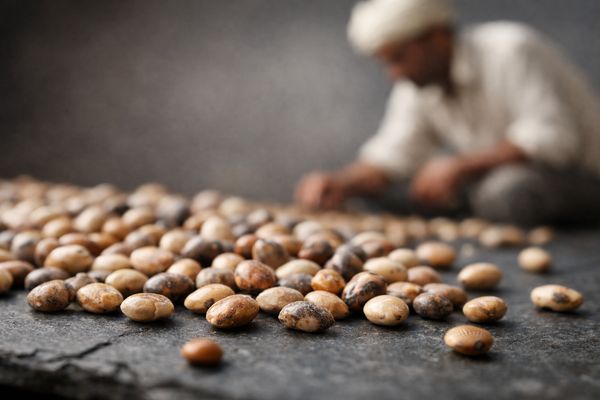
Guar seed prices in Hisar eased modestly this week as gum processing mills pulled back purchases, pointing to a phase of subdued industrial demand rather than any structural supply shock. With sowing still weeks away and hot, dry pre-monsoon weather persisting in Rajasthan, the market is trading chiefly on carry-forward stocks and short-term offtake from gum splitters.
Guar’s role as a drought-resilient legume and key input for hydraulic fracturing fluids, food thickeners and industrial applications continues to anchor its medium-term demand story. However, the immediate picture is one of range-bound pricing and cautious buying. European food, pharma and oilfield users currently see a buyer-friendly environment at the seed level, but the balance could shift quickly if drilling activity strengthens or early monsoon guidance for Rajasthan turns more positive.
Exclusive Offers on CMBroker

Guar gum
Powder
FOB 4.04 €/kg
(from VN)

Guar gum
Powder
FOB 4.10 €/kg
(from IN)
📈 Prices & Market Tone
At Hisar wholesale market in Haryana, guar seed values slipped by about EUR 0.50 per 100 kg to roughly EUR 55.50–56.00 per quintal, reflecting lighter gum mill participation and a mild correction after a phase of relative stability.
The retreat is modest in absolute terms and signals consolidation rather than a full-fledged downtrend. Guar gum splits and guar korma were not separately quoted in Hisar’s latest session, underlining the current lack of aggressive downstream buying interest.
Export-oriented guar gum powder prices remain broadly steady, with recent FOB offers from India and Vietnam around EUR 3.80–3.85 per kg, unchanged over the past two weeks. This stability suggests that soft seed prices are being partly absorbed in the value chain rather than immediately translating into sharper declines in processed gum offers.
🌍 Supply, Stocks & Weather
Supply fundamentals are currently dominated by carry-forward stocks, as the kharif sowing window for guar in Rajasthan and Haryana (June–October) has not yet begun. Rajasthan still provides the bulk of India’s guar seed output, with Haryana the second key contributor, so pre-monsoon conditions in these states are closely watched by market participants.
Over the coming week, Rajasthan faces very hot, dry pre-monsoon weather with daytime highs frequently above 40°C. While current heat does not yet affect the new crop, it reinforces the importance of timely and well-distributed monsoon rains for acreage decisions and yield expectations in the upcoming season.
Because no fresh crop is in play, sellers are cautious about discounting aggressively, preferring to release stocks gradually into a market where industrial demand is tepid but not collapsing. This balance between measured selling and reluctant buying is anchoring the present range-bound pattern.
📊 Demand Drivers & Downstream Links
The immediate driver behind this week’s softening is reduced buying from gum splitting and processing mills, which are the main domestic industrial consumers of guar seed. With processing orders subdued, mills have little incentive to chase raw material, and this has translated into slightly lower bids at Hisar.
Internationally, guar demand remains closely linked to oil and gas drilling activity, particularly in North American shale basins where guar-based hydraulic fracturing fluids are widely used. Any revival in drilling programs or completion activity would quickly translate into higher guar gum offtake and, by extension, stronger support for Indian seed prices.
For European food ingredient, pharmaceutical and oilfield service companies, the current environment reflects moderate, not distressed, demand. Guar gum derivatives continue to flow without visible logistical disruption, and end-users benefit from steady gum export prices combined with slightly easier seed valuations in India.
📆 Short-Term Outlook (2–4 Weeks)
- Price direction: Guar seed is likely to trade sideways within a narrow band, with limited downside as long as sellers manage stock releases and no demand shock emerges.
- Key upside triggers: A clear uptick in gum mill processing orders or early, favourable monsoon indications for Rajasthan that encourage market participants to pre-emptively price in tighter future supplies.
- Risks to the downside: Prolonged weakness in industrial offtake or a significant slowdown in global oil and gas activity, which would cap export gum demand and keep mills on the sidelines.
- Weather watch: Persistently hot, dry pre-monsoon conditions heighten the market’s sensitivity to first official monsoon forecasts; any hint of delay or deficit could later become a bullish factor for guar if acreage expectations are cut.
💡 Trading & Procurement Recommendations
- European food and pharma buyers: Use the current soft, range-bound seed environment and steady gum export prices to extend coverage modestly into early summer, while keeping flexibility to add volumes if monsoon or drilling indicators turn more supportive.
- Oilfield service companies: Align guar gum purchasing with project pipelines; if there are signs of higher completion activity, consider pre-booking part of Q3 needs before any potential rebound in seed-linked costs.
- Indian processors: With seed prices slightly easier and gum export prices stable, margins can be selectively locked in; staggered procurement remains prudent until clearer signals emerge from monsoon forecasts and overseas demand.
📉 3-Day Directional Price Indication
| Market / Product | Current Level (EUR) | 3-Day Bias |
|---|---|---|
| Hisar guar seed (wholesale, per 100 kg) | ≈ 55.5–56.0 | Sideways to slightly weak |
| India FOB guar gum powder (per kg) | ≈ 3.80–3.85 | Stable |
| Vietnam FOB guar gum powder (per kg) | ≈ 3.75–3.80 | Stable |
Related posts:
 Guar Seed Market Tightens as Indian Output Collapses and Stocks Run Thin
 Guar Seed Prices Firm on Tight Indian Supply and Strong Gum Demand
 Guar Complex Holds Steady as Markets Watch Monsoon Risk and Demand Signals
 Guar Seeds Market Pauses After Rally as Monsoon Risks Loom
 Guar Gum Prices Hold Steady as Heat Builds in India and Vietnam