Cherry growers in Jammu and Kashmir are betting on expanded rail cargo services to cut extreme post-harvest losses and capture better prices in distant Indian markets. The shift from highway-dependent trucking toward parcel trains could be a structural change in how the Valley moves one of its most perishable and valuable horticultural exports.
As the new harvest approaches, multiple parcel vans are already booked to carry over 640 tonnes of cherries to Mumbai’s wholesale markets. With Ganderbal district at the core of this ramp-up, improved logistics are expected to strengthen grower margins, reduce distress sales and integrate Kashmir’s cherry supply more firmly into India’s premium fresh-fruit trade.
📈 Prices & Market Access
Cherries from Jammu and Kashmir have historically suffered from wide intra-season price swings, largely driven by supply shocks and highway disruptions rather than demand weakness. Growers frequently face distress selling when delayed road shipments hit markets in poor condition, eroding price realisation and bargaining power.
The planned deployment of parcel train services to Bandra Terminus in Mumbai directly targets this problem. Faster, more predictable arrivals of higher-quality fruit should support firmer wholesale prices in key consumption centres, particularly during the short peak window when supply surges. While no reliable, up-to-date EUR price benchmarks are available for this niche market segment, the direction of impact is clearly supportive for farmgate returns if rail volumes scale as planned.
🌍 Supply & Demand Structure
The Kashmir Valley dominates India’s cherry supply, accounting for nearly 95% of national production. Around 3,000 hectares are under cherry cultivation, yielding over 23,000 metric tonnes per year and generating roughly €19–€20 million in regional value after currency conversion. Roughly 14,000 farming families depend on this crop for a significant share of their annual income.
Within the Valley, Ganderbal is the production hub, contributing about 65% of total cherry output with approximately 1,200 hectares under orchards. This concentration means that any improvement or disruption in Ganderbal’s logistics has an outsized impact on the overall Indian cherry market, particularly on early- and mid-season supplies to large metropolitan buyers.
📊 Post-Harvest Losses & Logistics
Post-harvest losses in Kashmiri cherries are exceptionally high, estimated at 40–49%, among the worst ratios for any major horticultural crop in the region. The fruit’s soft texture and short shelf life mean even moderate delays in transit can translate quickly into unsellable or heavily discounted consignments.
Currently, road transport via the Jammu–Srinagar highway is the main channel, but frequent weather-related closures and congestion often delay shipments at precisely the time when speed is most critical. These disruptions compress effective marketing windows, leading to gluts in local markets and forcing growers to accept sharply lower prices to avoid total loss.
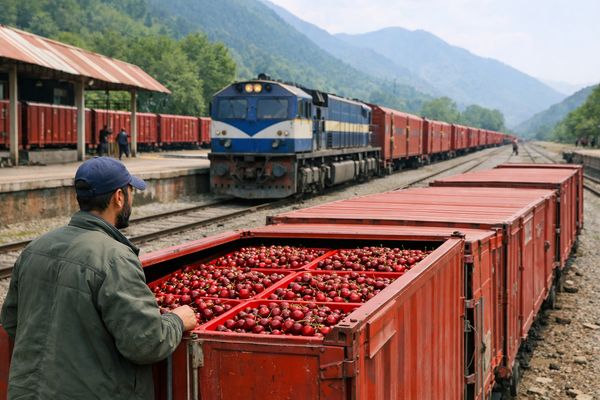
Rail cargo provides a partial solution by offering scheduled, longer-haul capacity less exposed to mountain-road bottlenecks. The plan to move over 640 tonnes of cherries to Mumbai on parcel trains builds on last season’s pilot, which demonstrated that rail can move perishable fruit faster and with less damage over long distances when cooling and handling are adequately managed.
⛅ Weather & Harvest Timing
In the immediate term (April 29–May 1), the Srinagar region faces mostly mild spring conditions with a mix of clouds, some sunshine and scattered thundershowers. Daytime highs around 20–23°C and cool nights near 8–10°C are generally favourable for late flowering to early fruit set, with no severe cold risks.
Short, localised thundershowers can temporarily disrupt orchard operations and road movements, but they are unlikely to materially alter cherry yield prospects at this stage. For logistics planning, the key risk remains sudden highway closures rather than weather at orchard level, reinforcing the strategic value of more predictable rail windows during the upcoming picking and shipping peak.
🚆 Strategic Role of Rail Cargo
The core benefit of expanded rail services lies in de-risking the supply chain at its most vulnerable points. Direct parcel trains linking Kashmir with major demand hubs like Mumbai shorten travel times, reduce handling steps and provide firmer delivery schedules, all of which are critical for a crop where quality deteriorates rapidly.
By proving last year that cherries can be successfully transported by rail, growers and traders have gained confidence to commit larger volumes this season. As utilisation of parcel vans increases, economies of scale could lower unit freight costs, further supporting net returns at the farm gate. Over time, consistent rail-based deliveries may also encourage buyers to structure longer-term procurement relationships rather than purely opportunistic spot purchases.
📌 Impact on Grower Economics
With current annual cherry output contributing roughly ₹175 crore (around €19–€20 million) to the local economy, even a modest reduction in losses can generate substantial value. Cutting post-harvest losses from the estimated 40–49% range by just 10 percentage points would effectively free up several thousand additional tonnes for sale, without needing any increase in planted area.
Lower loss rates and more stable access to distant, higher-value markets would translate into better average realised prices and reduced income volatility. For the approximately 14,000 farming families engaged in cherry production, this can improve cash flows at the start of the agricultural season, supporting investments in orchard management, inputs and on-farm storage or grading infrastructure.
🧭 Trading & Marketing Outlook
- Growers: Prioritise alignment of harvest and packing schedules with confirmed rail departures to capture quality premiums; invest in basic pre-cooling and careful grading to maximise the benefit of faster transit.
- Traders/Commission Agents: Use parcel train capacity to diversify away from highway risk on high-value consignments, particularly for Mumbai-bound shipments during the early season when prices tend to be highest.
- Retailers & Wholesalers: Explore forward volume commitments with Kashmiri suppliers tied to rail-based delivery windows to secure consistent quality and supply during the short cherry season.
- Policy & Rail Operators: Maintain flexible wagon allocation and transparent freight terms during peak harvest weeks to lock in grower confidence and ensure sustained utilisation beyond the current season.
📆 3-Day Directional Outlook
- Local farmgate market (Kashmir, EUR terms): Stable to slightly firmer as harvest preparations advance and confidence in rail logistics reduces expected distress selling.
- Long-haul shipments to Mumbai (converted to EUR): Mildly bullish bias on wholesale prices, contingent on timely rail dispatches and limited highway disruptions that would otherwise flood markets with lower-grade road-shipped fruit.
- Overall sector sentiment: Cautiously optimistic for the next three days, with weather supportive and logistics planning centred on scaling up rail usage ahead of peak picking.