
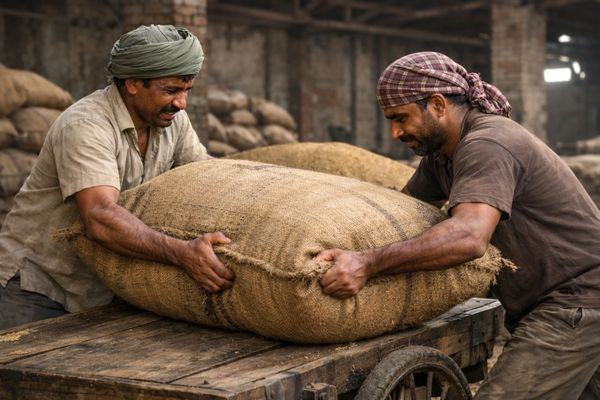
Indian mustard seed remains under pressure, with seed, oil and cake prices edging lower despite three consecutive days of falling arrivals. Weak demand from domestic oil mills and cheaper competing vegetable oils are outweighing any support from tightening physical supply, keeping the near‑term outlook soft and range‑bound.
The market is trading in the shadow of recent volatility in crude oil and global vegetable oils around the Strait of Hormuz reopening and subsequent tensions, which have eased freight and import cost pressures for edible oils overall. Export offers from India in EUR are broadly steady to slightly softer, mirroring this domestic weakness and confirming a cautious tone among buyers and sellers.
[cmb_offer ids=255,254,252]
📈 Prices & Spreads
In India’s benchmark Jaipur market, conditioned mustard seed fell by about $1.08 per quintal to $76.53 per quintal last week, extending a gradual decline even as arrivals fell. Mustard oil mirrored the seed’s softness, with raw cold‑pressed values in Jaipur slipping to $15.44 per 10 kg and Bharatpur to $15.31 per 10 kg, while Kolkata held firmer at $17.04 per 10 kg, underscoring regional demand resilience there.
By‑product values also weakened: mustard oil cake eased to $29.89 per quintal in Jaipur and $30.16 in Bharatpur, while remaining steady near $28.85 in Charki Dadri. Export‐oriented offers from New Delhi are broadly in line with this softening domestic tone. Recent indicative prices for Indian mustard seeds (FOB/FCA New Delhi, converted to EUR) cluster roughly between EUR 0.68–0.98/kg depending on colour and grade, with brown types at the lower end and bold yellow lots at the upper end.
| Product | Location / Term | Latest Price (EUR/kg) | 1–2 Week Change (approx.) |
|---|---|---|---|
| Mustard seeds, yellow, micro, sortex | New Delhi, FOB | 0.88 | Stable vs mid‑April |
| Mustard seeds, yellow, bold, sortex | New Delhi, FOB | 0.98 | Stable |
| Mustard seeds, brown, bold, sortex | New Delhi, FOB | 0.69 | Slightly lower |
🌍 Supply & Demand
Arrivals in key producing mandis have started to tighten: daily inflows fell to around 9 lakh bags (about 90,000 tonnes) from 9.5 lakh bags in the prior session, marking a third straight day of lower arrivals. Normally this would lend support to seed prices, but the expected firming has been neutralised by weak mill demand and the broader softness in vegetable oils.
Oil mills are actively cutting purchase bids by $1.08–$1.62 per quintal in late trading sessions as they struggle to move mustard oil in a soft retail environment. Cake prices slipping alongside oil underline a lacklustre offtake from the feed sector as well. Domestic wholesale prices in stronger Rajasthan and Delhi mandis have edged only modestly higher from minimum support price levels in recent weeks, suggesting the current demand pull is insufficient to tighten the balance decisively.
📊 Global Context & External Drivers
The international backdrop has turned less supportive for mustard. The reopening of the Strait of Hormuz around 17 April triggered a sharp pullback in crude oil benchmarks, with May WTI retreating from highs near $119 per barrel towards the mid‑$80s and Brent also correcting, easing freight and import cost pressures across the edible oil complex.
This coincided with declines in Malaysian crude palm oil futures and softer soybean oil values out of Argentina, pushing global vegetable oil prices lower overall.
As imported palm and soybean oils become more accessible and relatively cheaper, Indian buyers have less urgency to secure domestic mustard oil, weakening the transmission of any supply tightening into higher mustard seed prices. The domestic mustard market is therefore closely tracking the downtrend in global oils rather than local arrivals alone, with analysts highlighting the strong link between imported oil costs and domestic mustard oil pricing.
🌦️ Weather & Crop Outlook
No major weather shock is currently reported in India’s core mustard belts, and the main harvest has largely progressed, so immediate weather risk is limited for nearby physical supply. The key focus over the next fortnight is instead on logistics and energy costs linked to Middle East shipping routes, which indirectly influence landed costs of competing edible oils.
Any renewed escalation that keeps freight and insurance premia elevated could lend some floor to vegetable oil prices, but the recent combination of partial traffic resumption through Hormuz and easing crude benchmarks is currently acting as a headwind for mustard’s relative value.
📆 Short‑Term Forecast (2–3 Weeks)
Market expectations point to a soft, range‑bound phase for Indian mustard seed in the near term. With imported oils cheaper and mills cutting bids, seed prices are projected to oscillate in a relatively narrow band around $74–$77.50 per quintal, assuming no abrupt change in either global oil markets or domestic arrivals.
A more durable recovery would likely require one of two triggers: renewed tightness or price spikes in global edible oils (for instance from supply disruptions or weather issues in palm or soybean origins), or a sharp, sustained drop in domestic mustard arrivals that tightens spot availability and forces mills to step back into the market more aggressively.
📌 Trading Outlook
- Importers & crushers (EU/MENA): Use current soft Indian offers in the EUR 0.70–0.95/kg range to secure short‑term coverage, but avoid over‑committing far forward while global oil markets remain volatile.
- Indian stockists: Near‑term rallies towards the upper end of the projected $74–$77.50/quintal band may offer opportunities to scale out of excess stocks, given weak oil and cake demand.
- Feed and livestock users: Gradual buying of mustard cake on dips is justified as a cost‑effective protein source, but demand‑side weakness suggests no need for aggressive front‑loading.
- Speculative participants: Bias remains mildly bearish to neutral; consider selling into strength rather than chasing downside after recent declines, with tight stop‑losses around key resistance levels.
📉 3‑Day Directional View (Key Hubs, EUR Terms)
- Jaipur / Rajasthan mandis: Mild downside to sideways; seed likely to test lower end of the recent range if mills continue evening bid cuts.
- New Delhi export corridor (FOB/FCA): Mostly stable in EUR, with a slight soft bias for brown mustard types; yellow premium expected to hold.
- Eastern India (e.g. Kolkata oil market): Oil prices relatively firmer than Rajasthan, but overall tone still capped by cheaper imported oils; sideways bias.
[cmb_chart ids=255,254,252]
Related posts:
 Indian Mustard Seed Prices Edge Higher as Arrivals Slow and Weather Stays Supportive
 Indian Mustard Seed Prices Under Pressure Despite Lower Arrivals
 Indian Mustard Seed FOB Prices Edge Lower as New Crop Arrivals Build
 Indian Cumin Softens Slightly as New Crop Arrivals Meet Firm Demand
 Indian mustard seed prices edge higher as mills absorb steady arrivals
 Indian mustard seed under pressure as edible oil complex softens
 Indian Mustard Seed Prices Steady as Weather Disrupts Arrivals but Record Crop Caps Upside
 Indian Mustard Seed Prices Ease on Heavy Arrivals but MSP Caps Downside