

Poland’s potato market is trapped in a deep surplus crisis: farm-gate prices near EUR 0.07/kg leave many growers at break-even or loss, stocks clog warehouses, and quality is deteriorating. Without rapid structural and policy action, today’s oversupply is likely to morph into tomorrow’s quality and seed shortage problem rather than a genuine recovery.
A prolonged imbalance between record harvests and stagnant domestic demand is crushing margins across the fresh potato chain. Many Polish farmers enter spring 2026 with full stores, mounting energy bills for climate-controlled storage and little or no cash flow from the last campaign. At the same time, the segment for processed products such as potato starch shows more resilient pricing, underlining a widening gap between raw tuber values and processed returns and making strategic decisions on seed, storage and marketing crucial for the coming season.
Exclusive Offers on CMBroker

Potato starch
powder
FCA 0.85 €/kg
(from PL)
📈 Prices & Market Mood
Production costs in Poland often exceed PLN 20,000/ha, while many growers report selling potatoes at around PLN 0.30/kg (≈ EUR 0.07/kg), barely covering variable costs and leaving no margin for investment. With warehouses still holding large volumes, some lots harvested under wet conditions are already fit only for disposal, yet many farms cannot even finance proper destruction of unsaleable stocks.
In retail, consumers routinely pay PLN 2–3/kg (≈ EUR 0.47–0.70/kg), highlighting the wide gap between farm-gate and shelf prices and fuelling frustration among producers. Regional wholesale quotations around EUR 0.21/kg in mid‑March confirm that price pressure has been persistent at least since late winter and has not yet triggered a meaningful supply response on the ground, as physical stocks remain high.
🌍 Supply & Demand Imbalance
Polish potato production in the last season surged to roughly 6.8–7.0 million tonnes, outstripping domestic use estimated near 5.5–6.0 million tonnes. This structural surplus is amplified by strong harvests and excess supplies across much of Europe, leaving limited room to offload Polish stocks into neighbouring markets and forcing some growers to plough in or dump otherwise marketable crops.
The lack of effective offtake channels means many farmers finished the season either with unsold volumes or with sales that only covered production costs. Storage – intended as a risk‑management tool – has become a cost trap: modern warehouses require significant electricity for temperature and humidity control, so the longer potatoes stay unsold, the worse the economics and the higher the risk of quality loss and waste.
📊 Fundamentals & Quality Risks
The most acute emerging risk is not only low prices today, but deteriorating quality and the knock‑on impact on the next crop. With cash flows strained and many farms facing a liquidity crunch, a growing number of growers are cutting back on certified seed purchases, crop protection and agronomic precision. Instead, they plan to replant their own stock from last season to reduce cash outlays and “use up” stored potatoes.
This cost‑saving strategy threatens seed quality, varietal purity and plant health, increasing the likelihood of disease pressure, uneven emergence and lower marketable yields. If producers of certified seed respond by reducing their own production in view of poor sales, the market could face an undersupply of high‑quality seed in subsequent seasons, turning today’s surplus into a medium‑term quality and availability problem for Polish potatoes.
🏭 Processed Segment & Starch Prices
Against the backdrop of collapsing fresh-potato margins, industrial outlets show relative resilience. Potato starch offers in Poland currently hover around EUR 0.85/kg FCA Łódź, modestly firmer than late‑March levels near EUR 0.82/kg, suggesting that processing margins, while not excessive, are more stable than those in the table potato segment. This underscores the importance of integration with processors and contract‑based production for risk management.
Strong raw potato supply, combined with comparatively steady demand for starch and frozen products in food and industrial uses, keeps processors in a stronger bargaining position. However, their capacity is limited, and they cannot absorb the entire surplus. The policy discussion is therefore shifting not only towards short‑term relief – such as redirecting some volumes into energy or alcohol production – but also towards long‑term strategies to move more of the value chain, including branding and processing, closer to farms.
🌦️ Weather & Short-Term Outlook
Weather conditions across key Polish potato regions in late April remain seasonally cool, with alternating mild days and chilly nights, which supports gradual fieldwork without excessive heat stress. While no widespread extreme events are currently in view, localised rainfall and temperature swings can still disrupt timely planting and early crop protection passes, especially on farms already trying to cut costs on inputs and operations.
Any delays or uneven emergence caused by suboptimal seed quality, poorer plant protection or missed agronomy windows could magnify quality issues later in the season. In this context, the coming weeks are critical: how many hectares are actually planted with high‑quality seed and properly managed will largely determine whether the current surplus persists or sets the stage for a tighter, more quality‑driven market in 2027.
📆 Trading & Strategy Outlook
- For growers: Avoid extreme cuts in seed and crop protection quality wherever possible; preserving field and tuber quality is essential to maintaining market access and avoiding a deeper crisis next season.
- For processors and buyers: Use the current surplus to secure longer‑term contracts with quality‑oriented farms, offering volume commitments and fairer pricing formulas to stabilise supply and reduce volatility.
- For policymakers: Prioritise targeted support for disposal of unmarketable stocks, improvement of storage technology and incentives for value‑added processing, rather than generic price interventions that might prolong structural imbalances.
- Risk management: Where possible, consider partial hedging via processed‑product exposure (e.g. starch) to offset weak fresh‑market returns and capture part of the more resilient processed margin.
📉 3-Day Price Indication (Poland)
| Market segment | Region/Term | Indicative level (EUR/kg) | Direction 3 days |
|---|---|---|---|
| Farm-gate table potatoes | PL, bulk | ≈ 0.07–0.09 | Sideways to slightly down – surplus persists |
| Wholesale table potatoes | Main markets | ≈ 0.18–0.23 | Sideways – high stocks, weak demand |
| Potato starch | FCA Łódź | ≈ 0.85 | Sideways to slightly firm – demand relatively stable |
Related posts:
 Polish Potato Starch Prices Hold Firm as Weather Turns Colder and Dry
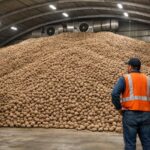 San Luis Valley Potato Surplus Puts Structural Pressures in Focus
 Potato Oversupply in Poland: Crisis for Growers, Stable Starch Prices
 Taiwan’s New Potato Import Rules Support Trade While Oversupply Caps Prices
 Polish Potato Starch Prices Hold Firm as Spring Season Begins
 Polish Potato Market under Heavy Pressure from Surplus Stocks
 EU Potato Market: Cost Shock Triggers Cautious Planting and Tightening Risks